Join us on a literary world trip!
Add this book to bookshelf
Grey
Write a new comment Default profile 50px
Grey
Subscribe to read the full book or read the first pages for free!
All characters reduced
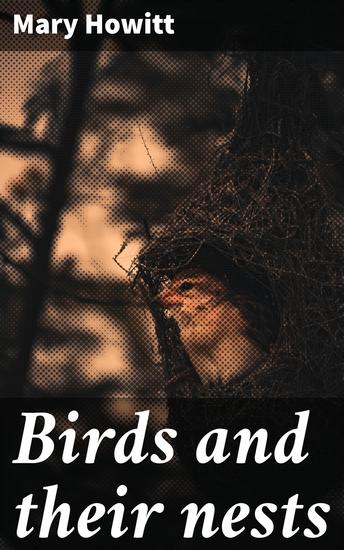
Birds and their nests - Exploring Avian Life and Nesting Behaviors in Victorian England: An Elegant Journey into the World of Birds - cover

Birds and their nests - Exploring Avian Life and Nesting Behaviors in Victorian England: An Elegant Journey into the World of Birds

Mary Howitt

Publisher: Good Press

  • 0
  • 0
  • 0

Summary

In "Birds and their Nests," Mary Howitt captures the delicate interplay between nature and literature, offering a rich exploration of avian life through vivid poetic imagery and charming prose. The work serves as both an educational treatise and an artistic reflection, emulating the Romantic era's fascination with ornithology while providing detailed accounts of various bird species and their habitats. Howitt intertwines her lyrical style with a moralistic tone, enriching readers' appreciation for nature'Äôs intricate beauty and sparking curiosity about the importance of ecological conservation. Mary Howitt, an esteemed Victorian author and poet, is noted for her extensive contributions to children'Äôs literature and her advocacy for social reform. Born in 1799, Howitt was influenced by the Romantic ideals of her time, fostering a deep connection with the natural world. Her love for nature not only informed her writing but also underlined her belief in the moral responsibility to protect it. This background illuminates the themes present in "Birds and their Nests," positioning it as a personal and societal commentary. This enchanting volume is highly recommended for readers who appreciate nature, poetry, and the intricate relationships between humans and the avian world. Howitt'Äôs work invites readers of all ages to pause and reflect on the beauty surrounding them and inspires a conservationist spirit that resonates to this day.
Available since: 08/21/2022.
Print length: 98 pages.

Other books that might interest you

  • Human Psychology and Language Analysis - For Advancing Linguistic Artificial Intelligence - cover

    Human Psychology and Language...

    Allen Young

    • 0
    • 0
    • 0
    Humans use their languages to communicate for their successes in the survival, social, economic, sexual, political, competitive, collaborative, creative, and procreative human endeavors. 
    In this book, Allen Young, the transhumanistic Asian-American man, specifies how the psychological human linguistic capabilities should be used in advancing linguistic artificial intelligence.
    Show book
  • The Simulated Multiverse - An MIT Computer Scientist Explores Parallel Universes The Simulation Hypothesis Quantum Computing and the Mandela Effect - cover

    The Simulated Multiverse - An...

    Rizwan Virk

    • 0
    • 0
    • 0
    abc
    Show book
  • NREMT - Ace your National Registry Of Emergency Medical Technicians exam! Dive into dynamic audio lessons tailored for your ultimate test success" - cover

    NREMT - Ace your National...

    Vance Holloway

    • 0
    • 0
    • 0
    NREMT:  
    ⭐⭐ Simplified Guide & Explanations Included ⭐⭐  
    Are you ready to advance your career and solidify your knowledge by successfully passing the NREMT Exam? 
    Searching for a comprehensive guide that provides all necessary elements to ace the NREMT Exam? 
    Your search ends here! 
    This guide serves as your definitive companion for deepening your understanding, applying your skills, and engaging in hands-on exercises. With this, you're geared for success. 
    Updated for the NREMT Exam Structure. 
    Key features of this enriched guide: 
    - Profound insights about the NREMT Certification  
    - Detailed explanation of the National Registry Of Emergency Medical Technicians  
    - Fruitful strategies for exam preparation and tackling 
    Our guide distinguishes itself through comprehensive coverage, which is essential for your exam victory. Concepts aren't merely skimmed; they are delved into with precision. 
    Please note that this guide is not affiliated with any official NREMT entity and is purely an independent resource for your benefit. 
    Designed with a clear structure and easy-to-understand language, our NREMT Exam Guide ensures smooth transitions between topics. Say goodbye to dense jargon and welcome clear, precise, and technically accurate content. 
    So, why wait? Click the BUY NOW button, secure your guide, and begin your journey to NREMT Exam success!
    Show book
  • Paleozoic Era The: The History of the Geologic and Evolutionary Changes that Began Over 500 Million Years Ago - cover

    Paleozoic Era The: The History...

    Editors Charles River

    • 0
    • 0
    • 0
    The current view of science is that Earth is around 4.6 billion years old, and the first 4 billion years of its development are known as the Precambrian period. For the first billion years or so, there was no life in Earth. Then the first single-celled life-forms, early bacteria and algae, began to emerge. It’s unclear where they came from or even if they originated on this planet at all, but this gradual development continued until around four billion years ago when suddenly (in geological terms) more complex forms of life began to emerge.  
    	Scientists call this time of an explosion of new forms of life the Paleozoic Era, and it stretched from around 541 to 250 million years ago. In the oceans and then on land, new creatures and plants began to appear in bewildering variety, and by the end of this period, life on Earth had diversified into a myriad of complex forms that filled virtually every habitat and niche available in the seas and on the planet’s only continent, Pangea. 
    	The Precambrian Period is divided into three eons: the Hadean, the Archaean, and the Proterozoic. One layer of carbon in rocks that date to the Archaean Eon, found on islands west of Greenland, seems to have fossilized tracks that may have been left by some form of organic life, but scientists simply are not certain. The oldest confirmed remains of life date from the same eon and were found in rocks in Western Australia, which were found to contain fossilized bacteria estimated to be 3.46 billion years old. It seems likely that there were thousands, perhaps even millions of forms of life in these early periods, and most seem to have been microscopic in size and very simple in developmental terms.
    Show book
  • Life Earth and Politics - Ideas for the Next 400 Years - cover

    Life Earth and Politics - Ideas...

    Sherman Lewis

    • 0
    • 0
    • 0
    Science, not speculative philosophy, is the only guide, however imperfect, to the nature of existence. Science culture uses and supports science. The social brain experiences free will and needs religious faith. Empathy is a choice based on intuition. We need a better scientific understanding of dogma and chauvinism, and this book explores these issues. It also describes the Crisis of the Anthropocene, described in under a hundred pages, is a wakeup that needs to overcome ignorance and naïve optimism, and reach our deepest emotions. Topics include climate change, biodiversity, pollutants, population, and political causes behind the collapse. This book also presents data from Internationalcomparisons.org that demonstrates that the US is neither advanced nor a democracy and has failed to deal with guns, reproductive rights, taxation, social welfare, fiscal discipline, and other issues. Even with these already significant problems Americans must face, there is even more: Trumpism and Putinism are existential threats to American freedom and democracy. This book presents a framework for others to act in the time of these issues.
    Show book
  • Magnetic Current - cover

    Magnetic Current

    Edward Leedskalnin

    • 0
    • 0
    • 0
    Magnetic Current is a short pamphlet by eccentric sculptor and writer Edward Leedskalnin. Detailing his many experiments with magnets, this work posits that it is not metal itself that is magnetic. Rather, tiny individual magnet particles that circulate in and around the metal give it its pull.Edward Leedskalnin was born in Latvia in 1887. While his formal education lasted only until 4th grade, he was intensely curious and spent much of his youth reading. At the age of 26, Leedskalnin became engaged. But as the young woman was only 16, she (or her mother) decided that he wasn’t a suitable match and called off the wedding the day before it was set to occur. Heartbroken, Leedskalnin emigrated to the United States. In 1923, he purchased an undeveloped acre of land in Florida City. Over the next 28 years, Leedskalnin cut massive pieces of oolite rock from his property, moved them, and sculpted them—all on his own. He built a two-story tower from oolite, which served as his living quarters. In the grounds below, sculptures and carved stone furniture dot the landscape. The project was dedicated to his “Sweet Sixteen,” the woman who rejected him years before.During the years of his construction project, Leedskalnin studied and tested magnets from his home base of Rock Gate. His findings were eventually compiled into Magnetic Current, a short pamphlet detailing his theories of magnetism. The pamphlet explains many of his experiments. Using U-shaped, round, and bar magnets, as well as car batteries, light bulbs, and coils of wire, he demonstrates the movements of magnetic currents in a double helix pattern, swirling around each other to create pull.
    Show book