Join us on a literary world trip!
Add this book to bookshelf
Grey
Write a new comment Default profile 50px
Grey
Subscribe to read the full book or read the first pages for free!
All characters reduced
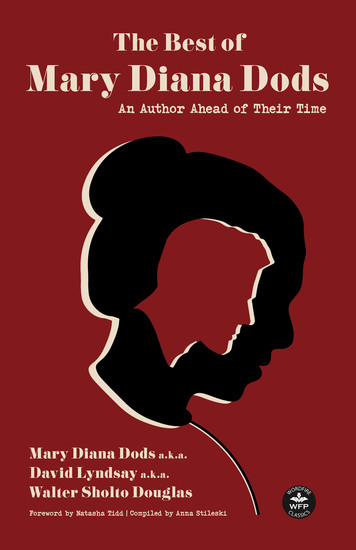
The Best of Mary Diana Dods - Collected Works from an Author Ahead of Their Time - cover

The Best of Mary Diana Dods - Collected Works from an Author Ahead of Their Time

Mary Diana Dods

Publisher: WordFire Press

  • 0
  • 0
  • 0

Summary

Delve into the works and mystery of an LGBTQ+ author whom historians are still trying to unravel over 200 years later. Previously known only as a quiet but intelligent wallflower friend of renowned author Mary Shelley, Mary Diana Dods is far from an ordinary Eighteenth-century daughter of an Earl.  Throughout their life, they lived under three identities. First was their birth name, Mary Diana Dods. Due to the negative opinions of women authors during this time, they adopted the pseudonym, David Lyndsay, which was the pen name under which they published much of their work. Most intriguing of all, they fully transitioned to an additional male identity of scholar and diplomat, Walter Sholto Douglas, for the latter part of their personal life.  Until Mary Shelley expert Betty T. Bennett’s research in 1991, it was believed that Dods, Lyndsay, and Sholto Douglas were all separate individuals. By studying a series of letters sent to Shelley, Bennett discovered that all correspondents were in fact the same person. Since this research, historians have been working tirelessly to uncover the truth behind the life of this groundbreaking author whom society has forgotten.
Available since: 05/22/2022.
Print length: 186 pages.
Other books that might interest you

  • More Tales of the City - cover

    More Tales of the City

    Armistead Maupin

    • 0
    • 0
    • 0
    Narrated by Armistead Maupin 
    ""Remarkable. . . delectable, addictive."" —New York Times Book Review 
    The second novel in the beloved Tales of the City series, Armistead Maupin’s bestselling San Francisco saga. 
    The tenants of 28 Barbary Lane have fled their cozy nest for adventures far afield. Mary Ann Singleton finds love at sea with a forgetful stranger, Mona Ramsey discovers her doppelgänger in a desert whorehouse, and Michael Tolliver bumps into his favorite gynecologist in a Mexican bar. Meanwhile, their venerable landlady takes the biggest journey of all—without ever leaving home.
    Show book
  • Beware of the Dog - cover

    Beware of the Dog

    Roald Dahl

    • 0
    • 0
    • 0
    Published in Harper's Magazine in 1946, "Beware of the Dog," by Roald Dahl, is a short story that recounts the experiences of Royal Air Force (RAF) fighter pilot Peter Williamson after he is shot down during a World War II bombing mission. 
     
    Roald Dahl (September 13, 1916 - November 23, 1990), born in Cardiff, Wales, was a novelist, poet, screenwriter, and short story author, as well as a fighter pilot and intelligent officer in the Royal Air Force (RAF) during World War II. Considered one of the greatest storytellers for children of the 20th century, Dahl's classic works include Charlie and the Chocolate Factory, James and the Giant Peach, The Witches, The Twits and Matilda. His books have sold more than 300 million copies worldwide.
    Show book
  • Wood's Reach - Action and Adventure in the Florida Keys - cover

    Wood's Reach - Action and...

    Steven Becker

    • 0
    • 0
    • 0
    From Bestselling author Steven Becker comes a great new series 
    Desperate for money and with Alicia in danger, Mac is forced to deal with a dubious antiquities dealer. The treasure hunt turns deadly as he tries to solve the riddle of the relic he found years ago. 
    An action-packed thriller featuring plenty of boating, SCUBA diving, fishing and flavored with a generous dose of Conch Republic counterculture
    Show book
  • Frankenstein - cover

    Frankenstein

    Mary Shelley

    • 0
    • 0
    • 0
    Frankenstein tells the story of Victor Frankenstein, a young scientist who creates a sapient creature in an unorthodox scientific experiment. Shelley started writing the story when she was 18, and the first edition was published anonymously in London on 1 January 1818, when she was 20. Her name first appeared in the second edition, which was published in Paris in 1821.Shelley travelled through Europe in 1815, moving along the river Rhine in Germany, and stopping in Gernsheim, 17 kilometres (11 mi) away from Frankenstein Castle, where, two centuries before, an alchemist had engaged in experiments.[note She then journeyed to the region of Geneva, Switzerland, where much of the story takes place. Galvanism and occult ideas were topics of conversation for her companions, particularly for her lover and future husband Percy B. Shelley. In 1816 Mary, Percy and Lord Byron had a competition to see who could write the best horror story. After thinking for days, Shelley was inspired to write Frankenstein after imagining a scientist who created life and was horrified by what he had made.Though Frankenstein is infused with elements of the Gothic novel and the Romantic movement, Brian Aldiss has argued for regarding it as the first true science-fiction story. In contrast to previous stories with fantastical elements resembling those of later science fiction, Aldiss states, the central character "makes a deliberate decision" and "turns to modern experiments in the laboratory" to achieve fantastic results. The novel has had a considerable influence on literature and on popular culture; it has spawned a complete genre of horror stories, films, and plays.Since the publication of the novel, the name "Frankenstein" has often been used, erroneously, to refer to the monster, rather than to his creator/father.
    Show book
  • Blue & Green - From their pens to your ears genius in every story - cover

    Blue & Green - From their pens...

    Virginia Woolf

    • 0
    • 0
    • 0
    Adeline Virginia Woolf was born on the 25th January 1882 in South Kensington in London. 
    Although lauded as a founder of modernist writing with such classics as ‘Orlando’, ‘Mrs Dalloway’ and ‘To the Lighthouse’ and, of course, many classic short stories, her background is filled with elements of tragedy that she somehow overcame to become such a revered writer.   Her mother died when she was 13, her half-sister Stella two years later and with it her first of several nervous breakdowns.  Appallingly it was later found that three of her half-brothers had sexually abused her so darkness must have seemed ever present.   
    She began writing professionally at age 20 but her father’s death two years later brought a complete mental collapse and she was briefly institutionalised.  Somehow she found within herself a literary career and with it great innovations in writing; she was a pioneer of “stream of consciousness”.    
    Her tight circle of friends were the founders of the Bloomsbury Group, a movement whose legacy still influences across the arts and society in many way to this day.   
    Whilst the dark periods continued to interrupt her emotional state her rate of work never ceased.  Until, on 28th March 1941, Woolf put on her overcoat, filled up its pockets with stones, and walked into the River Ouse, in Lewes, East Sussex and drowned herself.  Her body was not recovered until the 18th April.  She was 59. 
    She left behind a note which read in part “Dearest, I feel certain that I am going mad again.  I feel we can't go through another of those terrible times.  And I shan't recover this time.  I begin to hear voices, and I can't concentrate.  So I am doing what seems the best thing to do”.
    Show book
  • The Doll - cover

    The Doll

    Charles W. Chesnutt

    • 0
    • 0
    • 0
    Charles Chesnutt's "The Doll" is a story of seeking truth, facing discrimination, and making bold choices for the sake of one's own livelihood.
    "The Doll", depicts the African American barber as a human character by showing him struggle with and simply show human thoughts and emotions. The story takes place during a time of huge racial prejudice, a time in which some people did not even consider African Americans to be human.
    Show book