Rejoignez-nous pour un voyage dans le monde des livres!
Ajouter ce livre à l'électronique
Grey
Ecrivez un nouveau commentaire Default profile 50px
Grey
Abonnez-vous pour lire le livre complet ou lisez les premières pages gratuitement!
All characters reduced
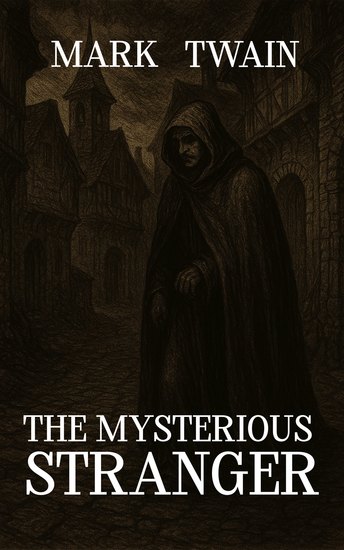
The Mysterious Stranger - cover

The Mysterious Stranger

Mark Twain

Maison d'édition: CLXBX

  • 0
  • 0
  • 0

Synopsis

"The Mysterious Stranger" by Mark Twain is a haunting, philosophical work that reveals the darker, more skeptical side of the author's imagination. Written during the later years of Twain's life and published posthumously, the novel departs from his familiar humor to explore profound questions about morality, free will, religion, and the nature of humanity.

Set in a small, isolated European village, the story follows a group of boys who encounter a supernatural figure calling himself Satan, a mysterious and otherworldly being who claims kinship with the biblical fallen angel. Possessing immense power and a cold, rational view of humanity, the stranger observes human behavior with detached amusement and often cruel honesty. Through his interactions with the boys, he exposes the hypocrisy, cruelty, and self-deception that shape human societies.

As the narrative unfolds, Twain challenges traditional notions of good and evil, divine justice, and moral responsibility. The stranger's unsettling logic forces readers to confront uncomfortable truths about human suffering, innocence, and the illusion of meaning. What begins as a tale of youthful curiosity gradually transforms into a bleak meditation on existence itself.

Despite its dark themes, The Mysterious Stranger is rich in symbolism and intellectual depth. Twain's sharp wit remains present, but it is stripped of sentimentality, replaced by a relentless philosophical inquiry that reflects his disillusionment with organized religion and human pretensions.

Provocative, unsettling, and deeply thought-provoking, The Mysterious Stranger stands as one of Mark Twain's most challenging and controversial works. It is an essential read for those interested in philosophical fiction, classic literature, and the complex evolution of Twain's worldview.
Disponible depuis: 06/02/2026.
Longueur d'impression: 123 pages.

D'autres livres qui pourraient vous intéresser

  • Passed - From their pens to your ears genius in every story - cover

    Passed - From their pens to your...

    Charlotte Mew

    • 0
    • 0
    • 0
    Charlotte Mary Mew was born on 15th November, 1869 in London to professional parents – her father was responsible for the design of Hampstead Town Hall. 
    Charlotte, one of seven children; three of whom died in early childhood, was educated at Lucy Harrison's School for Girls and attended lectures at University College, London. 
    In 1898 her father died but failed to make provision for the family. Her mother, anxious about the family's social standing, did not want that known even though there was heavy ongoing expense for two other siblings who were in mental institutions. 
    However for Charlotte helping to support this overhead and her mother and sister, Anne, meant that her ambition to be a paid writer must now become a reality. Initially this meant prose - her poetry was to gestate until later in life. 
    During this time Charlotte and Anne made a pact never to marry for fear of passing on insanity to their children. 
    As a writer Charlotte was a modernist, resisting the shackles of Victorian society's suffocating demands on behaviour especially for women. Despite her diminutive figure and dainty feet, she wore trousers, kept her hair short, smoked roll ups, was a Lesbian and tried to appear masculine. 
    Her difficult family life, although her close relationship with Anne was a constant source of comfort and companionship until her death in 1927, was coupled with rejection in her personal life but also provided inspiration for her wonderfully insightful and original poetry that you can read here. 
    Despite her fans including Thomas Hardy, Virginia Woolf and Siegfried Sassoon, Charlotte's works have been shamefully neglected.  
    Charlotte Mew died on 24th March in 1928 and was buried at Hampstead Cemetery.
    Voir livre
  • Rudin - cover

    Rudin

    Ivan Turgenev

    • 0
    • 0
    • 0
    "Rudin" by Ivan Turgenev is a captivating and introspective novel that explores the complexities of human nature, love, and intellectual ideals in 19th-century Russia. Through the compelling character of Dmitry Rudin, Turgenev presents a profound examination of the clash between lofty ideals and the realities of life. With its lyrical prose and profound exploration of the human condition, "Rudin" serves as a timeless reflection on the complexities of human nature and the eternal quest for personal fulfillment. Turgenev's masterful storytelling and astute social commentary make this novel a compelling and thought-provoking work that continues to resonate with readers today.
    Voir livre
  • Cymbeline King of Britain - cover

    Cymbeline King of Britain

    William Shakespeare

    • 0
    • 0
    • 0
    Cymbeline, also known as The Tragedie of Cymbeline or Cymbeline, King of Britain, is a play by William Shakespeare set in Ancient Britain (c. 10–14)[a] and based on legends that formed part of the Matter of Britain concerning the early Celtic British King Cunobeline. Although listed as a tragedy in the First Folio, modern critics often classify Cymbeline as a romance or even a comedy. Like Othello and The Winter's Tale, it deals with the themes of innocence and jealousy. While the precise date of composition remains unknown, the play was certainly produced as early as 1611.
    Cymbeline, the Roman Empire's vassal king of Britain, once had two sons, Guiderius and Arvirargus, but they were stolen twenty years earlier as infants by an exiled traitor named Belarius. Cymbeline discovers that his only child left, his daughter Imogen (or Innogen), has secretly married her lover Posthumus Leonatus, a member of Cymbeline's court. The lovers have exchanged jewellery as tokens: Imogen with a bracelet, and Posthumus with a ring. Cymbeline dismisses the marriage and banishes Posthumus since Imogen — as Cymbeline's only child — must produce a fully royal-blooded heir to succeed to the British throne. In the meantime, Cymbeline's Queen is conspiring to have Cloten (her cloddish and arrogant son by an earlier marriage) married to Imogen to secure her bloodline. The Queen is also plotting to murder both Imogen and Cymbeline, procuring what she believes to be deadly poison from the court doctor. The doctor, Cornelius, is suspicious and switches the poison with a harmless sleeping potion. The Queen passes the "poison" along to Pisanio, Posthumus and Imogen's loving servant — the latter is led to believe it is a medicinal drug. No longer able to be with her banished Posthumus, Imogen secludes herself in her chambers, away from Cloten's aggressive advances.
    Although the play is named Julius Caesar, Brutus speaks more than four times as many lines as the title character; and the central psychological drama of the play focuses on Brutus' struggle between the conflicting demands of honour, patriotism, and friendship. 
    Among the most significant works William Shakespeare: Hamlet, Othello, King Lear, Macbeth, Orpheus, Romeo and Juliet, Julius Caesar, Troilus and Cressida, The Tempest, Venus and Adonis, Antony and Cleopatra, Measure for Measure, The Winter's Tale and many more.
    Voir livre
  • The Antiquary - cover

    The Antiquary

    Andrew Lang

    • 0
    • 0
    • 0
    The third novel in the Waverley series, and Scott's personal favorite, The Antiquary centers on a young man called Lovel who meets Jonathan Oldbuck, a loquacious old antiquary, on a trip to Scotland. There Lovel falls in love with the daughter of Sir Arthur Wardour, a local landowner. However, with no wealth or title to offer, Lovel's feelings go unrequited until an extraordinary act of courage.
    Voir livre
  • Henry IV Part 1 - cover

    Henry IV Part 1

    William Shakespeare

    • 0
    • 0
    • 0
    The second of Shakespeare's tetralogy that deals with the successive reigns of Richard II, Henry IV, and Henry V. Henry IV, Part One depicts a span of history that begins with Hotspur's battle at Homildon against the Douglas late in 1402 and ends with the defeat of the rebels at Shrewsbury in the middle of 1403. From the start it has been an extremely popular play both with the public and the critics and this full cast performance is by The Marlowe Society.
    Voir livre
  • Middlemarch (Book 8: Sunset and Sunrise) - cover

    Middlemarch (Book 8: Sunset and...

    George Eliot

    • 0
    • 0
    • 0
    Middlemarch (Book 8: Sunset and Sunrise), A Study of Provincial Life is a novel by English author George Eliot, the pen name of Mary Ann Evans. It appeared in eight installments (volumes) in 1871 and 1872. Set in Middlemarch, a fictional English Midlands town, from 1829 to 1832, it follows distinct, intersecting stories with many characters. Issues include the status of women, the nature of marriage, idealism, self-interest, religion, hypocrisy, political reform, and education. Leavened with comic elements, Middlemarch approaches significant historical events in a realist mode: the Reform Act 1832, early railways, and the accession of King William IV. It looks at medicine of the time and reactionary views in a settled community facing unwelcome change. Eliot began writing the two pieces that formed the novel in 1869–1870 and completed it in 1871. Initial reviews were mixed, but it is now seen widely as her best work and one of the great English novels.
    Voir livre