Join us on a literary world trip!
Add this book to bookshelf
Grey
Write a new comment Default profile 50px
Grey
Subscribe to read the full book or read the first pages for free!
All characters reduced
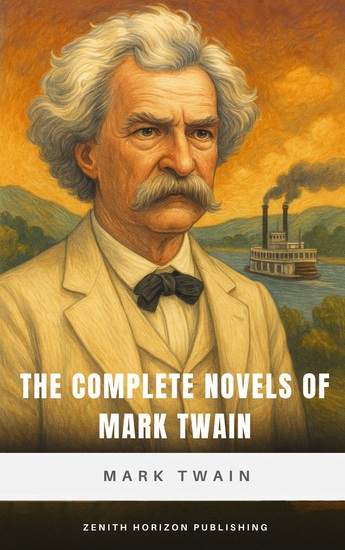
The Complete Novels of Mark Twain - Timeless Adventures American Wit and Literary Mastery - cover

The Complete Novels of Mark Twain - Timeless Adventures American Wit and Literary Mastery

Mark Twain, Zenith Horizon Publishing

Publisher: Zenith Horizon Publishing

  • 0
  • 0
  • 0

Summary

Discover the voice of America—bold, brilliant, and unforgettable.
Step into the world of Mark Twain, the father of American literature, with this definitive collection of his complete novels—a treasure trove of humor, adventure, and piercing social insight.

🌊 From rafting down the Mississippi River with Huck Finn to the royal courts of The Prince and the Pauper, Twain's storytelling weaves together satire, honesty, and raw humanity like no other.

📚 This Complete Edition Includes:

The Adventures of Tom Sawyer

The Adventures of Huckleberry Finn

The Prince and the Pauper

A Connecticut Yankee in King Arthur's Court

The Tragedy of Pudd'nhead Wilson

The American Claimant

The Gilded Age

Personal Recollections of Joan of Arc

Roughing It

The Mysterious Stranger, and more!

Whether you're captivated by Twain's boyhood mischief, biting satire, or visionary storytelling, this collection delivers an unforgettable journey through 19th-century America and beyond.

🌟 Why Readers Revere Mark Twain:

"Twain's genius lies in his humor and humanity."
"A master observer of people, society, and the absurdities of life."
"These novels shaped American literature—and still make us laugh, think, and feel."

📖 Perfect for fans of classic fiction, historical satire, and coming-of-age adventures, this complete edition is a must-have for every serious reader's digital shelf.

👉 Add The Complete Novels of Mark Twain to your collection today—and sail into the heart of American storytelling.
Available since: 06/26/2025.
Print length: 2966 pages.

Other books that might interest you

  • The Gift - cover

    The Gift

    Mike Monsoon

    • 0
    • 0
    • 0
    What's the ultimate gift you could give your best friend? Money, a holiday, your boyfriend?! Greg is horrified when he forgets to get his best friend, Geoff, a birthday gift. When his friend suggests an alternative, it will not only alter their friendship forever, it could change his whole life.  
    New passions will be unleashed, secret fantasies and desires. This will be a night that Greg and his boyfriend Lee will never forget, for very different reasons.
    Show book
  • The Birth of Anarchism - 1849-1887 - cover

    The Birth of Anarchism - 1849-1887

    Pierre-Joseph Proudhon, Mikhail...

    • 0
    • 0
    • 0
    Mankind can rule itself without the force of top-down authority, and freedom is more than just choosing how to meet the needs and demands of capital. Inequality is structural and intentional, not inevitable and necessary.  
    It does not have to be this way. In solidarity, we are better. 
    Think for yourself, and question authority. 
    This is the essence of anarchism, which has a bad name and reputation because it attacks the necessity of centralised power and authority. The media archetype is Tyler Durden, filled with violence and nihilism – yet anarchism is the most positive of political philosophies, one that Jesus and Buddha both preached, stating that empathy and a rejection of authority were key to human flourishing. Neither would disagree with most early anarchists. 
    Proudhon, whose “property is robbery” is perhaps the most well-known anarchist slogan, lays out the conceptual foundation for key anarchist ideas. He argues that usury (charging interest) is a fundamental harm to society, that there is enough for everyone if we simply take other values to be higher than capital gain, that mutualism is inevitable, and that all governments and ideologies make the same mistake, in trying to change society from the top. Positive change must arise from the great masses of humanity, not from their rulers. 
    Bakunin's speeches are about solidarity arising from the masses, and the ground for a global reconfiguration. 
    Louis Lingg was convicted to death with six others, for being one of the ‘Chicago Anarchists’. They were executed to make a political point, based on corrupted evidence and perjury. His statement is one of contempt for the powers that be, and his belief that mankind should be free and should fight until it is. 
    We end with Kropotkin, who firmly believed in decentralized society. He believed that the greatest strength of mankind lies in the masses, not their rulers, and exhorts us to “Act for Yourselves”.
    Show book
  • Hamburg Climate Futures Outlook 2024 - Conditions for Sustainable Climate Change Adaptation - cover

    Hamburg Climate Futures Outlook...

    Anita Engels, Jochem Marotzke,...

    • 0
    • 0
    • 0
    Many countries, communities, and social actors around the world are struggling to cope with the impacts of climate change. Adapting to climate change in a sustainable manner involves a huge collective effort and is barely happening. How can sustainable climate change adaptation become plausible? The Hamburg Climate Futures Outlook 2024 provides a unique systematic and global assessment of the context conditions for sustainable climate change adaptation, evaluating the social dynamics of deep decarbonization and the physical dynamics in regional climate variability and extremes. Through nine case studies across the globe, the assessment provides insights into key barriers and opportunities for sustainable climate change adaptation.
    Show book
  • 102 Minutes - The Untold Story of the Fight to Survive Inside the Twin Towers - cover

    102 Minutes - The Untold Story...

    Anonymous

    • 0
    • 0
    • 0
    The dramatic and moving account of the struggle for life inside the World Trade Center on the morning of September 11, when every minute counted. 
    At 8:46 AM on September 11, 2001, 14,000 people were inside the twin towers -- reading e-mails, making trades, eating croissants at Windows on the World. Over the next 102 minutes, each would become part of a drama for the ages, one witnessed only by the people who lived it -- until now. 
    New York Times reporters Jim Dwyer and Kevin Flynn rely on hundreds of interviews; thousands of pages of oral histories; and phone, e-mail, and emergency radio transcripts. They cross a bridge of voices to go inside the infernos, seeing cataclysm and heroism, one person at a time, to tell the affecting, authoritative saga of the men and women -- the 12,000 who escaped and the 2,749 who perished -- who made 102 minutes count as never before. 
    Read by Ron McLarty
    Show book
  • Horizons Unbound - cover

    Horizons Unbound

    Santiago Machain

    • 0
    • 0
    • 0
    Horizons Unbound chronicles the transformative era when daring voyages, cultural encounters, and the relentless pursuit of knowledge and wealth redrew the world's boundaries. Through vivid storytelling, the book explores the motivations behind exploration, the challenges faced by explorers, the profound impact on indigenous societies, and the exchange of goods, ideas, and diseases that reshaped continents. From the bustling markets of Tenochtitlan to the perilous return journeys of sailors, this volume delves into the triumphs and tragedies that defined an age when the world grew larger, more connected, and forever changed.
    Show book
  • How to Stop a Conspiracy - An Ancient Guide to Saving a Republic - cover

    How to Stop a Conspiracy - An...

    Sallust, Josiah Osgood

    • 0
    • 0
    • 0
    In 63 BC, frustrated by his failure to be elected leader of the Roman Republic, the aristocrat Catiline tried to topple its elected government. Backed by corrupt elites and poor, alienated Romans, he fled Rome while his associates plotted to burn the city and murder its leading politicians. The attempted coup culminated with the unmasking of the conspirators in the Senate, a stormy debate that led to their execution, and the defeat of Catiline and his legions in battle. In How to Stop a Conspiracy, Josiah Osgood presents a brisk, modern new translation of the definitive account of these events, Sallust's The War with Catiline. 


    In a taut, jaw-dropping narrative, Sallust combines juicy details about Catiline and his louche associates with highly quotable moral judgments and a wrenching description of the widespread social misery they exploited. Along the way, we get unforgettable portraits of the bitter and haunted Catiline, who was sympathetic to the plight of Romans yet willing to destroy Rome; his archenemy Cicero, who thwarts the conspiracy; and Julius Caesar, who defends the conspirators and is accused of being one of them. Complete with an introduction that discusses how The War with Catiline has shaped and continues to shape our understanding of how republics live and die, this volume makes Sallust's gripping history more accessible than ever before.
    Show book