Join us on a literary world trip!
Add this book to bookshelf
Grey
Write a new comment Default profile 50px
Grey
Subscribe to read the full book or read the first pages for free!
All characters reduced
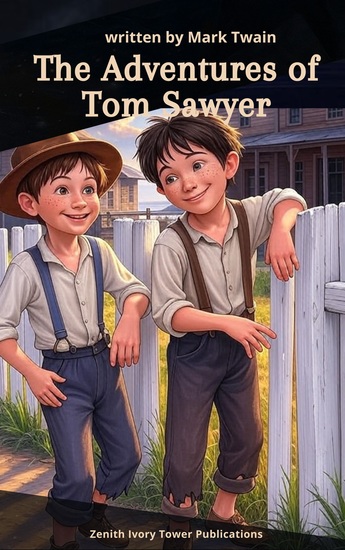
The Adventures of Tom Sawyer - A Timeless Coming-of-Age Classic of Mischief Friendship & Adventure - cover

The Adventures of Tom Sawyer - A Timeless Coming-of-Age Classic of Mischief Friendship & Adventure

Mark Twain, Zenith Ivory Tower Publications

Publisher: Zenith Ivory Tower Publications

  • 0
  • 0
  • 0

Summary

Join Tom Sawyer on a Joyride of Adventure, Laughter, and Lifelong Lessons!
From whitewashed fences to river escapades, Mark Twain's beloved classic captures the untamed spirit of youth like no other.

Step into the mischievous world of Tom Sawyer—a spirited boy growing up along the banks of the Mississippi River—where every day promises a new thrill. Whether he's scheming with Huck Finn, uncovering buried secrets, or charming Becky Thatcher, Tom's escapades are filled with heart, humor, and a healthy dose of mischief.

Mark Twain masterfully paints a vivid portrait of 19th-century American life, weaving nostalgia, wit, and wisdom into a coming-of-age story that still resonates with readers of all ages. The Adventures of Tom Sawyer isn't just a tale of youthful adventure—it's a celebration of imagination, courage, and the power of friendship.

"One of the most enduring characters in American literature." – The New York Times
"A pure dose of joy and rebellion. Twain's voice is unforgettable." – Goodreads Reviewer
"Required reading that still feels fresh and alive with every turn of the page." – Literary Digest

Perfect for fans of classic literature, young readers discovering the magic of storytelling, or anyone in need of a feel-good escape to a simpler time.

Click 'Buy Now' and rediscover why Tom Sawyer continues to inspire generations of dreamers and adventurers!
Available since: 07/23/2025.
Print length: 243 pages.
Other books that might interest you

  • Central European History 7 Books In 1 - History Of Austria Hungary Slovakia Czech Republic & Poland - cover

    Central European History 7 Books...

    HISTORY FOREVER

    • 0
    • 0
    • 0
    Book 1 - The History Of Hungary: Pagan Nomads To Kingdom Of Hungary: Magyars, Austro-Hungarian Empire And The Royal Hungarian Army In World War 1 & 2 
    Book 2 - Hungarian History: Hungary In World War 1 & 2, The Golden Age Of Football, The Worst Inflation Ever Recorded And The Collapse Of Communism  
    Book 3 - History of Czech Republic & Yugoslavia: Bohemia, Czechoslovakia, Czech Republic & Czechia 
    Book 4 - History of Czechoslovakia: Czech Republic, Slovakia, Czechia & Habsburg Monarchy 
    Book 5 - History of Poland between 966-1919: The Rise and Fall of the Polish Lithuanian Commonwealth 
    Book 6 - History Of Poland Between 1933-1945: Holocaust In Auschwitz & Genocide Of The European Jews 
    Book 7 - Polish History Between 1919-2022: Communism To Capitalism: The Sovietization Of Poland, Poznan Protest And Modern Capitalist Poland
    Show book
  • The Slippery Slope Fallacy - Arguing That One Action Will Lead to Extreme Consequences - cover

    The Slippery Slope Fallacy -...

    William Rands

    • 0
    • 0
    • 0
    Fallacies are errors in reasoning that undermine the logical validity of an argument. They often appear persuasive on the surface, yet, when examined closely, they reveal flaws that can mislead individuals or entire groups. In an increasingly complex world, recognizing these logical fallacies is crucial for navigating discussions, making informed decisions, and engaging in rational debate. The ability to identify fallacious reasoning helps individuals critically evaluate arguments and avoid being swayed by flawed logic. 
    Among the various types of fallacies, the Slippery Slope fallacy is one of the most prevalent. It involves the assumption that a particular action will inevitably lead to extreme and undesirable consequences, often without sufficient evidence to support such a claim. This form of argument relies heavily on fear and exaggeration, suggesting that even a small step in a certain direction will set off a chain of events leading to catastrophic results. The Slippery Slope fallacy is commonly used in political, legal, and social debates, where the consequences of a decision or policy are often portrayed as extreme and far-reaching. 
    The importance of understanding fallacies like the Slippery Slope lies in their widespread use in everyday life. From political campaigns to media coverage and even casual conversations, individuals are often presented with arguments that rely on fallacious reasoning. These arguments, though compelling, can lead to faulty conclusions, influencing public opinion and decision-making in harmful ways. By recognizing the Slippery Slope fallacy, we can avoid being manipulated by fear-based rhetoric and instead focus on making decisions grounded in evidence and logical reasoning.
    Show book
  • Feminist Philosophy - Rethinking Gender Roles and Power through Modern Philosophers - cover

    Feminist Philosophy - Rethinking...

    Hector Davidson

    • 0
    • 0
    • 0
    Feminist philosophy has emerged as a critical lens for understanding and deconstructing gender roles, power structures, and the ways in which societal norms shape individual identities. At its core, feminist philosophy challenges traditional, patriarchal systems that often position women and marginalized genders as secondary to men. It is not merely a critique of these systems but an exploration of alternative ways of thinking about power, justice, and equality. Feminist philosophers have sought to unravel the deep-rooted assumptions about gender, questioning how these assumptions limit the full potential of individuals and societies. 
    The intersection of gender, power, and identity plays a pivotal role in feminist thought. Feminist philosophers argue that gender is not a natural or static characteristic but a social construct shaped by historical, cultural, and political forces. This perspective invites us to reconsider the rigid distinctions between what is typically considered "masculine" and "feminine," and challenges the belief that these roles are inherent or unchangeable. It also calls attention to the ways in which power dynamics inform our understanding of gender. Feminism examines how power operates not just in political or economic spheres, but in everyday interactions, personal relationships, and within institutions.
    Show book
  • Hollywood’s Favorite Screwball Actresses: The Lives and Legacies of the Women Who Popularized the Comedy Genre - cover

    Hollywood’s Favorite Screwball...

    Editors Charles River

    • 0
    • 0
    • 0
    “If I couldn't laugh, I'd rather die.” – Claudette Colbert 
    The 1930s were the height of the classical Hollywood era, known for lavish studio productions by heavyweights like MGM, RKO, Warner Brothers, Paramount, and 20th Century Fox, which were operating at the height of their powers. Every major studio possessed a long roster of contract players, and films were released at such a rapid pace that it made for an especially competitive environment within the industry. Even while America remained in the throes of the Great Depression, the film industry continued to flourish, and movies easily supplanted the theater as the main attraction for American entertainment. Indeed, it would be no exaggeration to claim that the film industry reached its zenith during the decade precisely because it offered an affordable (if very temporary) escape from the anxieties of the economic woes of the era. 
    When the American Film Institute ranked its top 50 screen legends of the 20th century, many of the people named had careers spanning several decades, but one of them managed the feat despite living less than three decades. Ranked as the 22nd greatest actress of the 20th century, Jean Harlow was on the screen for less than 10 years, but in that time the “Blonde Bombshell” became the most popular actress of the 1930s, eclipsing superstars like Joan Crawford and Norma Shearer along the way. In fact, the platinum blonde accomplished that feat as a leading lady for just five years before her premature death of renal failure at the age of 26. 
    Carole Lombard has been memorialized in many fitting ways as an actress, and one of her biggest contributions to Hollywood was the blond archetype that the film industry used successfully for decades in screwball comedies, paving the way for the success of women like Marilyn Monroe. Perhaps the most remarkable aspect of that fact is that it was actually based on Carole’s gushing personality. 
    Show book
  • Three Questions - The Wisdom of the Present Moment and the Power of Compassion - cover

    Three Questions - The Wisdom of...

    Leo Tolstoy, Tim Zengerink

    • 0
    • 0
    • 0
    What are the most important things in life—and how do we know when to act on them? 
    In Three Questions, Leo Tolstoy delivers a timeless story about a king in search of wisdom. When scholars fail to give him clear answers, a visit to a humble hermit reveals the truth through action rather than words. 
    This modern audiobook adaptation captures the heart of Tolstoy’s parable with simple, clear language, making its message of mindfulness, service, and human connection resonate for today’s listener. 
    What You’ll Hear in This Modern Translation: 
    •	A short, beautiful story about life’s most meaningful questions 
    •	A journey of discovery through compassion, humility, and presence 
    •	A timeless lesson told with quiet power and emotional warmth 
    Included in This Edition: 
    Refined for clarity and accessibility, this audiobook preserves the original’s soul while making its message more relatable than ever. 
    Listen today—and rediscover what truly matters.
    Show book
  • Plato's Ion - cover

    Plato's Ion

    Plato

    • 0
    • 0
    • 0
    Socrates questions Ion, an actor who just won a major prize, about his ability to interpret the epic poetry of Homer. How does an actor, a poet, or any other artist create? Is it by knowing? Is it by inspiration? As the dialogue proceeds, the nature of human creativity emerges as a mysterious process and an unsolved puzzle.
    Show book