Junte-se a nós em uma viagem ao mundo dos livros!
Adicionar este livro à prateleira
Grey
Deixe um novo comentário Default profile 50px
Grey
Assine para ler o livro completo ou leia as primeiras páginas de graça!
All characters reduced
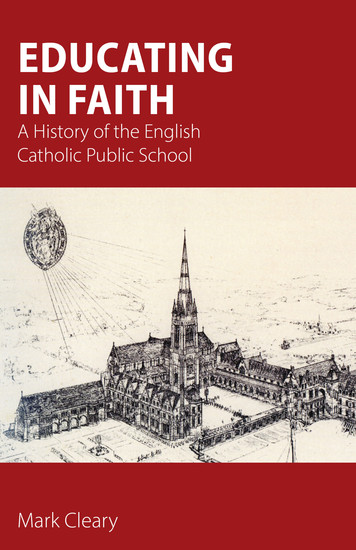
Educating in Faith - A History of the English Catholic Public School - cover
LER

Educating in Faith - A History of the English Catholic Public School

Mark Cleary

Editora: Sacristy Press

  • 0
  • 0
  • 0

Sinopse

Roman Catholic public schools in England emerged from the early 1800s as part of the wider educational mission of a Catholic church seeking to support a growing Catholic population.

 
Around a dozen such schools – male, boarding, upper class and staffed by priests, monks and brothers from the dioceses and religious orders – had emerged by the early twentieth century. Some – Ampleforth, Stonyhurst, St Edmund’s, Beaumont, the Oratory, Downside, or Prior Park – catered for an aristocratic clientele, whilst others – Douai, Mt St Mary, Ratcliffe or Cotton – sought more middle class pupils. Their objectives were similar: the creation of a new Catholic elite which might take its place in the Establishment.

 
By the mid-twentieth century, they were at their zenith, but at the millennium they faced the challenges of declining vocations to the religious life, a stagnant Catholic population, and a series of child sexual abuse cases.

 
Educating in Faith seeks to place a diverse set of school histories within the wider demographic, social and religious development of Roman Catholicism in England. It seeks to move beyond the finer detail of school histories to better understand the place of the public schools within the Catholic educational mission and the nature of the academic, cultural and spiritual character of these institutions. As co-education, increasing competition, the disappearance of a religious workforce in the schools and the child sexual abuse crises altered school environments, the book reflects on the contemporary relevance, place and character of these schools.
Disponível desde: 01/03/2024.

Outros livros que poderiam interessá-lo

  • Our Polyvagal World - How Safety and Trauma Change Us - cover

    Our Polyvagal World - How Safety...

    Stephen W. Porges, Seth Porges

    • 0
    • 0
    • 0
    The creator of the Polyvagal Theory explains the principles in simple terms that are accessible to all. 


    Since Stephen Porges first proposed the Polyvagal Theory in 1994, its basic idea—that the level of safety we feel impacts our health and happiness—has radically shifted how researchers and clinicians approach trauma interventions and therapeutic interactions. Yet despite its wide acceptance, most of the writing on the topic has been obscured behind clinical texts and scientific jargon. 


    Our Polyvagal World definitively presents how Polyvagal Theory can be understandable to all and demonstrates how its practical principles are applicable to anyone looking to live their safest, best, healthiest, and happiest life. What emerges is a worldview filled with optimism and hope, and an understanding as to why our bodies sometimes act in ways our brains wish they didn't. 


    Filled with actionable advice and real-world examples, this book will change the way you think about your brain, body, and ability to stay calm in a world that feels increasingly overwhelming and stressful.
    Ver livro
  • Mexican History - Drug Cartels Wars and Heroes (3 in 1) - cover

    Mexican History - Drug Cartels...

    Kelly Mass

    • 0
    • 0
    • 0
    This book includes three titles about Mexico's history: 
    Cristero War - The Cristero War, also known as the Cristero Rebellion or La Cristiada [la kistjaa], was a widespread and deeply significant conflict that unfolded in central and western Mexico during the late 1920s. It was primarily driven by a violent response to the secularist and anti-clerical provisions of the 1917 Mexican Constitution, which sought to curtail the influence of the Catholic Church over the country's political and social life. The Constitution introduced sweeping reforms, including the restriction of church property rights and the severe limitations placed on the clergy’s ability to engage in public life. 
    Mexican Drug Cartels - The Mexican drug war, also known as the Guerra contra el narcotráfico en México, is the Mexican theater of the global war on drugs, a campaign led by the United States federal government. This war has resulted in a protracted, asymmetric low-intensity conflict between the Mexican government and various drug trafficking organizations. The Mexican government’s main objective when it intervened militarily in 2006 was to curb drug-related violence, which had escalated in the preceding years. The government’s stated aim, in collaboration with U.S. officials, was to eliminate the cartels and reduce the demand for drugs trafficking. 
    Pancho Villa - Francisco Villa, better known as Pancho Villa, was a key figure in the Mexican Revolution, known for his transformation from a bandit to one of the revolution’s most influential commanders. Villa’s rise to prominence in the early 20th century marked him as a central player in the violent upheavals that reshaped Mexico’s political landscape. In 1911, Villa became a significant actor in the revolutionary violence that led to the overthrow of President Porfirio Díaz, ushering in Francisco I. Madero’s government.
    Ver livro
  • Hidden History of Everglades City & Points Nearby - cover

    Hidden History of Everglades...

    Maureen Sullivan-Hartung

    • 0
    • 0
    • 0
    Discover this collection of quirky and fun stories about the history of Everglades City. 


    Drawing from the author's time as a reporter for the Everglades City Echo, this book will chronicle lesser-known stories about the area. The book discusses the original pioneer families of Everglades City, and the time when this city was the governing center of Collier County. It goes on to chronicle colorful characters from the area, local landmarks, and the annual Seafood Festival that draws 20,000 people to the city every year.
    Ver livro
  • Haitian Nobility - cover

    Haitian Nobility

    Berlin Julien Theodore

    • 0
    • 0
    • 0
    The main focus of this text details the establishment of the Haitian Nobility from the Empire and Kingdom of Haiti. The text highlights the lives of Emperors Jacques the First, Henry the First and Soulouque the First. Emperor Jacques the First ruled over the First Empire of Haiti from 1804 until his assassination in 1806. His Royal Majesty, Henry the First ruled the Kingdom of Haiti after having previously ruled as president of the State. Emperor Soulouque the First, re-established the monarchy and the Empire.
    Ver livro
  • One Great Family: Domestic Relationships in Samuel Richardson's Novels - cover

    One Great Family: Domestic...

    Simone Höhn

    • 1
    • 3
    • 0
    This study examines concepts of morality and structures of domestic relationships in Samuel Richardson's novels, situating them in the context of eighteenth-century moral writings and reader reactions. Based on a detailed analysis of Richardson's work, this book maintains that he sought both to uphold hierarchical concepts of individual duty, and to warn of the consequences if such hierarchies were abused. In his final novel, Richardson aimed at a synthesis between social hierarchy and individual liberty, patriarchy and female self-fulfilment. His work, albeit rooted in patriarchal values, paved the way for proto-feminist conceptions of female character.
    Ver livro
  • A Treatise of Human Nature - cover

    A Treatise of Human Nature

    David Hume

    • 0
    • 0
    • 0
    A Treatise of Human Nature is a philosophical work written by the Scottish philosopher David Hume and published in three volumes between 1739 and 1740. The book explores a wide range of philosophical topics, including metaphysics, epistemology, ethics, and aesthetics, and it is considered one of the most influential works in the history of philosophy. 
    Hume's central thesis is that all human knowledge is ultimately derived from sensory experience, and that there is no inherent connection between cause and effect. He argues that our beliefs about cause and effect are based on custom and habit, rather than any rational or logical foundation. This leads him to challenge many traditional metaphysical and religious beliefs, including the existence of God and the immortality of the soul. 
    Hume's skeptical approach to knowledge and causality is also applied to ethics and aesthetics. He argues that moral judgments and aesthetic preferences are not based on reason, but rather on subjective feelings and emotions. This leads him to reject the idea of objective moral and aesthetic standards, and to propose a theory of moral and aesthetic relativism. 
    Despite its controversial and radical views, A Treatise of Human Nature is widely regarded as a masterpiece of philosophical writing, and has had a profound influence on subsequent philosophical thought.
    Ver livro