Unisciti a noi in un viaggio nel mondo dei libri!
Aggiungi questo libro allo scaffale
Grey
Scrivi un nuovo commento Default profile 50px
Grey
Iscriviti per leggere l'intero libro o leggi le prime pagine gratuitamente!
All characters reduced
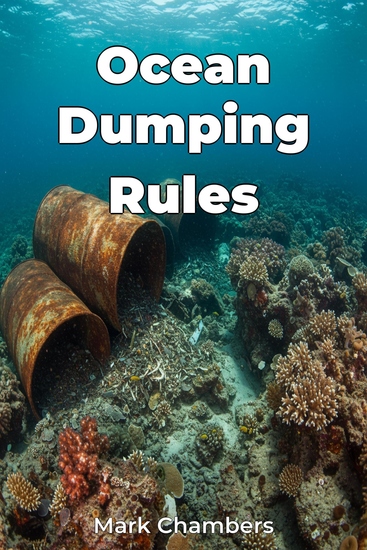
Ocean Dumping Rules - cover

Ocean Dumping Rules

Mark Chambers

Traduttore A AI

Casa editrice: Publifye

  • 0
  • 0
  • 0

Sinossi

Ocean Dumping Rules explores the intricate legal framework governing waste disposal at sea, a practice with significant environmental and political ramifications. The book examines how waste is classified under international law, influencing what materials can be disposed of in the ocean and under what conditions. Readers will learn about the evolution of understanding the impact of these practices, from early assumptions that the ocean could absorb unlimited waste, to the current awareness of the harm to marine life and human health.

 
The book progresses through key areas: waste classification, shipping regulations designed to prevent illegal dumping, and the London Convention, a crucial international treaty. It highlights the challenges of enforcement, evolving waste streams, and political complexities that hinder effective marine environment protection.

 
By combining legal analysis with scientific and political insights, Ocean Dumping Rules offers a unique perspective on the ongoing debates surrounding ocean waste disposal and the ethical considerations of using the ocean as a waste sink.
Disponibile da: 05/04/2025.
Lunghezza di stampa: 92 pagine.

Altri libri che potrebbero interessarti

  • No Scrap Left Behind - My Life Without Food Waste - cover

    No Scrap Left Behind - My Life...

    Teralyn Pilgrim

    • 0
    • 0
    • 0
    Teralyn Pilgrim had no idea the environmental and economic impact of food waste, or that she could save $100 a month by being waste free. But when a story of hungry children fills her with unbearable guilt, she decided to make a change to the way her family approached mealtime. Despite finicky kids and a skeptical husband, Pilgrim turned her feelings of guilt into action and created a zero-food waste kitchen. 


    Pilgrim began her journey by defining food waste with Rule #1: the Hungry Kid Test—would you throw something edible away with a hungry child watching? If the answer is yes, it can go in the compost. If the answer is no, then it's time to get creative. 


    Narrating her trials and errors—emphasis on errors—Pilgrim invites listeners to her table, where leftover food is a personal challenge to reduce waste, save money, and guard against squandering natural resources. Things get tricky when she discovers a five-year-old fish in her freezer, accidentally buys the grossest fat-free cookies in the world, and finds her dog is as picky as the kids. Addressing myths about how being waste-free is too hard (it's not) and whether expiration dates mean anything (they don't), Pilgrim teaches listeners clever ways to be resourceful while also offering a broader look at why food waste matters and the global effects of this massive problem.
    Mostra libro
  • QAnon Unlocked: Secrets from the Source - Inside Q’s Mind- The Deeper Q’s Hidden Secrets and Theories - cover

    QAnon Unlocked: Secrets from the...

    Mr.Babylon

    • 0
    • 0
    • 0
    The Storm Is Brewing-Unlock the Secrets of QAnon 
    Who is Q? What's the Deep State hiding? What dark plans are unfolding for the next decade? 
    QAnon isn't just a conspiracy theory-it's a battle cry from the shadows, a glimpse into a war most don't even know is being fought. At its core lies the "Deep State"-a secretive cabal accused of weaving a global tapestry of corruption, manipulation, and unspeakable evil. Their goal? Some say it's a New World Order, a totalitarian reset of society. Others whisper of something even more sinister. The edges of this puzzle are jagged, the pieces don't always fit, and even Q's followers wrestle with the question: what's the real endgame? You will discover: 
    Who Is Q? The elusive figure-or figures-driving this revolution, and the allies tied to the cause. 
    Decoding the Drops: Master the art of unraveling Q's cryptic messages and see what others miss. 
    The Deep State Unveiled: Names, faces, and the shadowy power pulling the world's strings. 
    Symbolism in QAnon: The hidden codes and signs that whisper truths in plain sight. 
    The Epstein Connection: How one scandal ties into Q's warnings and shakes the elite to their core. 
    The QAnon phenomenon is a labyrinth-wild, tangled, and more bizarre with every passing day. It's a web of rumors, revelations, and red-hot debates that can swallow the unprepared whole. But you don't have to face it alone. This book is your torch in the dark-a carefully crafted guide to the terms, players, and buried secrets that define QAnon. 
    The clock is ticking. Are you ready to unlock Q's deepest secrets and stand on the front lines of the truth?
    Mostra libro
  • Lost Fatherland - Europeans between Empire and Nation-States 1867-1939 - cover

    Lost Fatherland - Europeans...

    Iryna Vushko

    • 0
    • 0
    • 0
    How the demise of the Habsburg Empire, postwar sovereignty, and new diplomatic frontiers shaped the nature of citizenship, identity, and belonging across Europe 


    This book is a collective portrait of twenty-one key statesmen who came of age during the Habsburg Empire. They include the cofounder of Austro-Marxism and the Austrian republic's first foreign minister, the cofounder of the European Union after the Second World War, the founder of the Communist Party of Czechoslovakia, and Mussolini's ambassador to Vienna. Some survived the First World War and the resulting geographical divisions in their homelands, and some went on to serve in politics and governments throughout Europe. 


    Taken together, the stories of these men offer listeners a window on broad issues of European history in the late nineteenth and early twentieth centuries—chiefly, how an imperial heritage, a shared vision of statehood and nationalism, and a commitment to peaceful conflict resolution helped establish enduring loyalty and unity despite the geographical fault lines resulting from the war. As Iryna Vushko explains, their stories also offer an increasingly nuanced understanding of the achievements and failures of the Habsburg Empire.
    Mostra libro
  • Is It Possible to Renew the Mind? - Amsterdam 1967 - Public Talk 3 - cover

    Is It Possible to Renew the...

    Jiddu Krishnamurti

    • 0
    • 0
    • 0
    Is it possible to renew the mind? - 24 May 1967 
    • When the mind is living through imagination and thought, it is incapable of 
    living in the complete fullness of the present. 
    • Thought has created time, not chronological time but psychological time. That 
    is, ‘I will be,’ ‘I should be.’ 
    • Is it possible for the brain to be quiet, to give an interval between the old and 
    the new? This interval is the timeless nature in which thought cannot possibly 
    enter. 
    • That which has continuity is repetitive, which is time. It’s only when time 
    comes to an end there is something new taking place. 
    • To die every day to every problem, every pleasure, and not carry over any 
    problem at all; so the mind remains tremendously attentive, active, clear. 
    • Since love is not desire or pleasure, how does one come upon it? 
    • Q: Is the feeling of responsibility a part of the order and discipline you were 
    talking about? 
    • Q: Why don’t people get angry with what you are saying?
    Mostra libro
  • Golden Era of Hollywood’s Most Famous Couples The: The History of Tinseltown’s Legendary Romances - cover

    Golden Era of Hollywood’s Most...

    Anonimo

    • 0
    • 0
    • 0
    The 1930s were, without a doubt, the height of the classical Hollywood era. It is no accident that 1939 has historically been designated as the pinnacle of Hollywood film history. The era was known for its lavish studio productions, with MGM, RKO, Warner Brothers, Paramount, and 20th Century Fox all operating at the height of their powers. Every major studio possessed a long roster of contract players, with films released at such a rapid pace that it made for an especially competitive environment within the industry. Even while America remained in the throes of the Great Depression, the film industry continued to flourish, and movies easily supplanted the theater as the main attraction for American entertainment. Indeed, it would be no exaggeration to claim that the film industry reached its zenith during the decade precisely because it offered an affordable (if very temporary) escape from the anxieties of the economic woes of the era. 
    The 1930s were also a time in which Hollywood boasted an unprecedented array of famous leading men. Clark Gable, Humphrey Bogart, Gary Cooper, Cary Grant, James Stewart, and Fred Astaire were just a handful of the A-list stars of the decade, along with star actresses like Katharine Hepburn, Bette Davis, Joan Crawford. Perhaps it's no surprise that many actors and actresses had romances not just on the screen, but off of it as well, leading to some of the most memorable pop culture stories of the 20th century.
    Mostra libro
  • Habit Forming - Drug Addiction in America 1776-1914 - cover

    Habit Forming - Drug Addiction...

    Elizabeth Kelly Gray

    • 0
    • 0
    • 0
    Habitual drug use in the United States is at least as old as the nation itself. Habit Forming traces the history of unregulated drug use and dependency before 1914, when the Harrison Narcotic Tax Act limited sales of opiates and cocaine under US law. Many Americans used opiates and other drugs medically and became addicted. Some tried Hasheesh Candy, injected morphine, or visited opium dens, but neither use nor addiction was linked to crime, due to the dearth of restrictive laws. After the Civil War, American presses published extensively about domestic addiction. Later in the nineteenth century, many used cocaine and heroin as medicine. As addiction became a major public health issue, commentators typically sympathized with white, middle-class drug users, while criticizing such use by poor or working-class people and people of color. When habituation was associated with middle-class morphine users, few advocated for restricted drug access. By the 1910s, as use was increasingly associated with poor young men, support for regulations increased. In outlawing users' access to habit-forming drugs at the national level, a public health problem became a larger legal and social problem, one with an enduring influence on American drug laws and their enforcement.
    Mostra libro