Join us on a literary world trip!
Add this book to bookshelf
Grey
Write a new comment Default profile 50px
Grey
Subscribe to read the full book or read the first pages for free!
All characters reduced
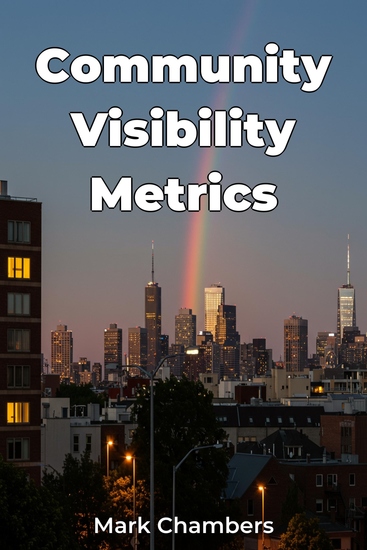
Community Visibility Metrics - cover

Community Visibility Metrics

Mark Chambers

Translator A AI

Publisher: Publifye

  • 0
  • 0
  • 0

Summary

Community Visibility Metrics tackles the complex task of measuring LGBTQ public integration as a crucial indicator of social progress and equality. It emphasizes the need for a multi-dimensional approach to evaluating LGBTQ visibility, moving beyond anecdotal evidence to provide tangible metrics for change. The book highlights that understanding LGBTQ representation in census data is vital for resource allocation and policy making, while media representation shapes public perception.

 
The book examines census data methodologies, media portrayals, and social indicators to assess community acceptance. It argues that relying on single metrics provides an incomplete picture, advocating for a nuanced framework. For example, analyzing rates of discrimination alongside access to healthcare offers a more holistic view of LGBTQ integration.

 
Structured in three parts, the book introduces core concepts, analyzes data, and proposes a standardized LGBTQ visibility index. By combining quantitative data analysis with qualitative insights, it provides a rigorous yet accessible exploration valuable to policymakers, social scientists, and LGBTQ advocates.
Available since: 04/07/2025.
Print length: 86 pages.

Other books that might interest you

  • Sahih Al Bukhari English Translation Volume 8 Book 78-86 Hadith 5970-6860 of 7563 - Most Authentic Hadith Audio Collection (English Translation) - cover

    Sahih Al Bukhari English...

    Imam Bukhari, Translator - Dr....

    • 0
    • 0
    • 0
    Ṣaḥīḥ al-Bukhārī is a collection of hadīth compiled by Abu Abdullāh Muhammad Ibn Ismā`īl al-Bukhārī(rahimahullāh). His collection is recognized by the overwhelming majority of the Muslim world to be one of the most authentic collections of the Sunnah of the Prophet (peace be upon him). It contains roughly 7563 hadīth (with repetitions) in 97 books. The translation provided here is by Dr. M. Muhsin Khan. 
    Volume 8 contains hadith 5970-6860 of 7563 in book 78-86: 
    78 The Book Of Good Manners (Al-Adab) Hadith 5970-6226 of 7563 English 
    79 The Book Of asking permission (to enter somebody else's dwelling place) Hadith 6227-6303 of 7563 English 
    80 The Book Of Invocations or Dua (Du'a's) Hadith 6304-6411 of 7563 English 
    81 The Book Of Softening of the hearts (Ar-Riqaq) Hadith 6412-6593 of 7563 English 
    82 The Book Of Divine Preordainment (Al-Qadar) Hadith 6594-6620 of 7563 English 
    83 The Book Of Oaths and Vows Hadith 6621-6707 of 7563 English 
    84 The Book Of Expiation of Unfulfilled Oaths Hadith 6708-6723 of 7563 English 
    85 The Book Of Laws of Inheritance (Al-Faraaid) Hadith 6724-6771 of 7563 English 
    86 The Book Of Limits and Punishments set by Allah (Hudood) Hadith 6772-6860 of 7563 English 
    Contact: For any feedback or correction please feel free to contact at qnsacademy@outlook.com
    Show book
  • Common Ground - Second Language Acquisition Theory Goes to the Classroom - cover

    Common Ground - Second Language...

    Florencia G. Henshaw, Maris D....

    • 0
    • 0
    • 0
    "Common Ground is accessible to teachers at all levels yet firmly rooted in current questions of second language acquisition (SLA). One of its primary strengths is the authors themselves, both of whom are accomplished language teachers who understand the challenges and opportunities in communication-focused language teaching. Their experience, expertise, insight, and enthusiasm for language teaching translate into a book that is refreshingly practical for teachers, especially teachers who are striving to break from traditional drills commonly presented in textbooks. I hope this book finds its way into the hands of every language teacher who is looking for concrete examples of how SLA principles meet the realities of the classroom." —Stacey Margarita Johnson, Vanderbilt University
    Show book
  • Enter the Writing Business - cover

    Enter the Writing Business

    Edie Roones

    • 0
    • 0
    • 0
    How do I succeed at writing? Most answers to that question focus on creativity ~ story development, character explorations, poetic contemplations, blogging topics, and more. 
    Refine the question ~ How do I succeed at the writing business? 
    Even our refined question can be divided into several.A] What are the best systems for writers?B] What are the best daily procedures?C] The best ways to balance creativity and practicality? 
    These are the first decisions to build a writing business. 
    Think of writing as running a small business. Writers create content ~ stories, poems, blogs, any of our writing. That content is our product to sell. 
    As creators of quality products, we have a Writing Biz. 
    Now, imagine a writing career. What is the reality? No, not the fantasy. What will the actual day-to-day writing life be? 
    Daily writing requires that we find ways to cope with the soul-suckers who interfere with your creative energies. 
    Enter the Writing Business offers the reality of the writing career, the daily creative process and the daily devotion to writing. We look at the necessary writing space then the essential hard and soft skills. To succeed, though, we need a business plan designed for writers. That biz plan will direct our daily actions, weekly plans, and monthly reviews and previews -- the Do’s that few consider until swamped by the constant Do-ing of them. 
    A workbook with the lessons from Enter the Writing Business is available at https://www.buymeacoffee.com/winkbooksr 
    Edie Roones writes fantasy. Her current focus is the Wild Sherwood series. Write to Edie at winkbooks@aol.com
    Show book
  • Courageous Women of the Bible - 30 timeless lessons on faith courage wisdom and devotion - cover

    Courageous Women of the Bible -...

    Arcelio Hernández Mussio

    • 0
    • 0
    • 0
    The Bible often remembers and celebrates the names of great men of God. People like Abraham, Moses, David, Paul, Isaiah, and Elijah are well-known for their important roles in the story of God's people. These men are honored for their faith, leadership, and the key parts they played in God's plan. 
    However, as we delve into the Scriptures, we often overlook the equally significant contributions of women of God. The Bible, while rich with the stories of these men, also holds accounts of extraordinary women whose strength, wisdom, and faithfulness were crucial to the unfolding of God's narrative. For instance, Sarah's faith in God's promise of a son, Ruth's loyalty to her mother-in-law, and Mary's acceptance of her role in God's plan. Yet, these women often remain in the background, their stories less frequently told, their virtues less regularly celebrated. 
    This book is a necessary contribution to Christian literature, as it celebrates the strength and wisdom of prominent women in the Bible. In the pages you are about to read, you will get a glimpse into the lives of these extraordinary women. Their faith and actions were significant and played pivotal roles in shaping the Biblical narrative. The book is organized chronologically, starting with the Old Testament and moving through to the New Testament, to provide a comprehensive view of these women's contributions. 
    This book celebrates these 30 women, each embodying unique qualities and virtues that can guide and inspire us in our modern lives. Their stories offer timeless lessons on resilience, faith, leadership, and profound love, demonstrating that the challenges and virtues they faced are just as relevant and applicable in our lives today. Whether it is Hannah's unwavering faith, Abigail's strategic wisdom, or Ruth's selfless loyalty, these women provide powerful examples of how to live with purpose and integrity in our contemporary world.
    Show book
  • Progress and poverty: Book Summary & Analysis - cover

    Progress and poverty: Book...

    Henry George

    • 0
    • 0
    • 0
    "Progress and Poverty" is a seminal work written by Henry George, first published in 1879. The book addresses economic and social issues, particularly focusing on the unequal distribution of wealth and the causes of poverty in the midst of progress and economic growth. In "Progress and Poverty," Henry George explores the relationship between economic progress and the persistence of poverty. He critiques the existing economic system and advocates for a single tax on land as a solution to address wealth inequality and eradicate poverty. George argues that land, as a resource, should be treated as a common good, and the benefits of land value increases should be shared by the community. The book gained widespread attention and sparked discussions on economic reform and social justice.
    Show book
  • Egyptian Medicine - Practices and Beliefs in Ancient Healing - cover

    Egyptian Medicine - Practices...

    Omar Khalil

    • 0
    • 0
    • 0
    The origins of Egyptian medicine trace back to the earliest periods of ancient Egypt, where the intertwining of practical knowledge and spiritual beliefs laid the foundation for one of the most advanced medical systems of the ancient world. As early as the Pre-Dynastic period, evidence of rudimentary medical practices reveals that Egyptians were already exploring ways to treat injuries and ailments using natural resources available in their environment. 
    Religion played a fundamental role in shaping the practice of medicine in ancient Egypt. The Egyptians believed that the gods held power over health and illness, with many deities associated with specific aspects of healing. For instance, Sekhmet, the lioness goddess, was both a bringer of plague and a healer, while Thoth, the god of wisdom, was revered as a patron of physicians. Temples dedicated to these deities often served as centers for both worship and healing, where priests acted as both spiritual leaders and medical practitioners. 
    Early medical practices were closely linked to mythology, with illnesses often attributed to divine displeasure or the influence of malevolent spirits. Healing rituals and incantations were designed to restore the balance between the individual and the divine order, highlighting the Egyptian belief in a holistic approach to health. The blending of prayer, magic, and practical remedies reflects a medical philosophy that considered both the physical and spiritual dimensions of wellness.
    Show book