Join us on a literary world trip!
Add this book to bookshelf
Grey
Write a new comment Default profile 50px
Grey
Subscribe to read the full book or read the first pages for free!
All characters reduced
Future Trends For Top Materials - cover

Future Trends For Top Materials

Mário J. F. Calvete

Publisher: Bentham Science Publishers

  • 0
  • 0
  • 0

Summary

This reference focuses on defined types of compounds which are of interest to readers who are motivated to explore basic information about new materials for advanced industrial applications. General and established synthetic methodologies for several compounds are explained giving a straightforward approaches for researchers who intend to pursue new projects in materials sciences. This book presents 9 chapters, covering phthalocyanines, polymethines, porphyrins, BODIPYs, dendrimers, carbon allotropes, organic frameworks, nanoparticles and future prospects. Each chapter covers detailed synthetic aspects of the most established preparation routes for the specific compounds, while giving a historical perspective, with selective information on actual and outstanding applications of each material, unraveling what likely might be the future for each category. This book is intended as a hands-on reference guide for undergraduates and graduates interested in industrial chemistry and materials science.
Available since: 02/16/2024.

Other books that might interest you

  • 60 Most Delicious Coconut Oil Recipes and Amazing Health Benefit For Perfect Weight Loss - cover

    60 Most Delicious Coconut Oil...

    Tanya Simons

    • 0
    • 0
    • 0
    People nowadays are becoming increasingly concerned about their body weight, which seems to determine them to approach a wide array of weight loss regimens to shed pounds. At the same time, many people are putting a great effort into improving their general health using various multivitamin supplements that claim to help them achieve balance among several functions of their bodies. Dieting has quickly grown to become an efficient solution for both problems, yet many people fail to understand the importance of eating healthily. 
    Of all superfoods available, coconut oil is probably one of the best, especially since there is a lot of evidence to back up its efficiency in helping one lose weight, reduce belly fat, and restore his health – all of them by simply including this superfood to their day-to-day nutrition habits. Read on to find out how coconut oil works and how it can help you achieve these goals. 
    Click the Buy Now button. Grab your copy today and try these Amazing Recipes. You will be pleased with the mouth-watering food you are going to taste. 
    Thank you 
    Tanya Simons
    Show book
  • Journal of a Black Queer Nurse - cover

    Journal of a Black Queer Nurse

    Britney Daniels

    • 0
    • 0
    • 0
    In this searing, honest memoir, a Black queer emergency-room nurse works the front lines of care during COVID-19. 


    Britney Daniels is a Black, masculine-presenting, tattooed lesbian from a working-class background. For the last five years, she has been working as an emergency-room nurse. She began Journal of a Black Queer Nurse as a personal diary, a tool to heal from the day-to-day traumas of seeing too much and caring too much. 


    Hilarious, gut-wrenching, and infuriating by turns, these stories are told from the perspective of a deeply empathetic, no-nonsense young nurse, who highlights the way race, inequality, and a profit-driven healthcare system make the hospital a place where systemic racism is lived. 


    Whether it is giving one's own clothes to a homeless patient, sticking up for patients of color in the face of indifference from white doctors and nurses, or nursing one's own back pain accrued from transporting too many bodies, Journal of a Black Queer Nurse reveals the ways in which care is much more than treating a physical body and how the commitment to real care—care that involves listening to and understanding patients in a deeper sense—demands nurses, especially nurses of color, must also be warriors.
    Show book
  • NASA’s Space Race Programs: The History and Legacy of NASA Missions in the 1950s and 1960s - cover

    NASA’s Space Race Programs: The...

    Editors Charles River

    • 0
    • 0
    • 0
    Today the Space Race is widely viewed poignantly and fondly as a race to the Moon that culminated with Apollo 11 “winning” the Race for the United States. In fact, it encompassed a much broader range of competition between the Soviet Union and the United States that affected everything from military technology to successfully launching satellites that could land on Mars or orbit other planets in the Solar System. Moreover, the notion that America “won” the Space Race at the end of the 1960s overlooks just how competitive the Space Race actually was in launching people into orbit, as well as the major contributions the Space Race influenced in leading to today’s International Space Station and continued space exploration. 
    The Apollo space program is the most famous and celebrated in American history, but the first successful landing of men on the Moon during Apollo 11 had complicated roots dating back over a decade. Landing on the Moon presented an ideal goal all on its own, but the government’s urgency in designing the Apollo program was actually brought about by the Soviet Union, which spent much of the 1950s leaving the United States in its dust (and rocket fuel). In 1957, at a time when people were concerned about communism and nuclear war, many Americans were dismayed by news that the Soviet Union was successfully launching satellites into orbit. 
    Throughout the 1960s, NASA would spend tens of billions on missions to the Moon, the most expensive peacetime program in American history to that point, and Apollo was only made possible by the tests conducted through earlier missions. Of course, by the time it was all done, Americans sure felt the cost was worth it as they watched the first live shots of astronauts Neil Armstrong and Buzz Aldrin walking on the Moon. As he left his first footprint on the Moon, Armstrong transmitted one of the 20th century’s most famous phrases: “That’s one small step for man, one giant leap for mankind.”
    Show book
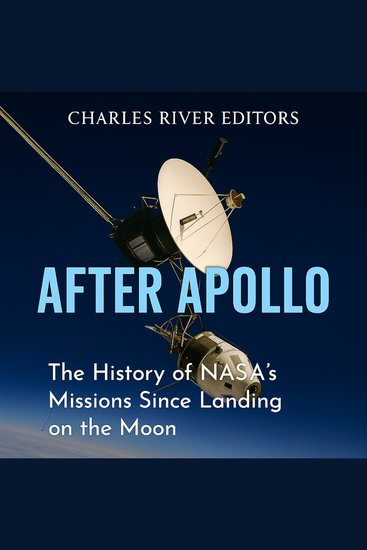
  • After Apollo: The History of NASA’s Missions Since Landing on the Moon - cover

    After Apollo: The History of...

    Charles River Editors

    • 0
    • 0
    • 0
    Today the Space Race is widely viewed poignantly and fondly as a race to the Moon that culminated with Apollo 11 “winning” the Race for the United States. In fact, it encompassed a much broader range of competition between the Soviet Union and the United States that affected everything from military technology to successfully launching satellites that could land on Mars or orbit other planets in the Solar System. Moreover, the notion that America “won” the Space Race at the end of the 1960s overlooks just how competitive the Space Race actually was in launching people into orbit, as well as the major contributions the Space Race influenced in leading to today’s International Space Station and continued space exploration.  
    Space exploration was always an expensive business, and throughout NASA’s history, the agency has had to justify to Congress its need for every dollar it intended to spend. This problem has helped NASA to be more careful and more creative with the money they did receive, and scientists had to justify the equipment they wanted to include on each space probe. They had to justify the size and the power demand, too. If they wanted too much, the entire mission might be scrubbed, and all their work would have been for naught. This made planning and designs leaner and more efficient, as scientists and engineers were more careful with their recommendations. 
    Although Apollo 11’s successful mission to the Moon is seen as the culmination of the Space Race, and the Apollo program remains NASA’s most famous, one of the space agency’s most successful endeavors came a few years later. In fact, the Pioneer program was the most diversified sequence of any of NASA’s programs, and though they’re now remembered for being among the first probes in history to reach the Outer Solar System, the elaborate planning changed goals several times over several years before resulting in historic successes. 
    Show book
  • Animal Crossing - cover

    Animal Crossing

    Kelsey Lewin

    • 0
    • 0
    • 0
    Before the world of Animal Crossing became a pandemic lifeline for millions, the "social sim" communication game Dо̄butsu no Mori, or "Animal Forest," debuted in 2001 on Nintendo 64 in Japan, then once again in 2002 on GameCube to critical and commercial success all over the world. 


    An open-ended casual game ahead of its time, Animal Crossing set the stage for the series's many incarnations to come with its focus on building community and friendship, its in-game currency of Bells, and its village of Animalese-speaking friends like Tom Nook, K. K. Slider, and the mean Mr. Resetti. You could visit the villages of your friends and give them gifts—all without being connected to the internet. 


    Video game preservationist and historian Kelsey Lewin tells the story of how a mundane-sounding game full of bug-catching, letter-writing, and furniture-collecting became one of Nintendo's best-loved franchises, with Animal Crossing: New Horizons eclipsing Super Mario Bros. for all-time sales in Japan, unlocking gaming's massive potential to tap into our desire to plant trees, find friends, and make the world a better place.
    Show book
  • Brief Answers to the Big Questions: Book Summary & Analysis - cover

    Brief Answers to the Big...

    Briefly Summaries

    • 0
    • 0
    • 0
    This is a concise summary and analysis of Brief Answers to the Big Questions, by Stephen Hawking.
     
    It is not the original book and is not affiliated with or endorsed by Stephen Hawking.
     
    Ideal those seeking a quick and insightful overview.
    
     
    Brief Answers to the Big Questions tackles some of humanity's most profound questions, from the existence of God to the potential for time travel and the future of artificial intelligence. Written in clear and accessible language, it explores the mysteries of the universe, the nature of reality, and humanity’s place in it, offering insights into the most pressing scientific and philosophical questions of our time.
    Show book