Join us on a literary world trip!
Add this book to bookshelf
Grey
Write a new comment Default profile 50px
Grey
Subscribe to read the full book or read the first pages for free!
All characters reduced
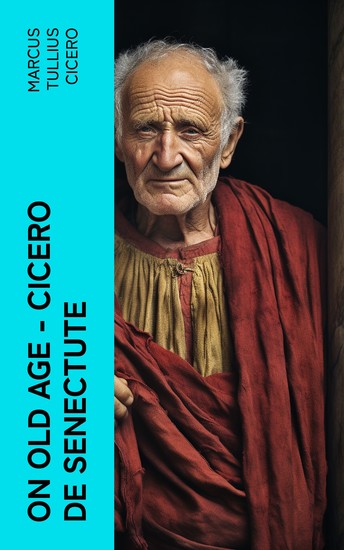
On Old Age - Cicero de Senectute - cover

On Old Age - Cicero de Senectute

Marcus Tullius Cicero

Translator Andrew Preston Peabody

Publisher: e-artnow

  • 0
  • 0
  • 0

Summary

'On Old Age', sometimes also known as 'Cato Maior de Senectute',  is an essay written by Cicero on the subject of aging and death. To lend his reflections greater import, Cicero wrote his essay such that the esteemed Cato the Elder was lecturing to Scipio Africanus and Gaius Laelius Sapiens.
Available since: 12/07/2023.
Print length: 61 pages.

Other books that might interest you

  • On the Genealogy of Morals - cover

    On the Genealogy of Morals

    Friedrich Nietzsche

    • 0
    • 0
    • 0
    The sight of suffering does one good, the infliction of suffering does one more good - this is a hard maxim, but none the less a fundamental maxim, old, powerful, and "human, all-too-human".
     
    In this daring and insightful work, Nietzsche lays bare the hypocrisies at the foundations of our ideas of morality. Considering ideas of good and evil, guilt and conscience, and law and violence along the way, On the Genealogy of Morals takes the reader on a journey through the history of value systems in three masterful essays.
     
    His insights are sometimes uncomfortable, sometimes provocative, but always demonstrate the workings of an exceptional mind. Together, this collection of essays makes up one of the most powerful works of modern philosophy that seeks to do nothing less than unravel the mysteries of human nature.
    Show book
  • How to Have a Life - An Ancient Guide to Using Our Time Wisely - cover

    How to Have a Life - An Ancient...

    Seneca

    • 0
    • 0
    • 0
    A vibrant new translation of Seneca's "On the Shortness of Life," a pointed reminder to make the most of our time 


    Who doesn't worry sometimes that smart phones, the Internet, and TV are robbing us of time and preventing us from having a life? How can we make the most of our time on earth? In the first century AD, the Stoic philosopher Seneca the Younger offered one of the most famous answers to that question in his essay "On the Shortness of Life"—a work that has more to teach us today than ever before. In How to Have a Life, James Romm presents a vibrant new translation of Seneca's brilliant essay, plus two Senecan letters on the same theme, complete with an inviting introduction. 


    With devastating satiric wit, skillfully captured in this translation, Seneca lampoons the ways we squander our time and fail to realize how precious it is. We don't allow people to steal our money, yet we allow them to plunder our time, or else we give it away ourselves in useless, idle pursuits. Seneca also describes how we can make better use of our brief days and years. In the process, he argues, we can make our lives longer, or even everlasting, because to live a real life is to attain a kind of immortality.
    Show book
  • The Body-Based Obsessions Workbook - CBT Skills to Manage Anxiety and Intrusive Thoughts About Your Body and Brain - cover

    The Body-Based Obsessions...

    LCPC Molly Bradley Schiffer, MFT...

    • 0
    • 0
    • 0
    If you have anxiety or obsessive-compulsive disorder (OCD), you may also struggle with body-based obsessions—constant fears and worries about your physical and mental health. You may worry that your heart will stop beating, or that you'll stop breathing. You might obsess over your physical appearance, feel like there's something physically wrong with your brain, or fear that you are "going crazy." So, how can you break free from anxiety and obsessions about your body and brain? 


    Drawing on a combination of evidence-based CBT, exposure and response prevention therapy (ERP), mindfulness, and compassion-focused therapy, The Body-Based Obsessions Workbook offers powerful skills to help you manage intrusive thoughts and obsessions, and take back your life. You'll learn the difference between body-based obsessions and other disorders such as body dysmorphic disorder or health anxiety, and find practical tools to manage your worst symptoms—such as rumination, constant checking or monitoring of your breathing or heart rate, or fears about your mental health. 


    If you struggle with intense, intrusive thoughts about your body and brain, you're not alone—and there is help. This workbook will teach you proven-effective skills to overcome your obsessions, so you can experience lasting peace and comfort in your own body.
    Show book
  • A Brief History of 20th Century Western Philosophy - cover

    A Brief History of 20th Century...

    Garrett Thomson

    • 0
    • 0
    • 0
    During the 20th century, our understanding of the world was transformed thanks to the likes of relativity, quantum physics, molecular biology, chaos theory and computer science. Likewise, our comprehension of ourselves developed dramatically courtesy of theories such as behaviourism, structuralism and cognitive science.  
     
    The history of Western philosophy in the 20th century broadly reflects all of this change and diversity, but at an abstract level. Part of its story is of the contrast between two conflicting traditions: the analytic and the continental. In the analytic tradition, there are thinkers such as Russell, Quine and Davidson, who, among other things, aim to show how semantic meaning fits into the scientifically conceived physical world. This often goes hand in hand with the idea that social progress must be in part scientific. However, within this analytic branch, there are several counter-narratives, such as the work of the pragmatists and the ordinary language philosophers, who resist the idea that language must conform to an idealized scientific picture, and who often point towards a conception of social progress that is not scientific.  
     
    In sharp contrast, much continental thought tries to characterise the human condition through descriptions of experience as such in ways that are pre-scientific. This applies especially to thinkers in the phenomenological and existentialist traditions, such as Husserl, Heidegger and Sartre. Branching out from this, hermeneutics examines the art of interpreting texts, especially with regard to the historical and linguistic assumptions that make interpretation possible. Poststructuralism constitutes largely a rejection of these traditions that emphasizes the shifting relations between signifiers within a whole system and which defies all attempts to seek absolutes beyond those relations.  
     
    In this illuminating overview, Professor Garrett Thomson surveys the field, considering the work and influence of 29 major thinkers representing logical atomism and logical positivism (including Russell and Wittgenstein), analytic philosophy (including Quine, Davidson, Rawls), phenomenology and existentialism (including Husserl, Heidegger, Sartre), hermeneutics (including Gadamer and Habermas) and post-structuralism (including Foucault, Derrida and Deleuze). Also examined are some recent thinkers including Richard Rorty and Charles Taylor. The field is clearly presented with a short biography of the major figures followed by their thoughts and views. With over 20 books to his credit, Professor Thomson is an experienced presenter of his subject, conveying his knowledge expertly while injecting his personal enthusiasm for the challenges of 20th century Western philosophy. The text is read with clarity by James Gillies.  
     
    PLEASE NOTE: When you purchase this title, the accompanying PDF will be available in your Audible Library along with the audio.
    Show book

  • Jewish Revolts in Antiquity The: The History of the Jews’ Uprisings against the Seleucids and Romans in Ancient Judea - cover

    Jewish Revolts in Antiquity The:...

    Editors Charles River

    • 0
    • 0
    • 0
    Judea is one of the most important regions in the modern world. It is the center of two of the world’s great religions and extremely important to a 3rd. Politically, the whole area is the focus of conflict between Jews and Arabs, as well as different Muslim sects. Its history is littered with wars, insurrections, and religious revolutions. To say that it has had a turbulent past is to understate the case in the extreme.  
    	The history of Judea is, of course, inextricably linked to the history of the Jewish people, their dispersal throughout the Mediterranean world, and their reestablishment of the modern state of Israel in the wake of the horrors of the Holocaust. And among all the tumultuous events associated with Jewish history, few can rival the period of Roman rule during the 1st century CE, when Roman attempts to suppress Jewish nationalism met with violent resistance. Ultimately, the Romans forcibly removed much of the Jewish population from the region, setting the scene for later events that have impacted so directly on world history. Events in the region during the 1st century CE also brought about the birth of Christianity, a religious movement that has been at the forefront of European history ever since.  
    This whole period relating to the United Monarchy, and the events leading up to the Assyrian invasion, has been the subject of fierce debate between religious scholars and what might be termed more dispassionate academics. The issue of the “Historicity of the Bible” is a massive field of study in its own right but for the purposes of this paper the words of T.L Thompson sums up the position of those who refuse to consider any possibility that the Bible may contain historical facts in relation to the original origins of the Kingdoms centered on Judea.
    Show book
  • Brain Lock - cover

    Brain Lock

    Anonymous

    • 0
    • 0
    • 0
    The 20th anniversary edition of the definitive classic on defeating obsessive-compulsive behavior, with all-new material from the author. 
     
    An estimated 5 million Americans suffer from obsessive-compulsive disorder (OCD) and live diminished lives in which they are compelled to obsess about something or to repeat a similar task over and over. Traditionally, OCD has been treated with Prozac or similar drugs. The problem with medication, aside from its cost, is that 30 percent of people treated don't respond to it, and when the pills stop, the symptoms invariably return.  
    In Brain Lock, Jeffrey M. Schwartz, M.D., presents a simple four-step method for overcoming OCD that is so effective, it's now used in academic treatment centers throughout the world. Proven by brain-imaging tests to actually alter the brain's chemistry, this method doesn't rely on psychopharmaceuticals. Instead, patients use cognitive self-therapy and behavior modification to develop new patterns of response to their obsessions. In essence, they use the mind to fix the brain.  
    Using the real-life stories of actual patients, Brain Lock explains this revolutionary method and provides readers with the inspiration and tools to free themselves from their psychic prisons and regain control of their lives.
    Show book