Rejoignez-nous pour un voyage dans le monde des livres!
Ajouter ce livre à l'électronique
Grey
Ecrivez un nouveau commentaire Default profile 50px
Grey
Abonnez-vous pour lire le livre complet ou lisez les premières pages gratuitement!
All characters reduced
For Aulus Caecina — 69 BC - cover

For Aulus Caecina — 69 BC

Marcus Tullius Cicero

Traducteur Charles Duke Yonge

Maison d'édition: DigiCat

  • 0
  • 0
  • 0

Synopsis

In "For Aulus Caecina," penned in 69 BC, Marcus Tullius Cicero showcases his exceptional rhetorical prowess while addressing a legal case of considerable public interest. This work is a masterclass in the art of persuasion, blending sharp logic with emotive appeal, as Cicero defends his client, Aulus Caecina, against charges of illegal possession of a disputed inheritance. The literary style is characterized by Cicero's elegant and fluid Latin prose, replete with rhetorical devices that illuminate the intricacies of his arguments, placing this text within the broader context of Roman oratory and legal discourse. Notably, Cicero's ability to intertwine personal anecdotes with legal principles exemplifies the humanistic approach that shaped the literary and philosophical currents of his time. Marcus Tullius Cicero, born in 106 BC, emerged as one of the foremost figures in Roman politics and philosophy. His extensive experience as a lawyer, politician, and statesman provided him with invaluable insights into the workings of the Roman legal system and the social dynamics of his era. Cicero's deep commitment to justice and the Republic influenced his writings profoundly, fostering a legacy that would resonate through the ages and inspire countless thinkers and orators. "For Aulus Caecina" is not merely a legal defense; it is a compelling exploration of the intersection of law and ethics, making it essential reading for students of rhetoric, law, and Roman history. Cicero's ability to evoke empathy while arguing with intellectual rigor ensures that this work endures as a significant contribution to the canon of classical literature. Engaging with Cicero's text invites readers to reflect on the enduring power of words and the importance of justice in society.
Disponible depuis: 10/08/2022.
Longueur d'impression: 45 pages.

D'autres livres qui pourraient vous intéresser

  • Ghost Child: The new fostering memoir from THE MILLION-COPY BESTSELLING AUTHOR CASEY WATSON - cover

    Ghost Child: The new fostering...

    Casey Watson

    • 0
    • 0
    • 0
    All Molly wants is somewhere she can feel safe… 
    After her mother is charged with drugs and neglect, six-year-old Molly arrives at Casey and Mike's as an emergency placement, carrying secrets no child should have to keep. 
    But just as Molly begins to trust Casey, a heartbreaking event and the arrival of someone from her past threaten her chance of a fresh start. 
    Can Casey uncover the truth and protect Molly before her past catches up with her? 
    Perfect for readers who were moved by Breaking Point, A Family Friend and Little Girl Lost – powerful true stories of vulnerable children, resilience, and the life-changing impact of foster care. 
    Casey Watson's book Little Girl Lost was a Sunday Times bestseller w/c 2024-04-01. 
    For fans of Ann Cusack (The Convent), Joe Cusack (Please Don't Leave Me), Linda Watson-Brown (Please Save Me), Ashley Rhodes-Courter (Three Little Words), and Katy Weitz (Undercover Copper).
    Voir livre
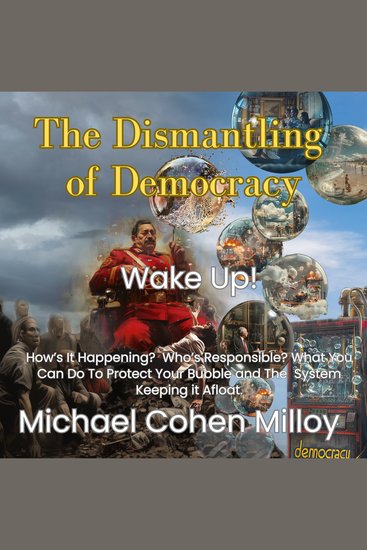
  • The Dismantling of Democracy - How's it being done? Who's doing it? How can we turn the tide fast? - cover

    The Dismantling of Democracy -...

    Michael Cohen Milloy

    • 0
    • 0
    • 0
    Those who expect to reap the blessings of freedom, must undergo the fatigues of supporting it." - Thomas Paine 
    We are witnessing a systematic teardown of democracy worldwide. This book will help you make sense of the world, understand how this could happen, and consider what we can do as ordinary citizens to flip the script on authoritarians. 
    We are in a perpetual struggle between authoritarian rule and the enduring resilience of freedom, also known as Democracy. This resilience, this unwavering strength, is not just a concept but a beacon of hope that inspires us to fight for our freedom of choice. 
    Having peace of mind, understanding how the world works, and seeing real-world examples are priceless, as shown in this book. However, beware that the who, how, and what is being done to dismantle democracy is terrifying to learn. You need to start with a willingness to hold the knowledge; once you have it, there is no forgetting it and no turning back. In the last 80 years, Democracy, to date, has not offered up a defense. Hence, we have been slowly taken off course. We need to fortify our defenses and go on the offense. 
    President Ronald Reagan said it best: 
    "Freedom is a fragile thing, and it's never more than one generation away from extinction. It is not ours by way of inheritance; it must be fought for and defended constantly by each generation, for it comes only once to a people. And those in world history who have known freedom and then lost it have never known it again." 
    Here's a not-so-fun fact: you have a six times greater chance of being killed living under an authoritarian regime than you do living and fighting for Democracy (TUCCILLE, 2014). Reading this book will give you the same peace of mind and sense of purpose that we all long for. We have to have purpose in wanting to live free and safe. That must be our eternal focus because freedom is not a given. 
    Support mmilloy.com
    Voir livre
  • China Japan and the USA - cover

    China Japan and the USA

    John Dewey

    • 0
    • 0
    • 0
    "China, Japan, and the U.S.A." by John Dewey is a compelling exploration of the complex interplay between these three influential nations in the early 20th century. With keen insight and intellectual rigor, Dewey delves into the political, cultural, and philosophical dynamics that shaped their interactions and the global landscape. Drawing upon his extensive knowledge of history, Dewey meticulously examines the evolving relationships between China, Japan, and the United States during a pivotal era of transformation. He skillfully navigates the intricate threads of diplomacy, economic development, and cultural exchange, offering a nuanced understanding of the forces at play. Read in English, unabridged.
    Voir livre
  • Wicked Detroit - cover

    Wicked Detroit

    Mickey Lyons

    • 0
    • 0
    • 0
    The Motor City boasts a long and sordid history of scoundrels, cheats, and ne'er-do-wells. The wheeling and dealing prowess of founding father Antoine Cadillac is the stuff of legend. Fur trader and charlatan Joseph Campau grew so corrupt and rambunctious that he was eventually excommunicated by Detroit's beloved Father Gabriel Richard. The slovenly and eccentric Augustus Brevoort Woodward, well known as a judge but better known as a drunkard, renamed himself, reshaped the city streets and then named them after himself, creating a legion of enemies along the way. Local historian and creator of the Prohibition Detroit blog Mickey Lyons presents the stories of the colorful characters who shaped the city we know today.
    Voir livre
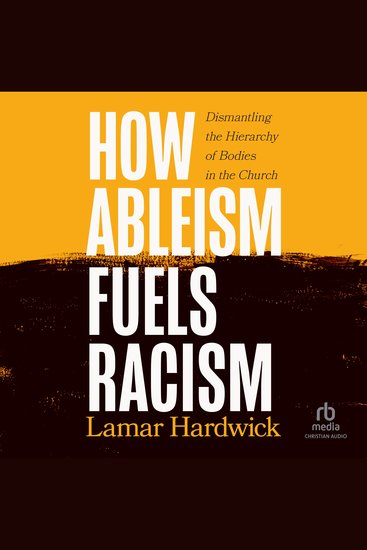
  • How Ableism Fuels Racism - Dismantling the Hierarchy of Bodies in the Church - cover

    How Ableism Fuels Racism -...

    Lamar Hardwick

    • 0
    • 0
    • 0
    Publishers Weekly starred review 


    "Marshaling fine-grained historical detail and scrupulous analysis, Hardwick persuades." —Publishers Weekly (starred review) 


    As a Black autistic pastor and disability scholar, Lamar Hardwick lives at the intersection of disability, race, and religion. Tied to this reality, he heeded the call to write How Ableism Fuels Racism to help Christian communities engage in critical conversations about race by addressing issues of ableism. 


    Hardwick believes that ableism—the idea that certain bodies are better than others—and the disability discrimination fueled by this perspective are the root causes of racial bias and injustice in American culture and in the church. Here, he uses historical records, biblical interpretation, and disability studies to examine how ableism in America led to the creation of images, idols, and institutions that perpetuate both disability and racial discrimination. 


    He then goes a step further, calling the church into action to address the deep-seated issues of ableism that started it all and offering practical steps to help listeners dismantle ableism and racism both in attitude and practice.
    Voir livre
  • Evolution Is Wrong - A Radical Approach to the Origin and Transformation of Life - cover

    Evolution Is Wrong - A Radical...

    Erich von Däniken

    • 1
    • 1
    • 0
    A Fascinating Exploration on Why the Darwinists’ Theory No Longer Explains Everything 
    There was once a set of ideas called the theory of evolution, conceived by clever people and confirmed by countless scientists. Then people discovered the electron microscope. This made it possible to make the molecules within the cell visible, and suddenly questions about evolution arose that were not possible before. Which force actually bundles the atoms in the right order? What moves the molecular chains into the correct position? How did the first living unit within the cell actually come about? How does inheritance work, how does information pass on to the next generation? Did humans descend only and exclusively from primates—as Charles Darwin and countless other great minds assumed—or did additional “engines” intervene in evolution?  
    Today it is clear: countless questions can no longer be answered with the previous theory of evolution. There is a form of life called “Blob” (Physarum polycephalum). The “thing” has neither eyes nor ears, neither a mouth nor a nose or even a brain. Nevertheless, it takes in food, overcomes obstacles by the shortest route and exchanges information with other “blobs.” The “blob” contradicts any evolutionary thought that one develops from the other. Or the “gastric-brooding frogs” (Rheobatrachus) found in Australia. They hatch their young in the stomach. Impossible in a slow, evolutionary process.  
    Everywhere there are characteristics of animals that do not want to fit into the theory of evolution anywhere. And man? Are we really the most adapted life-form on this planet? Today, more and more scientists who contradict the previous theory of evolution speak out. The theory fits the changes within the species, but it can no longer be reconciled with the inner workings of the cell. Some other influence that has so far escaped us is affecting evolution. It is called “Intelligent Design.” Intelligent planning is suspected behind this. Anyone or anything—a spirit of the universe? Aliens?—could be behind this planning.  
    Erich von Däniken uses countless examples to demonstrate the impossibility of the previous evolutionary idea. He quotes scientists who argue against the previous teaching, but also those who defend it. Unfortunately, established science still refuses to look at discrepancies and holes in the theory of evolution, even though it is quite obvious that there is more going on with regard to the development of all species, as well as human culture, than could be explained by the theory of evolution alone.
    Voir livre