Join us on a literary world trip!
Add this book to bookshelf
Grey
Write a new comment Default profile 50px
Grey
Subscribe to read the full book or read the first pages for free!
All characters reduced
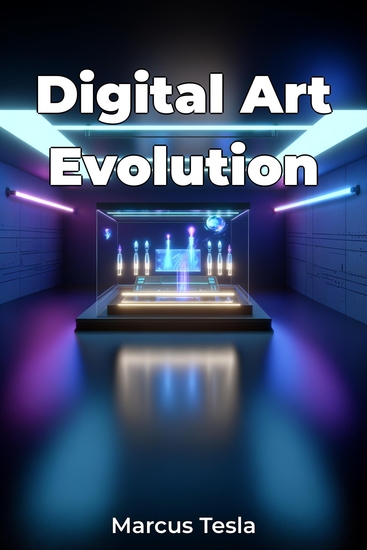
Digital Art Evolution - cover

Digital Art Evolution

Marcus Tesla

Publisher: Publifye

  • 0
  • 0
  • 0

Summary

"Digital Art Evolution" presents a comprehensive exploration of how technology has revolutionized artistic creation from the mid-20th century to today's digital age. The book masterfully weaves together three critical narratives: the shift from analog to digital tools, the birth of new artistic mediums through technological advancement, and artificial intelligence's growing influence on creative practices.

 
Through carefully documented case studies and interviews with over 50 artists and technologists, the book illuminates how digital tools have not just changed the way art is made but have fundamentally transformed our understanding of creativity and authorship. The journey begins with the earliest computer-generated artworks of the 1960s, providing crucial context for understanding both artistic movements and technological milestones.

 
The narrative progresses through three main sections, examining the transition to digital tools, exploring born-digital art forms like virtual reality and interactive installations, and investigating emerging technologies such as machine learning and blockchain in art. This structure allows readers to grasp how each technological advancement has shaped artistic possibilities and challenged traditional creative paradigms.

 
What sets this book apart is its balanced approach to examining both opportunities and challenges in digital art creation, making complex technical concepts accessible while maintaining scholarly depth. Whether discussing generative art, virtual reality, or AI-created artwork, the book serves as both a historical record and a forward-looking analysis of artistic innovation. For artists, technology professionals, and educators, it offers valuable insights into the intersection of creative expression and technological advancement, while providing practical applications for readers to explore in their own creative endeavors.
Available since: 01/05/2025.
Print length: 105 pages.

Other books that might interest you

  • Beethoven Symphony No 6 with Thunderstorms - cover

    Beethoven Symphony No 6 with...

    Ludwig van Beethoven

    • 0
    • 0
    • 0
    Listen to Beethoven Symphony No. 6 as thunderstorms surround the performance. 
     
    The Symphony No. 6 in F major, Op. 68, also known as the Pastoral Symphony, is a symphony composed by Ludwig van Beethoven, and completed in 1808. One of Beethoven's few works containing explicitly programmatic content, the symphony was first performed in the Theater an der Wien on 22 December 1808 in a four-hour concert.
    Show book
  • The Beatles' Let It Be - cover

    The Beatles' Let It Be

    STEVE MATTEO

    • 0
    • 0
    • 0
    The recording sessions for Let It Be actually began as rehearsals for a  proposed return to live stage work for the Beatles, to be inaugurated  in a concert at a Roman amphitheater in Tunisia. In this thoroughly  researched book, Steve Matteo delves deep into the complex history of  these sessions. He talks to a number of people who were in the studio  with the Beatles, recording the sights and sounds of the band at work  bringing to life a period in the Beatles’ career that was creative and  chaotic in equal measure.
    Show book
  • Post-Modern Buildings in Britain - cover

    Post-Modern Buildings in Britain

    Elain Harwood, Geraint Franklin

    • 0
    • 0
    • 0
    An illuminating look at a controversial architectural style – and its finest examples
    Post-modernism was the 1980s' counter to Brutalism but fell out of fashion until its best buildings began to disappear. Now is the time to reassess its values. Historians Geraint Franklin and Elain Harwood discuss its background and key architects before celebrating Britain's finest examples. Individual entries are beautifully illustrated, many with new photography, including the SIS Building made famous by James Bond, John Outram's awe-inspiring pumping station in London's Docklands and Judge Institute in Cambridge, and the late works of James Stirling and Michael Wilford, including No.1 Poultry – an extraordinary corner of the City that in 2016 became England's youngest listed building.
    Show book
  • MINSTREL BOY: Picasso of Song Part 2 - cover

    MINSTREL BOY: Picasso of Song...

    Chris Gregory

    • 0
    • 0
    • 0
    MINSTREL BOY: Picasso of Song Part 2 
    This book is about is one of the major cultural figures of the modern age, combining a reverence for the traditions of many forms of American music with a distinctly postmodern sensibility. It is no exaggeration to state that he has revolutionised the art of poetic songwriting. He is a recipient of the Nobel Prize for Literature, the Pulitzer Prize and numerous other awards, as well as being arguably the most influential single artist in the history of rock music.  
    This book is the second volume of Chris Gregory’s Picasso of Song, a highly comprehensive ‘trilogy in reverse’ which takes ‘deep dives’ into all of the songs, while exploring the many ways in which he has used live performance to expand and deepen the effects of his art. Following on from the acclaimed Determined to Stand which covered his later years, Minstrel Boy focuses on the many artistic and personal metamorphoses he went through between 1967 and 1990 - what might be called his ‘years of struggle’. Dylan could easily have rested on the laurels of his early fame but he refused to be categorised or ‘boxed in’ by the intense personal pressures that were placed on him. Instead, he continued his restless quest to find new ways to present his songs to fans and followers, knowing that they would hang onto every word he said or sang.
    Show book
  • Evolution of a Baby Boomer - Life Beyond Sex Drugs & Rock 'n' Roll - cover

    Evolution of a Baby Boomer -...

    Joyce Fidler

    • 0
    • 0
    • 0
    "Joyce Fidler's life is one of many twists and turns and highs and lows. Sometimes she'll shock you; other times she'll bring you to tears. If you have an alcohol or drug addiction problem, her book will uplift you and encourage you to make important changes in your life. It's not a preachy book; instead, it's very honest and forthright." Terry Hassman-Paulin, Editor at Silver Burdett Ginn (ret.) 
    "A memoir of a frenzied woman" Frank Dungan, TV Producer/Emmy Winning Writer 
    "Joyce Fidler tells a mind-blowing story. Being a musician myself who tripped through that era I knew from the first that this was real, but Fidler's unique POV made it a brand-new experience. I didn't think that I could be shocked, but particular parts of her story left me wide-eyed. The spiritual message left me teary-eyed." Gene Herd, Executive Director of the Hollywood Radio and Television Society (ret.)
    Show book
  • Blazing Saddles Meets Young Frankenstein - The 50th Anniversary of the Year of Mel Brooks - cover

    Blazing Saddles Meets Young...

    Bruce G. Hallenbeck

    • 0
    • 0
    • 0
    1974 was a busy year for Mel Brooks. Although still recovering after a series of failed projects threatened his career, he pulled off a one-two punch that saw the release of two of the most beloved American comedies ever made: Blazing Saddles and Young Frankenstein. Although both films are well-known, the stories beyond the making of each movie are less so. How did they come to be, and how did the era's culture and politics not only permit them to be made, but help them to become enduring comedy classics? 


    With their riotous parodies of Westerns and classic horror movies, Blazing Saddles and Young Frankenstein were not only hilarious. They played with charged social and cultural themes in an inimitable way, raising the bar for modern comedies even as they reshaped the two genres they were sending up. Blazing Saddles Meets Young Frankenstein: The 50th Anniversary of the Year of Mel Brooks explores in depth the zeitgeist and cinematic alchemy that led to 1974 becoming "the year of Mel Brooks."
    Show book