Join us on a literary world trip!
Add this book to bookshelf
Grey
Write a new comment Default profile 50px
Grey
Subscribe to read the full book or read the first pages for free!
All characters reduced
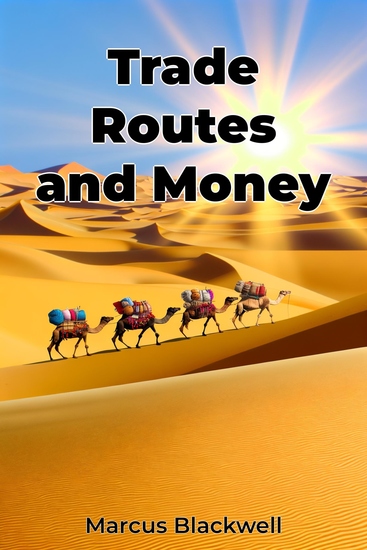
Trade Routes and Money - cover

Trade Routes and Money

Marcus Blackwell

Translator A AI

Publisher: Publifye

  • 0
  • 0
  • 0

Summary

Trade Routes and Money explores the profound connection between international commerce and the evolution of currency, particularly focusing on pre-industrial economies. It argues that historic trade routes, like the Silk Road and Spice Routes, were not just conduits for goods but also vital incubators for financial innovation and economic development. These routes spurred the creation of sophisticated currency exchange methods and banking systems, fundamentally reshaping societies and economies. For instance, the book highlights how the Silk Road influenced the development of paper money in China, showcasing the transformative power of trade on monetary systems. The book uniquely adopts a comparative approach, examining various trade routes across different eras and regions to identify common patterns and unique characteristics in the relationship between trade and monetary systems.

 
Structured in three parts, it first establishes the theoretical groundwork, then delves into detailed case studies of major historical trade routes like the Trans-Saharan trade network and its impact on gold-based currencies in West Africa. Finally, it synthesizes findings to draw broader conclusions about the lasting impact of trade routes on money and its implications for contemporary economic policy, offering readers a valuable perspective on the origins of our global economy.
Available since: 02/12/2025.
Print length: 69 pages.


Other books that might interest you

  • Daily Life in Ancient Egypt - Society Culture and Customs - cover

    Daily Life in Ancient Egypt -...

    Omar Khalil

    • 0
    • 0
    • 0
    Ancient Egyptian society was highly structured, with a rigid hierarchy that defined people’s roles and responsibilities. At the top of this social order was the pharaoh, considered both a political ruler and a divine figure. Below the pharaoh were the nobility and officials who managed the kingdom’s affairs. The middle class consisted of scribes, artisans, and merchants, while the majority of the population comprised farmers, laborers, and slaves. Each social group played a crucial role in maintaining Egypt’s stability and prosperity. 
    The pharaoh was the central authority in Egypt, believed to be the living embodiment of a god. His rule was absolute, and his primary duty was to maintain ma’at, the divine balance of order and justice. He oversaw military campaigns, religious ceremonies, and massive building projects, including temples and pyramids. The royal court and government officials assisted the pharaoh in administration. These officials, often chosen from the nobility, held positions such as viziers, tax collectors, and governors, ensuring the kingdom functioned efficiently. 
    Scribes, artisans, and merchants formed the middle class, contributing to Egypt’s economy and culture. Scribes were essential for maintaining records, writing official documents, and preserving religious texts. Their education was rigorous, requiring years of training in hieroglyphic writing. Artisans, including sculptors, painters, and metalworkers, created the intricate decorations found in tombs and temples. Merchants facilitated trade both within Egypt and with foreign lands, bringing valuable goods such as gold, spices, and precious stones. Although they did not hold political power, the middle class enjoyed a stable livelihood and social respect.
    Show book
  • Extinguished - A Fire Chief's Memoir - cover

    Extinguished - A Fire Chief's...

    Steve Serbic, Lori Yohannes

    • 0
    • 0
    • 0
    What do you do when you lose more than you can afford, when the stable bridge you’ve been crossing suddenly gives way and you find yourself plummeting into a chasm of fear and self-doubt? 
    After losing a dear friend and fellow firefighter to suicide, Steve is left shaken and leaves the fire service forever – or so he thinks. While trying to decide what his future holds, Steve takes us through his past. From Firefighter to Assistant Chief, a winning lottery ticket to a twist of fate, a series of strange health problems and devastating injury, Steve pulls us along the dizzying journey with him. And just when we think it can’t possibly get any worse for him, he leads us to the edge. And then the healing begins. 
    Although a sequel to his first book, The Unbroken, Extinguished is a story of its own, stranger than fiction, and another incredible example of Steve’s willingness to lay everything on the line to help anyone suffering from mental illness. At the same time, this isn’t a book just for them, or just for first responders. It is powerfully human and will resonate with everyone who reads it.
    Show book
  • The Privateers - How Billionaires Created a Culture War and Sold School Vouchers - cover

    The Privateers - How...

    Josh Cowen

    • 0
    • 0
    • 0
    A deep-dive investigation of education privatization that reveals voucher programs as the faulty products of decades of work by wealthy patrons and influential conservatives 


    This thought-provoking work traces the origins of voucher-based education reform to mid-twentieth-century fears over school desegregation. It shows how, in the intervening decades, a cabal of billionaire conservatives supporting a host of special political interests—including economic libertarianism, religious choice, and parental rights—have converged around the issue of education freedom in an ongoing culture war. Through deliberate policymaking, legislation, and litigation, Cowen reveals, an insular advocacy network has enacted a flawed system for education finance driven largely by dogma. 


    Far from realizing the purported goal of educational equity, privatization is failing students and exacerbating income inequality, Cowen finds. He cites multiple research studies that conclude that voucher programs return poorer academic outcomes, including lower test scores on state exams, especially among students who are at greater academic risk because of their race, their religion, their gender identity, or their family's income. Continued advancement of these policies, Cowen argues, is an assault on public education as a defining American institution.
    Show book
  • Ruined by the Snowboarder (Gay Head Shaving Erotica) - cover

    Ruined by the Snowboarder (Gay...

    Archer Vale

    • 0
    • 0
    • 0
    To uncover your true self, you need to strip away your beauty. You need to become vulnerable. 
    I sat motionless while the clippers buzzed. My hair fell to the ground, carrying away my sense of pride. 
    He’s my rival. I shouldn’t trust him. 
    But it’s too late now. 
    Bald, sweaty, and naked, I kneel at his feet. He snaps photos. He posts them online. 
    I’m so grateful for this lesson. I’m ready to accept his exquisite gift. 
    --- 
    CONTAINS EXPLICIT GAY SEXUAL CONTENT. 
    For exclusive stories, visit www.ArcherVale.com.
    Show book
  • Zadig - cover

    Zadig

    Voltaire

    • 0
    • 0
    • 0
    Voltaire's 'Zadig' is a philosophical tale of a young Babylonian navigating a tumultuous life. Zadig's journey unfolds through love, betrayal, and unforeseen events, offering insightful reflections on fate and human resilience. Voltaire's wit and irony illuminate the narrative, questioning conventional wisdom and moral ambiguity. 'Zadig' stands as a timeless exploration of life's uncertainties and the pursuit of wisdom in the face of adversity. Read in English, unabridged.
    Show book
  • 200 Ways to Raise a Girl's Self-Esteem - A Self-Worth Book for Teaching Guiding and Parenting Daughters - cover

    200 Ways to Raise a Girl's...

    Will Glennon

    • 0
    • 0
    • 0
    An Empowering Book for Parenting Daughters with Self Worth“200 short reflections on topics ranging from how parents can become good role models to talking about emotions.” —Publisher’s WeeklyAs kids, girls often advance faster than boys, but fall behind by the time they are teens, victims of low self esteem and confusing standards of womanhood. 200 Ways to Raise a Girl's Self-Esteem is a guide to raising teenage daughters with straightforward advice for people working with preteen girls who want to help girls build positive self-images and develop full lives.Be an example for your daughter. Raising healthy girls becomes easy as you advise and create rituals that are empowering young girls in their transition to adulthood with 200 Ways to Raise a Girl's Self-Esteem. Prevent anxiety and depression as you raise happy and confident teenage daughters.Affirming advice to empower your teenage daughters. Author of million-selling Random Acts of Kindness, Will Glennon, guides you through parenting daughters —like empowering girls through carefully considered "boosters,” and learning the subtle differences that can make them “busters”. For example, complimenting a woman’s appearance implies her value is in her looks, but complimenting her on a completed assignment helps her trust her intelligence. Find ways to impart a strong sense of self-worth as you go about parenting daughters, turning strong girls into strong women.Inside, find tips on uplifting teenage daughters, like:How to boost your girl’s self esteemHow to lead your daughter into womanhoodHow to be a good example when raising teenage daughtersIf you liked books for parenting daughters like Love Her Well, Thrivers, or Parenting the New Teen in the Age of Anxiety, you’ll love 200 Ways to Raise a Girl's Self-Esteem.
    Show book