Join us on a literary world trip!
Add this book to bookshelf
Grey
Write a new comment Default profile 50px
Grey
Subscribe to read the full book or read the first pages for free!
All characters reduced
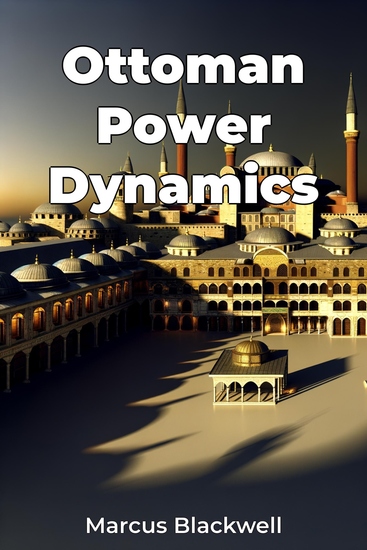
Ottoman Power Dynamics - cover

Ottoman Power Dynamics

Marcus Blackwell

Translator A AI

Publisher: Publifye

  • 0
  • 0
  • 0

Summary

"Ottoman Power Dynamics" masterfully traces the extraordinary transformation of the Ottoman Empire from a small Anatolian principality into one of history's most enduring powers, focusing on the sophisticated administrative systems that enabled its remarkable six-century reign.

 
The book illuminates how innovative governance structures, particularly under Sultan Mehmed II and Suleiman the Magnificent, created a resilient framework for ruling vast territories and diverse populations across three continents. At the heart of the narrative are three crucial elements that defined Ottoman success: the evolution of central authority, the development of sophisticated bureaucratic systems, and the integration of diverse populations through flexible administrative practices.

 
The book provides fascinating insights into unique Ottoman institutions, such as the devshirme system, which recruited talented Christian youth into state service, and the timar system of land management that supported their military structure. These administrative innovations demonstrate the empire's remarkable ability to balance central control with regional autonomy.

 
Drawing from extensive Ottoman archival sources, court documents, and contemporary accounts, the work presents a comprehensive analysis of how the empire maintained its power through a combination of military might and administrative adaptability. While the narrative spans from the empire's formation in 1299 to its golden age in the 16th century, it particularly emphasizes the revolutionary reforms following the conquest of Constantinople in 1453, showing how Ottoman governance systems influenced future state-building efforts and continue to offer relevant insights for understanding modern governmental organizations.
Available since: 01/30/2025.
Print length: 103 pages.
Other books that might interest you

  • Circassians The: The Turbulent History of the Ethnic Group in the North Caucasus - cover

    Circassians The: The Turbulent...

    Editors Charles River

    • 0
    • 0
    • 0
     Circassia could be broadly split into a western and eastern region. Eastern Circassia was inhabited by Kabardians who mainly spoke Kabardian while Western Circassia was made up of Adyghe, who spoke the eponymously-named Adyghe. As a result, discussions about the Circassians tend to split the geography of Circassia into two portions: Eastern Circassia, or Kabardia, and Western Circassia, or Adyghe. Geographically, Kabardia was situated in the middle segment of the Caucasian peninsula, with steppes to the north, and higher mountains to the south. The two key rivers in the Circassia region are the Kuban River, originating near Mount Elbrus in the Caucasus Mountains and flowing from south to north into the Sea of Azov, and the Terek River, originating in the Mtskheta-Mtianeti region of Georgia and flowing from west to east into the Caspian Sea. The Sunzha is another of the major rivers that dissects the region and acts as a tributary of the Terek. These waterways would provide strategic points in the long Russo-Circassian wars. The Caucasus region itself contains a repository of raw materials important in history (and today), including petroleum, natural gas, copper, manganese and tungsten. It also has fertile soil capable of growing wheat, barley, corn, sunflower, and many fruits and vegetables. It is unsurprising, therefore, that outsiders have coveted the region. 
    	 The Circassian people were never united as a single political bloc, which provided a core problem for their survival as larger powers, outsiders and invaders were able to exploit differences. They were invaded on many occasions during their history in the pre-modern period, including by the Mongols and the Khazars.
    Show book
  • The Analects of Confucius - cover

    The Analects of Confucius

    Confucius

    • 0
    • 0
    • 0
    The Analects are a fascinating anthology of the words and ideas of Confucius, gathered by his loyal disciples. They espouse a moral code by which each one of us should live based on ideals of responsibility, respect, kindness, and honesty - qualities as relevant and sought-after today as they were 2,500 years ago. His principles continue to shape Eastern philosophy, politics, and culture.
    Show book
  • Advanced English Conversations (2); Speak English Like a Native - More than 1000 common phrases and idioms presented through day-to-day handy dialogues - cover

    Advanced English Conversations...

    Robert Allans

    • 0
    • 0
    • 0
    You may have asked yourself whether there is some effective method that can make you speak English fluently, efficiently and with confidence. 
    Well, there is such a method! 
    Advanced English Conversations will first and foremost help you gain mastery and command of those tricky idioms and phrases that are so common in English. In this book you are going to be acquainted with 90 active dialogues that present the language functionally. In other words, you are going to learn exactly where and how to use the phrases effortlessly and with ease. All you need to do is to do the exercises below the dialogues and subsequently create similar dialogues on your own. This will integrate the phrases in your head in the form of a network. As a result, you are expected to master all the idioms and the phrases practically. Advanced English Conversations is designed to make a difference in the field of acquiring English as a Second Language. READ & SUCCEED
    Show book
  • History Of Egypt Chaldea Syria Babylonia and Assyria Vol 1 - cover

    History Of Egypt Chaldea Syria...

    Gaston Maspero

    • 0
    • 0
    • 0
    History Of Egypt, Chaldæa, Syria, Babylonia, and Assyria is the masterwork of one of the fathers of modern egyptology. This work, in twelve volumes, was translated from the French original, “Histoire ancienne des peuples de l'Orient classique” and published in 1903-1904. Maspero was a largely self-taught master of hieroglyphic translation. In November 1880, he was placed at the head of a French archeological mission, which developed later into the Institut Français d’Archéologie Orientale. Maspero then succeeded Mariette as director-general of excavations and of the antiquities of Egypt. 
     
    “Aware that his reputation was then more as a linguist than an archaeologist, Maspero's first work in the post was to build on Mariette's achievements at Saqqara. He expanded their scope from the early Old Kingdom to the later, with particular interest in tombs with long and complete hieroglyphic inscriptions that could help illustrate the development of the Egyptian language. Selecting five later Old Kingdom tombs, he was successful in that aim, finding over 4000 lines of hieroglyphics which were then sketched and photographed. 
     
    “As an aspect of his attempt to curtail the rampant illegal export of Egyptian antiquities by tourists, collectors and agents for the major European and American museums, Maspero arrested the Abd al-Russul brothers from the notorious treasure-hunting village of Gorna, who confessed under torture to having found the great cache of royal mummies at Deir el-Bahri in July 1881. The cache was moved to Cairo as soon as possible to keep it safe from robbers. 
     
    “In 1886 he resumed work begun by Mariette to uncover the Sphinx, removing more than 65 feet of sand and seeking tombs below it (which he did not find, but have later been found but not opened).” (Wikipedia).Maspero went on to sponsor and expand the system of national museums and presided over the growing collection of the Bulak Museum. Maspero gave a 17 year old Howard Carter his first Egyptological job – and it was he who recommended Carter to Lord Carnarvon. Carter and Carnarvon would go on to doscover the tomb of King Tutankhaman.In the first volume of this master work, Maspero tackles the importance of the Nile, the pantheon of Egyptian Gods, and the legendary history of Egyptian Gods. (Summary from Wikipedia)
    Show book
  • The Sayings of Marcus - cover

    The Sayings of Marcus

    Marcus Aurelius

    • 0
    • 0
    • 0
    To read The Sayings of Marcus is to walk beside an emperor who governed not through cruelty or conquest, but by reason, restraint, and virtue. This collection presents rare, firsthand glimpses of Marcus Aurelius not as a distant symbol of power, but as a human being navigating the immense burden of imperial responsibility with unwavering Stoic discipline.
    Here is Marcus confronting betrayal with mercy, rejecting revenge in the arena, and speaking candidly of philosophy, war, death, and duty. His words, at once spare and profound, offer a timeless testament to character under pressure.
    For admirers of Meditations, this companion text reveals the man in public life—deciding, judging, and leading. For newcomers to Stoicism or Roman history, it is an unforgettable introduction to one of history's most introspective rulers
    Show book
  • The Postmodern Predicament - Existential Challenges of the Twenty-First Century - cover

    The Postmodern Predicament -...

    Bruce Ackerman

    • 0
    • 0
    • 0
    Human beings have taken one thing for granted since our earliest days: we are bodily creatures dealing with one another on a face-to-face basis. The internet has shattered this fundamental feature of human existence. We are suddenly living our lives in two worlds at once—shifting endlessly from virtual to physical reality as we reach out to others. 


    Worse yet, we are developing different personal identities in our two worlds. We say and do things in virtual reality that flatly contradict our face-to-face commitments to family, friends, and fellow-workers—and vice versa. The Postmodern Predicament explores these dilemmas at each phase of the life cycle, beginning at the moment a young child picks up a cell phone. 


    The existentialist tradition of the twentieth century provides a precious perspective on our postmodern dilemmas. Thinkers and doers like Simone de Beauvoir and Jean-Paul Sartre considered the fragmentation of modern life as a central source of contemporary anxieties. Like them, Ackerman views the challenges of the internet age as a political, no less than personal, problem—and proposes concrete reforms that that could mobilize broad-based support for democracy against demagogic assaults on its very foundations.
    Show book