Join us on a literary world trip!
Add this book to bookshelf
Grey
Write a new comment Default profile 50px
Grey
Subscribe to read the full book or read the first pages for free!
All characters reduced
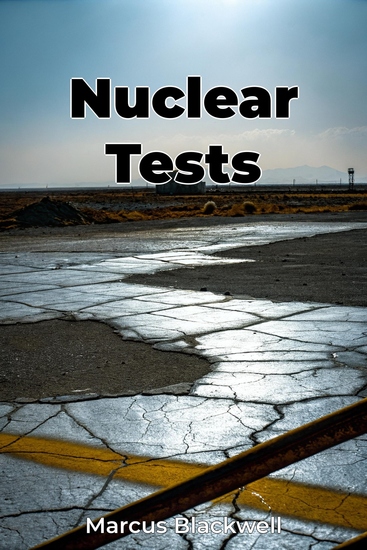
Nuclear Tests - cover

Nuclear Tests

Marcus Blackwell

Translator A AI

Publisher: Publifye

  • 0
  • 0
  • 0

Summary

Nuclear Tests explores the extensive history and far-reaching consequences of over two thousand nuclear detonations worldwide. It examines how these tests have profoundly impacted the environment, human health, and international relations, while also tracing the efforts to control nuclear proliferation. One intriguing aspect is how nuclear testing, initially seen as a display of scientific prowess, led to widespread radioactive contamination, affecting ecosystems and human populations for generations. The book highlights the Cold War's role in fueling the nuclear arms race, and the subsequent debates on nuclear disarmament and global security.

 
The book progresses by first laying the historical groundwork, detailing the scientific discoveries that initiated nuclear weapons development. It then delves into the atmospheric testing era, where numerous explosions exposed soldiers and civilians to radiation. It also explores the long-term environmental consequences, such as soil and water contamination, and the health impacts, including radiation-related diseases.

 
By combining historical analysis, scientific data, and personal accounts, Nuclear Tests provides a comprehensive and balanced perspective on this pivotal period in human history, making it a valuable resource for understanding the nuclear age.
Available since: 02/17/2025.
Print length: 73 pages.
Other books that might interest you

  • Philosophers of Individual Rights and Society - The Role of Rights Ethics and Political Thought in Human Society (3 in 1) - cover

    Philosophers of Individual...

    Hector Davidson

    • 0
    • 0
    • 0
    This book consists of the following three titles: 
    - Ayn Rand: Ayn Rand, born Alisa Zinov'yevna Rosenbaum in 1905 in St. Petersburg, Russia, had a formative early life that significantly influenced her later philosophical ideas. Growing up in a middle-class Jewish family, Rand experienced the upheavals of the Russian Revolution and the subsequent rise of Bolshevism. These events deeply affected her worldview and instilled in her a strong opposition to collectivism and authoritarianism. 
    - John Stuart Mill: John Stuart Mill, a British philosopher and political economist, remains one of the most influential thinkers of the 19th century. Born in 1806, Mill was exposed to rigorous intellectual training from an early age, particularly through his father, James Mill, a prominent utilitarian philosopher. This early exposure shaped Mill's understanding of the world, leading him to become a key figure in the development of utilitarianism, a moral theory that evaluates actions based on their ability to promote the greatest happiness for the greatest number of people. 
    - Mary Wollstonecraft: Mary Wollstonecraft was a pioneering British writer and philosopher whose ideas on women’s rights and education laid the foundation for modern feminism. Born on April 27, 1759, in Spitalfields, London, she grew up in a time when society severely restricted women's opportunities. Despite these limitations, Wollstonecraft’s determination, intellect, and relentless pursuit of knowledge allowed her to challenge the status quo and advocate for gender equality. Her life was shaped by personal struggles, societal constraints, and an unwavering belief in the power of education.
    Show book
  • Free Exercise - Religion the First Amendment and the Making of America - cover

    Free Exercise - Religion the...

    Chris Beneke

    • 0
    • 0
    • 0
    CONGRESS SHALL MAKE NO LAW RESPECTING AN ESTABLISHMENT OF RELIGION, OR PROHIBITING THE FREE EXERCISE THEREOF. Those words, scratched on parchment in 1789, open the US Constitution's First Amendment. From them, countless interpretations have been drawn. As a consequence, an astonishing variety of activities in modern America—prayer after football games, Bible reading in classrooms, company healthcare policies, the baking of wedding cakes, and Ten Commandment displays around courthouses—have been alternately authorized, prohibited, or modified. 


    In this compelling historical account, Chris Beneke explains how the religion clauses came into existence and how they were woven into American culture. He brings prominent early national figures to life, including George Washington, James Madison, and Thomas Paine, while chronicling the First Amendment's relationship to defining social conditions like slavery, civility, family life, and the free market. 


    Going beyond traditional church-state scholarship, Beneke also demonstrates how white women, African Americans, Roman Catholics, Jews, and nonbelievers widened religious liberty's application and illuminated its boundaries. In doing so he makes a groundbreaking contribution to both constitutional history and the history of American pluralism.
    Show book
  • Am I Alone Here? - Notes on Living to Read and Reading to Live - cover

    Am I Alone Here? - Notes on...

    Peter Orner

    • 0
    • 0
    • 0
    "Stories, both my own and those I've taken to heart, make up whoever it is that I've become," Peter Orner writes in this collection of essays about reading, writing, and living. Orner reads and writes everywhere he finds himself: a hospital cafeteria, a coffee shop in Albania, or a crowded bus in Haiti. The result is a book of unlearned meditations that stumbles into memoir. 


    Among the many writers Orner addresses are Isaac Babel and Zora Neale Hurston, both of whom told their truths and were silenced; Franz Kafka, who professed loneliness but craved connection; Robert Walser, who spent the last twenty-three years of his life in a Swiss insane asylum, working at being crazy; and Juan Rulfo, who practiced the difficult art of silence. Virginia Woolf, Eudora Welty, Yasunari Kawabata, Saul Bellow, Mavis Gallant, John Edgar Wideman, William Trevor, and Václav Havel make appearances, as well as the poet Herbert Morris—about whom almost nothing is known. 


    An elegy for an eccentric late father, and the end of a marriage, Am I Alone Here? is also a celebration of the possibility of renewal. At once personal and panoramic, this book will inspire listeners to return to the essential stories of their own lives.
    Show book
  • Free Speech and Turbulent Freedom - The Dangerous Allure of Censorship in the Digital Era - cover

    Free Speech and Turbulent...

    Michael J. Glennon

    • 0
    • 0
    • 0
    A vast censorship regime has smothered America's digital marketplace of ideas, squelching free speech on vital policy issues. Its supporters regard its benefits as morally and politically beyond question. They contend it's carried out by private social media platforms, not governmental authorities. 


    In Free Speech and Turbulent Freedom, Michael J. Glennon offers a timely and incisive response. The censors are short-sighted, he argues. Quibbling over outdated distinctions misses the real threat—which is the fusion of public and private power into a modern-day cartel able to overleap longstanding constitutional safeguards. American democracy, he argues, rests on a decentralized marketplace of ideas independent of the government. In crisp, trenchant terms, Glennon shows how concrete practical concerns justify protecting admittedly harmful online speech—even speech that advocates violence or embraces hatred or apparent falsehood. 


    To safely self-correct, democracy requires open channels of political communication. Glennon calls on the courts to unblock those channels—to measure such speech against enduring First Amendment precepts rather than pliable international norms—and to protect the speech interests not merely of the government and Big Tech, but of all participants in the marketplace of ideas.
    Show book
  • Our Lady of the World's Fair - Bringing Michelangelo's "Pieta" to Queens in 1964 - cover

    Our Lady of the World's Fair -...

    Ruth D. Nelson

    • 0
    • 0
    • 0
    Driven by different motives, Robert Moses and Francis Cardinal Spellman had the same vision: to display Michelangelo's masterpiece, the Pietà, in the Vatican's pavilion at the 1964 World's Fair in New York City. 


    As Ruth D. Nelson gracefully showcases, Moses believed this blockbuster would guarantee the fair's financial success. At the same time, Spellman, Archbishop of New York and the spiritual leader of Cold War America's Catholic community, hoped that at a time of domestic strife and global conflict, the Pietà's presence would have a positive spiritual impact on the nation. Although the fair did not turn out to be the financial bonanza that Moses expected, the Pietà drew record crowds of the faithful, art lovers, and the curious. 


    Nelson's fascinating uncovering of the intensive planning that went into designing the pavilion, transporting the art piece across the Atlantic, and coordinating Pope Paul VI's visit to New York in 1965—the first papal visit to the Western Hemisphere—demonstrates the sheer scale and opportunity of the two men's endeavors. Our Lady of the World's Fair depicts the skepticism and fierce criticism that faced the two New York power brokers. Rather than letting the negative weigh them down, they united and called on every resource at their disposal to make this unlikely cultural coup possible.
    Show book
  • Life in the UK Test Study Guide 2026 - Required Knowledge to Pass First Time + 150 Practice Questions! - cover

    Life in the UK Test Study Guide...

    Freddie Ixworth

    • 0
    • 0
    • 0
    Are you preparing for the Life in the UK test to obtain British citizenship? Look no further! 
    Our comprehensive and easy-to-follow guide is the ultimate resource to help you pass on your first attempt. 
    Key Features Included Inside: 
    Complete Coverage: This guide covers all the essential topics tested in the Life in the UK exam, including British history, government, customs, and traditions. Be well-prepared for every question! 
    Clear Explanations: We have broken down complex concepts into simple and easy-to-understand language, making learning a breeze. 
    Updated Content: Stay current with the latest information on British society, culture, and politics. Our guide reflects the most recent updates to the Life in the UK test for 2026. 
    Practice Questions: Sharpen your knowledge with a wide range of 150 practice questions. Reinforce your understanding of the material and track your progress. 
    Whether you're a recent immigrant or have been living in the UK for years, this audiobook is your passport to acing the citizenship test. Join thousands of successful candidates who have used this guide to pass with flying colors. 
    Start your journey toward British citizenship now - listen to the Life in the UK Test Study Guide 2026 and conquer the test with confidence!
    Show book