Join us on a literary world trip!
Add this book to bookshelf
Grey
Write a new comment Default profile 50px
Grey
Subscribe to read the full book or read the first pages for free!
All characters reduced
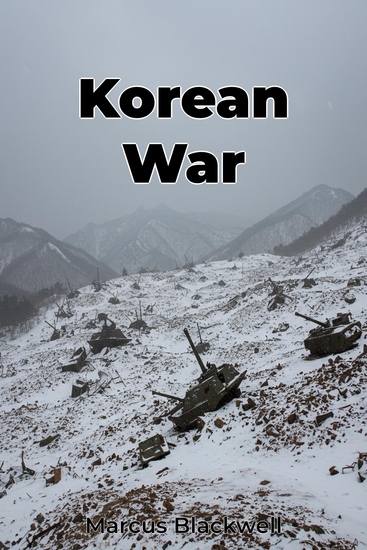
Korean War - cover

Korean War

Marcus Blackwell

Translator A AI

Publisher: Publifye

  • 0
  • 0
  • 0

Summary

Korean War offers a comprehensive exploration of a conflict often overshadowed, yet profoundly influential in shaping modern geopolitics. This book explains the war's origins in the context of Cold War tensions and the division of the Korean peninsula, highlighting the clash between communism and democracy. It provides insights into the major military campaigns, such as the Inchon landings and the subsequent Chinese intervention, which dramatically altered the war's trajectory. The book uniquely addresses the long-term consequences, examining the divergent paths of North and South Korea and the continuing security challenges in the region. The narrative progresses chronologically, beginning with pre-war conditions and culminating in an analysis of the armistice and its aftermath. Drawing on diverse sources, including declassified documents and personal accounts, the book adopts a balanced approach, presenting multiple perspectives and encouraging critical evaluation. By connecting military history with political science and economics, Korean War offers a multifaceted understanding of this pivotal event and its enduring legacy.
Available since: 02/17/2025.
Print length: 58 pages.
Other books that might interest you

  • War in the Smartphone Age - Conflict Connectivity and the Crises at Our Fingertips - cover

    War in the Smartphone Age -...

    Matthew Ford

    • 0
    • 0
    • 0
    Thanks to smartphones, war is everywhere, all the time. Anyone can view, analyze, and comment on photos, videos, or other warzone media. Where did this technology come from? And what does it mean for the future of war?This book explains why you see what you do on your phone, and how these devices shape our knowledge, conduct, and representation of war in the 2020s. It shows why smartphones are indispensable in peace and wartime: every device is a potential weapon, lines blur between war and daily life, and conflict becomes a shared digital experience. Social media platforms displace state-controlled narratives, amplifying violence and shaping war's legitimacy. Apps democratize conflict, enabling anyone to identify and attack perceived enemies. As the Ukraine war has shown, this new reality involves complex, unevenly distributed infrastructures, merging civilian communication with military targeting.With war accelerating beyond our comprehension, militaries have raced to benefit from and adapt to the smartphone age. Matthew Ford explores critical questions about today's hyper-connected battlefield.
    Show book
  • Overthinking? - cover

    Overthinking?

    Bryanscott Parker

    • 0
    • 0
    • 0
    We all overthink!   That’s who we are and that’s what we do. The brain process to think is always on.  And without notice or warning we begin to overthink. But is overthinking bad?  Can it be harmful?  Or, because we do it all the time is it possible that overthinking can be helpful?   This book is meant to be a guide and a resource to help you find relief from the daily stress, anxiety and needless worry you may encounter from overthinking.  If you believe that you think too much then it's essential that you understand how overthinking affects your day-to-day life.
    Show book
  • Tusculan Disputations - cover

    Tusculan Disputations

    Marcus Tullius Cicero

    • 0
    • 0
    • 0
    Tusculan Disputations (Latin: TUSCULANARUM DISPUTATIONUM) is divided into five books which discuss death, pain, grief, perturbations and virtue. At issue is whether wise people can always be happy regardless of the apparent evil that fortune throws in their way. Andrew Peabody says the A. and M. in the text may stand for Auditor, Adolescens, Atticus or Aulus and Marcus or Magister. Written by Marcus Tullius Cicero. Translated by Charles Duke Yonge. (Summary by Geoffrey Edwards)
    Show book
  • They Control The World - cover

    They Control The World

    Robert Teller

    • 0
    • 0
    • 0
    This audiobook is narrated by an AI Voice.  
    A gripping true story of an unwitting man's first-hand account into Power, Secrecy, and the Shadows Behind the Throne. 
    Who really holds the reins of power in our world? In They Control The World, the curtain is pulled back on the hidden networks, intelligence agencies, and global elite who shape our future from behind the scenes. Based on events about how the new physics of quantum entanglement was discovered, this powerful audiobook is a history book in the form of a novel. It exposes the silent forces that influence war, economics, democracy, and our forthcoming world of Artificial Intelligence as quantum entanglement begins to merge with it. 
    Spanning from post-WWII covert operations to the dawn of the 21st century, this deeply compelling work follows the journey of a spiritual seeker who inadvertently ends up entangled in the web of global manipulation. Through encounters with intelligence operatives, he uncovers the truths that challenge our understanding of freedom, morality, and who really calls the shots. 
    Whether you’re a seeker of truth, a lover of political intrigue, or someone simply questioning the official story, They Control The World is an essential listen that dares to ask: What if everything we thought we knew... was only part of the plan?
    Show book
  • The Unit - My Life Fighting Terrorists as One of America's Most Secret Military Operatives - cover

    The Unit - My Life Fighting...

    Adam Gamal, Kelly Kennedy

    • 0
    • 0
    • 0
    This program features an introduction narrated by the author. It has been modified to maintain the author's anonymity.The first and only audiobook by a member of America's most secret military unit―an explosive and unlikely story of immigration, service, and sacrifice.Inside our military is a team of operators whose work is so secretive that the name of the unit itself is classified. Highly-trained in warfare, self-defense, infiltration, and deep surveillance, "the Unit," as the Department of Defense has asked us to refer to it, has been responsible for preventing dozens of terrorist attacks in the Western world. Never before has a member of this unit shared their story — until now.From Adam Gamal, one of the only Muslim Arab Americans to serve inside “the Unit," comes an incisive firsthand account of our nation’s most secretive military group. When Adam arrived in the United States at the age of twenty, he spoke no English, and at 5’1” and 112 pounds, he was far from what you might expect of a soldier. But compelled into service by a debt he felt he owed to his new country, he rose through the ranks of the military to become one of its most elite and skilled operators.With humor and humility, Adam shares stories of life-threatening injuries, of the camaraderie and capabilities of his team, and of the incredible missions―but also of the growth he experienced as he learned to understand his own moderate faith.Enthralling and eye-opening, The Unit is at once a gripping account of the fight against terror, an urgent examination of the need for diversity, and an inside look at how America fights its battles abroad in the modern age of terrorism.A Macmillan Audio production from St. Martin’s Press.
    Show book
  • The Privateers - How Billionaires Created a Culture War and Sold School Vouchers - cover

    The Privateers - How...

    Josh Cowen

    • 0
    • 0
    • 0
    A deep-dive investigation of education privatization that reveals voucher programs as the faulty products of decades of work by wealthy patrons and influential conservatives 


    This thought-provoking work traces the origins of voucher-based education reform to mid-twentieth-century fears over school desegregation. It shows how, in the intervening decades, a cabal of billionaire conservatives supporting a host of special political interests—including economic libertarianism, religious choice, and parental rights—have converged around the issue of education freedom in an ongoing culture war. Through deliberate policymaking, legislation, and litigation, Cowen reveals, an insular advocacy network has enacted a flawed system for education finance driven largely by dogma. 


    Far from realizing the purported goal of educational equity, privatization is failing students and exacerbating income inequality, Cowen finds. He cites multiple research studies that conclude that voucher programs return poorer academic outcomes, including lower test scores on state exams, especially among students who are at greater academic risk because of their race, their religion, their gender identity, or their family's income. Continued advancement of these policies, Cowen argues, is an assault on public education as a defining American institution.
    Show book