Unisciti a noi in un viaggio nel mondo dei libri!
Aggiungi questo libro allo scaffale
Grey
Scrivi un nuovo commento Default profile 50px
Grey
Iscriviti per leggere l'intero libro o leggi le prime pagine gratuitamente!
All characters reduced
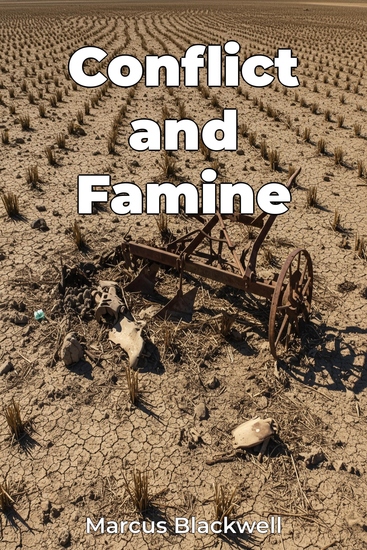
Conflict and Famine - cover

Conflict and Famine

Marcus Blackwell

Traduttore A AI

Casa editrice: Publifye

  • 0
  • 0
  • 0

Sinossi

"Conflict and Famine" explores the catastrophic relationship between war and hunger, revealing how armed conflict directly causes famine and food insecurity. It examines the ways conflict disrupts both agricultural production and food distribution, showing how these disruptions transform localized food shortages into widespread starvation. Understanding these dynamics is crucial for creating effective policies and humanitarian aid strategies to combat global hunger.

 
The book argues that conflict systematically undermines food systems, whether intentionally through strategies like scorched earth tactics or unintentionally through the breakdown of infrastructure. For example, the targeting of agricultural infrastructure can immediately reduce food availability and devastate long-term food security and economic stability.

 
Through case studies of Sudan, Syria, and Ethiopia, the book analyzes how warring parties target food production, manipulate food distribution, and create famine conditions. Beginning with a theoretical framework, the book progresses to detailed case studies and concludes with policy implications for preventing conflict-induced famine and improving humanitarian responses. It combines quantitative data on agricultural yields and malnutrition rates with qualitative data from interviews, bridging the gap between political science and agricultural studies to offer a unique perspective on this critical issue and its relevance to current events and world history.
Disponibile da: 17/02/2025.
Lunghezza di stampa: 67 pagine.

Altri libri che potrebbero interessarti

  • Surveillance - A Very Short Introduction - cover

    Surveillance - A Very Short...

    David Lyon

    • 0
    • 0
    • 0
    Surveillance permeates every aspect of our lives today. Every click on the keyboard, every call, text or email, every purchase, every contact with a doctor or the police or a government department, each time you walk under a video camera or pass through a security check, and in many other ways, you are recorded, identified, traced, and tracked. Who processes this free-flowing data, how, and with what consequences, is a critical question affecting everyone. 


    Surveillance is not inherently good or bad but neither is it neutral. It urgently needs to be understood better because people's lives and life-chances depend on it. Today surveillance is central to doing business, meeting friends, organizing governance, maintaining security, and being entertained. Surveillance requires not just exploration and understanding but ethical guidance and political debate. How you get credit or welfare benefits or get on a no-fly list or are ranked as a consumer depends on surveillance. This Very Short Introduction investigates how surveillance makes people visible, how it grew to its present size and prevalence, how it came to rely on technologies of data-handling, and how it developed its own cultural features. Throughout, David Lyon also considers the ethics of surveillance, and explores its potential in prompting political struggles.
    Mostra libro
  • Love Death + Explosives - Thomas Pynchon's Polipsychology - cover

    Love Death + Explosives - Thomas...

    Michael Finney

    • 0
    • 0
    • 0
    Love Death + Explosives: Thomas Pynchon’s Polipsychology is an essay that addresses the postmodern angle in the reclusive titular author’s writing, challenging readers to decontextualize the interpretive lens for the literal.
    Mostra libro
  • War Made Invisible - How America Hides the Human Toll of Its Military Machine - cover

    War Made Invisible - How America...

    Norman Solomon

    • 0
    • 0
    • 0
    More than twenty years ago, 9/11 and the war in Afghanistan set into motion a hugely consequential shift in America's foreign policy: a perpetual state of war that is almost entirely invisible to the American public. War Made Invisible, by the journalist and political analyst Norman Solomon, exposes how this happened, and what its consequences are, from military and civilian casualties to drained resources at home. 


    From Iraq through Afghanistan and Syria and on to little-known deployments in a range of countries around the globe, the United States has been at perpetual war for at least the past two decades. Yet many of these forays remain off the radar of average Americans. Compliant journalists add to the smokescreen by providing narrow coverage of military engagements and by repeating the military's talking points. Meanwhile, the increased use of high technology, air power, and remote drones has put distance between soldiers and the civilians who die. Back at home, Solomon argues, the cloak of invisibility masks massive Pentagon budgets that receive bipartisan approval even as policy makers struggle to fund the domestic agenda. 


    Necessary, timely, and unflinching, War Made Invisible is an eloquent moral call for counting the true costs of war.
    Mostra libro
  • Common Sense - cover

    Common Sense

    Thomas Paine

    • 0
    • 0
    • 0
    The explosive essay that sparked a revolution.
    
    When Common Sense hit the streets in 1776, it ignited the American colonies like never before. With bold, plain-spoken language, Thomas Paine challenged the authority of the British monarchy and made the urgent case for American independence. More than just a political argument, this short but powerful work gave everyday people the words to demand freedom—and the courage to fight for it.
    
    Radical, rebellious, and razor-sharp, Common Sense remains a landmark of political writing. Its message still resonates today: real change begins when ordinary people dare to speak truth to power.
    Mostra libro
  • We've Got to Try - How the Fight for Voting Rights Makes Everything Else Possible - cover

    We've Got to Try - How the Fight...

    Beto O'Rourke

    • 0
    • 0
    • 0
    This program is read by the author.“Uplifting. . . . O’Rourke gets an A-plus on both the moral frisson of the long fight and the rightness of the cause. . . . The happy warrior from Texas is inspiring.” --The Washington PostActivist and political leader Beto O’Rourke blends history, sociology, and travelogue for a thrilling, inspiring case for how voting rights is essential to a productive and healthy democracy.In We’ve Got To Try, O’Rourke shines a spotlight on the heroic life and work of Dr. Lawrence Aaron Nixon and the west Texas town where he made his stand. The son of an enslaved man, Nixon grew up in the Confederate stronghold of Marshall, Texas before moving to El Paso, becoming a civil rights leader, and helping to win one of the most significant civil and voting rights victories in American history: the defeat of the all-white primary. His fight for the ballot spanned 20 years and twice took him to the U.S. Supreme Court.With heart, eloquence, and powerful storytelling, O’Rourke weaves together Nixon’s story with those of other great Texans who changed the course of voting rights and improved America’s democracy. While connecting voting rights and democracy to the major issues of our time, O’Rourke also shares what he saw, heard, and learned while on his own journey throughout the 254 counties of his home state. By telling the stories of those he met along the way and bringing us into the epicenter of the current fight against voter suppression, the former El Paso Congressman shows just how essential it is that the sacred right to vote is protected and that we each do our part to save our democracy for generations to come.  A Macmillan Audio production from Flatiron Books.
    Mostra libro
  • God and Government - Breaking the Myth of Separation and the Deepening Evangelical Division in American Politics - cover

    God and Government - Breaking...

    Joshua M Ngoma

    • 0
    • 0
    • 0
    The Evangelical Church in the United States and other parts of the world, in general, is in a crisis of identity and stuck at a pivotal crossroads of history, conflicted about its God-given role and direction.This paralysis has been exposed and magnified by a renewed and raging debate about the role and relevance of Christianity in the governance and destiny of nations.“God and Government” establishes the truth about our role as Christians in the public affairs of nation states. It resolves one of the Church’s last frontiers yet to be conquered by Biblical truth: the old age conflict of the separation of God’s Word from the civil governance of nations.It explains why Evangelical Christians, between the so-called Religious Right and the Religious Left, are deeply divided about the role of the Church in the national politics of the United States.God’s blueprint guides the affairs of nations and He is not silent on matters of good governance, righteousness, and justice. Only God has unlimited power- His government rests on the shoulders of His Son Jesus Christ who has, in turn, delegated authority to the individual, family, Church and the State. “God and Government” is the definite answer to the following questions, and much more.
    Mostra libro