Join us on a literary world trip!
Add this book to bookshelf
Grey
Write a new comment Default profile 50px
Grey
Subscribe to read the full book or read the first pages for free!
All characters reduced
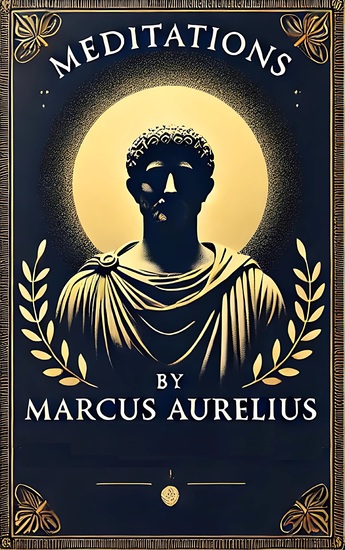
Meditations - Timeless Wisdom for Inner Peace and Purpose - cover

Meditations - Timeless Wisdom for Inner Peace and Purpose

Marcus Aurelius, Booktopia

Publisher: Booktopia

  • 0
  • 0
  • 0

Summary

Discover the timeless wisdom of Marcus Aurelius, the revered Roman Emperor and Stoic philosopher, in Meditations. This classic work is a profound guide to achieving inner peace, emotional resilience, and clarity amidst life's challenges.

Meditations by Marcus Aurelius is more than just a historical text—it's a practical manual for modern living. Whether you're navigating personal struggles, professional setbacks, or simply seeking greater self-awareness, this book offers actionable insights rooted in Stoic philosophy. Written as private reflections, Aurelius's thoughts reveal the principles of self-discipline, mindfulness, and enduring strength that continue to inspire readers around the world.

Perfect for those seeking personal growth, greater emotional control, or a deeper understanding of Stoicism, this ebook bridges the gap between ancient wisdom and modern needs. If you're a fan of philosophy, self-help classics, or books that challenge you to think deeply, this is the perfect addition to your library.

Unlock the secret to a more centered and purposeful life—download your copy of Meditations by Marcus Aurelius today and transform your perspective forever.

Start your journey toward greater peace and wisdom. Click "Buy Now" to download Meditations by Marcus Aurelius and experience the transformative power of Stoic philosophy today!
Available since: 12/16/2024.
Print length: 216 pages.
Other books that might interest you

  • Operation Greif: The History of the Infamous Waffen-SS Commando Operation during the Battle of the Bulge - cover

    Operation Greif: The History of...

    Editors Charles River

    • 0
    • 0
    • 0
    During the Battle of the Bulge, the Allies became understandably nervous, and Hitler hoped to capitalize on German momentum with a top-secret special operation that he named Operation Greif. This mission would utilize German soldiers, trained in sabotage techniques and disguised in American and British uniforms, and have them cross Allied lines to hold strategic targets for the German advance while destroying communication lines and ammunition depots. Most importantly, they would cause chaos and confusion by misdirecting the enemy, as Hitler explained in his orders: “I want you to command a group of American and British troops and get them across the Meuse and seize one of the bridges. Not, my dear Skorzeny, real Americans or British. I want you to create special units wearing American and British uniforms. They will travel in captured Allied tanks. Think of the confusion you could cause! I envisage a whole string of false orders which will upset communications and attack morale.” 
    	The Skorzeny he was addressing was none other than Otto Skorzeny, who had become famous by the late stages of the war because of his role in rescuing Benito Mussolini via the Gran Sasso raid. One thing that characterized Skorzeny was a continuing talent for self-aggrandizement and exaggeration of his role in events, which naturally worked on someone like Hitler. In the wake of the Gran Sasso raid, Hitler awarded Skorzeny the Knight’s Cross (one of the highest German awards for valor) and promoted him to Sturmbannführer (Major). Heinrich Himmler, who personally disliked and distrusted Skorzeny, seized the opportunity to raise the profile of the SS and to suggest that the success of the Gran Sasso raid was entirely due to the SS. As a result, it would be Skorzeny who led the Waffen-SS operation that Hitler envisioned for the Battle of the Bulge.
    Show book
  • The Ethics of Technology - Moral Challengers - cover

    The Ethics of Technology - Moral...

    Craig Dames

    • 0
    • 0
    • 0
    In an age where technology permeates nearly every aspect of our lives, understanding the ethical foundations behind its development and use has never been more critical. Tech ethics, at its core, explores the moral principles that guide our decisions regarding the design, implementation, and impact of technology. As digital tools become increasingly powerful and integrated into society, they bring with them profound questions about responsibility, fairness, and the human consequences of innovation. 
    The roots of technology ethics can be traced back to classical moral philosophy. Thinkers like Aristotle, Kant, and Mill laid the groundwork for how we approach right and wrong, justice, and duty. These age-old theories—virtue ethics, deontology, and utilitarianism—are still highly relevant in today's tech-driven world. For instance, when we ask whether a self-driving car should prioritize the life of a passenger over a pedestrian, we are invoking these very moral frameworks to guide the decision-making process. In this way, ethical theory provides a lens through which we can evaluate the choices we make as developers, users, and regulators of technology. 
    Modern concerns surrounding tech ethics often revolve around issues that were unimaginable even a few decades ago. Digital privacy, algorithmic bias, and autonomous systems challenge us to reinterpret traditional moral values in new contexts. This requires a dynamic understanding of ethics—one that can evolve alongside technological change. Unlike in the past, where tools were relatively neutral and required human operation, today's technologies often act with a degree of independence, raising the stakes of their ethical implications. Machines that learn, adapt, and decide are not just tools; they become agents of action whose behavior must be morally accountable.
    Show book
  • New Zealand Wars - Conflict and Change in the 19th Century - cover

    New Zealand Wars - Conflict and...

    Lillian Brooks

    • 0
    • 0
    • 0
    The New Zealand Wars, a series of armed conflicts in the 19th century, marked a defining period in the history of Aotearoa. These wars were fought primarily between the British colonial forces and various Māori iwi (tribes), though the conflicts were far from one-sided. They stemmed from a complex array of issues, including disputes over land, sovereignty, and the growing influence of European settlers on Māori society. The origins of these wars can be traced to the arrival of Europeans, whose presence in New Zealand brought with it not only trade but also significant cultural, political, and economic changes. 
    The initial encounters between Māori and European settlers were characterized by a mixture of curiosity, trade, and alliance-building. However, as more settlers arrived, pressure mounted on Māori land and resources. Tensions began to escalate as land was purchased, often under dubious circumstances, leading to Māori grievances over the loss of their ancestral territories. The New Zealand Company, a British settlement scheme, played a significant role in these land disputes, exacerbating tensions between Māori and the Crown. 
    In response to these threats, Māori began to organize and resist. Some iwi, such as the Waikato and Taranaki, developed strong resistance movements in defense of their land and way of life. The British, in turn, sought to assert their authority over the increasingly restless Māori population, leading to the outbreak of hostilities.
    Show book
  • The Newspaper Axis - Six Press Barons Who Enabled Hitler - cover

    The Newspaper Axis - Six Press...

    Kathryn S. Olmsted

    • 0
    • 0
    • 0
    How six conservative media moguls hindered America and Britain from entering World War II 
    How six conservative media moguls hindered America and Britain from entering World War II 


    “A landmark in the political history of journalism.”—Michael Kazin, author of What It Took to Win: A History of the Democratic Party 


    As World War II approached, the six most powerful media moguls in America and Britain tried to pressure their countries to ignore the fascist threat. The media empires of Robert McCormick, Joseph and Eleanor Patterson, and William Randolph Hearst spanned the United States, reaching tens of millions of Americans in print and over the airwaves with their isolationist views. Meanwhile in England, Lord Rothermere’s Daily Mail extolled Hitler’s leadership and Lord Beaverbrook’s Daily Express insisted that Britain had no interest in defending Hitler’s victims on the continent. 


    Kathryn S. Olmsted shows how these media titans worked in concert—including sharing editorial pieces and coordinating their responses to events—to influence public opinion in a right-wing populist direction, how they echoed fascist and anti‑Semitic propaganda, and how they weakened and delayed both Britain’s and America’s response to Nazi aggression.
    Show book
  • 1939: The History of the Year the World Fell Apart - cover

    1939: The History of the Year...

    Editors Charles River

    • 0
    • 0
    • 0
    Munich is widely reviled today and is held up as the epitome of appeasement, but historians still debate its effects on the Second World War, as well as Neville Chamberlain's character and motivations. Some believe the attempted appeasement of Nazi Germany hastened, or even caused, the mayhem occupying the next seven years. Others believe that the pact merely failed to alter war's inevitable arrival in either direction. Historians and authors alternately interpret Chamberlain as a bumbling, arrogant fool, a strong-willed statesman who simply miscalculated the nature of Hitler and Nazi Germany, or even a man with dictatorial ambitions surreptitiously inserting himself into the Fuhrer's orbit and prevented from further damaging democracy only by his fall and death from bowel cancer. Another possible interpretation, with considerable documentary support, asserts Chamberlain wished to enlist Germany's aid against the state most Europeans perceived as the true threat of the era, the Soviet Union. 
    Europe’s attempts to appease him, most notably at Munich in 1938, failed, as Nazi Germany swallowed up Austria and Czechoslovakia by 1939. Italy was on the march as well, invading Albania in April of 1939. The straw that broke the camel's back, however, was Germany's invasion of Poland on September 1 of that year. Two days later, France and Great Britain declared war on Germany, and World War II had begun in earnest. Of course, as most people now know, the invasion of Poland was merely the preface to the Nazi blitzkrieg of most of Western Europe, which would include Denmark, Belgium, and France by the summer of 1940.
    Show book
  • Limits of Liberty The: Book Summary & Analysis - cover

    Limits of Liberty The: Book...

    Briefly Summaries

    • 0
    • 0
    • 0
    This is a concise summary and analysis of The Limits of Liberty, by James M. Buchanan.
     
    It is not the original book and is not affiliated with or endorsed by 
    James M. Buchanan.
    Ideal those seeking a quick and insightful overview.
     
    The Limits of Liberty explores the delicate balance between individual freedom and collective governance. It delves into how societal rules emerge from the tension between self-interest and the need for cooperation, examining the social contracts that shape modern democracies. The book provides a compelling analysis of how these agreements can both enable liberty and impose constraints, offering profound insights into the foundations of political order and the challenges of achieving sustainable governance.
    Show book