Join us on a literary world trip!
Add this book to bookshelf
Grey
Write a new comment Default profile 50px
Grey
Subscribe to read the full book or read the first pages for free!
All characters reduced
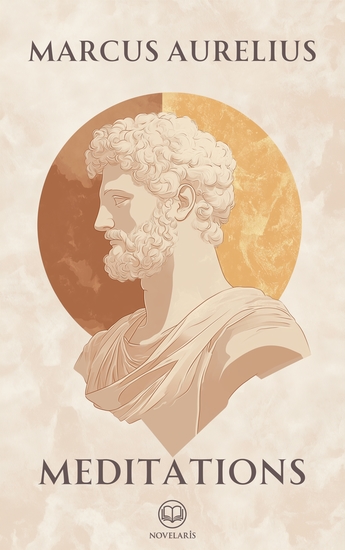
Meditations - The Original Writings of Marcus Aurelius on Stoicism in a New Translation for Contemporary Readers (Novelaris Classics) - cover

Meditations - The Original Writings of Marcus Aurelius on Stoicism in a New Translation for Contemporary Readers (Novelaris Classics)

Marcus Aurelius

Publisher: Novelaris Press

  • 0
  • 0
  • 0

Summary

This new translation of Meditations by Marcus Aurelius presents the personal reflections of one of Rome's most significant emperors. Marcus Aurelius, emperor and Stoic philosopher, explores fundamental questions of existence in this work. His writings cover topics such as ethics, duty, and the nature of the universe. The book provides insight into the emperor's approach to reconciling philosophical ideals with the realities of governance and personal challenges. 


This e-book edition of the Meditations by Marcus Aurelius is the perfect manual for anyone striving for emotional resilience and philosophical clarity. It offers a personal journey into the mind of an emperor, offering universal truths on leadership, mortality, and self-mastery that remain relevant in contemporary contexts.
Available since: 10/22/2024.
Print length: 136 pages.

Other books that might interest you

  • American Bulk - Essays on Excess - cover

    American Bulk - Essays on Excess

    Emily Mester

    • 0
    • 0
    • 0
    What if we explored our relationship to consumption with the same depth and feeling we use to tell stories of great loves and losses? 


    Americans are caught up in bulk. We guiltily watch Amazon boxes pile up on the porch, wade through endless reviews to find the perfect product, and crave the comforting indulgence of a chain restaurant. In American Bulk, Emily Mester intertwines cultural critique and personal history to explore how the things we buy, eat, amass, and discard become an intimate part of our lives. With humor and sharp intellect, she reflects on the joys and anxieties of family Costco trips, how a seasonal stint at Ulta Beauty taught her the insidious art of the sale, and what it means to get Mall Sad. In a nuanced examination of diet culture and fatness, Mester recounts her teenage summer at fat camp and the unexpected liberation she finds there. Finally, she ventures to Storm Lake, Iowa, to reckon with her grandmother's abandoned hoard, excavating the dysfunction that lies at the heart of her family's obsession with stuff. American Bulk introduces listeners to a striking new literary talent from the American heartland, one who dares to ask us to regard consumption not with guilt but with grace and empathy.
    Show book
  • Roald Amundsen: A short biography - 5 Minutes: Short on time – long on info! - cover

    Roald Amundsen: A short...

    5 Minutes, 5 Minute Biographies,...

    • 0
    • 0
    • 0
    Roald Amundsen, polar explorer and tragic hero: Life and work in a short biography! Everything you need to know, brief and concise. Infotainment, education and entertainment at its best!
    Show book
  • The Involuntary American - A Scottish Prisoner's Journey to the New World - cover

    The Involuntary American - A...

    Carol Gardner

    • 0
    • 0
    • 0
    In the winter of 1650–51, 150 ragged Scottish prisoners of war arrived at Massachusetts Bay Colony, where they were sold as indentured laborers for twenty to thirty pounds each. Among them was Thomas Doughty, a common foot soldier who had survived the Battle of Dunbar. Doughty was among some 420 Scottish soldiers who were captured during the War of the Three Kingdoms, transported to America, and sold between 1650 and 1651. Their experiences offer a fresh perspective on seventeenth-­century life. 


    The Involuntary American: A Scottish Prisoner's Journey to the New World describes Doughty's life as a soldier, prisoner of war, exile, servant, lumberman, miller, and ultimately free landowner. It follows him and his peers through critical events: the apex of the Little Ice Age, the War of the Three Kingdoms, the colonization of New England, the burgeoning transatlantic trade in servants and slaves, King Philip's and King William's wars, and the Salem witch crisis. 


    The Involuntary American demonstrates how even indi­viduals of humble circumstances were swept into the mael­strom of the First Global Age. It expands our understanding of immigration to the colonies, colonial servitude, the link­ages and tensions between Europe, Massachusetts Bay, and America's northeastern frontier, and of New England socie­ty in the early colonial period.
    Show book
  • Facing Down the Furies - Suicide the Ancient Greeks and Me - cover

    Facing Down the Furies - Suicide...

    Edith Hall

    • 0
    • 0
    • 0
    An award-winning classicist turns to Greek tragedies for the wisdom to understand the damage caused by suicide and help those who are contemplating suicide themselves 
     
    In Sophocles’ tragedy Oedipus the Tyrant, a messenger arrives to report that Jocasta, queen of Thebes, has killed herself. To prepare listeners for this terrible news, he announces, “The tragedies that hurt the most are those that sufferers have chosen for themselves.” Edith Hall, whose own life and psyche have been shaped by such loss—her mother’s grandfather, mother, and first cousin all took their own lives—traces the philosophical arguments on suicide, from Plato and Aristotle to David Hume and Albert Camus. 
     
    In this deeply personal story, Hall explores the psychological damage that suicide inflicts across generations, relating it to the ancient Greek idea of a family curse. She draws parallels between characters from Greek tragedy and her own relatives, including her great-grandfather, whose life and death bore similar motivations to Sophocles’ Ajax: both men were overwhelmed by shame and humiliation. 
     
    Hall, haunted by her own periodic suicidal urges, shows how plays by Sophocles and other Greek dramatists helped her work through the loss of her grandmother and namesake Edith and understand her relationship with her own mother. The wisdom and solace found in the ancient tragedies, she argues, can help one choose survival over painful adversity and offer comfort to those who are tragically bereaved. 
     
    Edith Hall is a professor in the Department of Classics and Ancient History at Durham University. She is the author of more than thirty books, including Aristotle’s Way: How Ancient Wisdom Can Change Your Life. She lives in Cambridgeshire, UK.
    Show book
  • Culture and Society - How Cultural Norms Shape Our Social Reality - cover

    Culture and Society - How...

    Fred Grandsen

    • 0
    • 0
    • 0
    Culture and society are deeply interconnected, shaping human behavior, beliefs, and institutions. Culture encompasses the shared practices, values, symbols, and artifacts that define a group of people, while society refers to the structured interactions and relationships within a community or nation. Culture provides the foundation for social norms, influencing everything from language and customs to laws and moral expectations. At the same time, society determines how culture is transmitted, adapted, and reinforced through institutions such as family, education, and government. 
    One of the key aspects of culture is its learned nature. Unlike biological traits, cultural knowledge is passed down through generations via socialization. From early childhood, individuals absorb cultural norms through interactions with family, peers, and media. These shared understandings create a sense of belonging and cohesion within a group. However, culture is not static; it evolves over time as societies encounter new ideas, technologies, and challenges. The dynamic nature of culture ensures that it remains relevant to the needs and values of the people who uphold it.
    Show book
  • We Philologists - cover

    We Philologists

    Friedrich Nietzsche

    • 0
    • 0
    • 0
    Nietzsche argues that philology is not just an academic discipline, but a way of life that requires a deep appreciation for language and culture. He emphasizes the importance of understanding the historical context of texts, and the need to read them in their original language to fully appreciate their meaning and beauty. "We Philologists" is a passionate and insightful reflection on the value and meaning of philology, and a call to approach the study of language and literature with greater creativity and sensitivity. Read in English, unabridged.
    Show book