Join us on a literary world trip!
Add this book to bookshelf
Grey
Write a new comment Default profile 50px
Grey
Subscribe to read the full book or read the first pages for free!
All characters reduced
Oration Over the Dead Body of Cæsar - cover

Oration Over the Dead Body of Cæsar

Marcus Antonius

Publisher: Edizioni Aurora Boreale

  • 0
  • 0
  • 0

Summary

Amid the chaos and strife following the assassination of Julius Caesar in 44 BCE, Mark Antony (83-30 BCE), with the advice of Cicero, persuaded the Roman Senate to declare an amnesty which pardoned the Liberators and accepted the legitimacy of Caesar's dictatorship. A public funeral followed, at which Antony delivered his famous funeral oration, a significant first step in his assertion of independent political authority in Rome.
Caesar's funeral took place on 20 March. It was a grand ceremony and the occasion for a funeral oration which, in accordance with tradition, celebrated the deceased's heritage but chiefly recounted the departed's illustrious deeds and their value to the Republic.
The Oration Over the Dead Body of Cæsar was delivered by Marcus Antonius in the Roman Forum, 44 B.C. and reported by Dion Cassius in his History of Rome. We present it to our readers today in the English translation by Herbert Baldwin Porter (1905), Professor of Greek in Lehigh University.
Available since: 04/14/2024.
Other books that might interest you

  • God's Monsters - Vengeful Spirits Deadly Angels Hybrid Creatures and Divine Hitmen of the Bible - cover

    God's Monsters - Vengeful...

    Esther Hamori

    • 0
    • 0
    • 0
    The Bible is teeming with monsters. Giants tromp through the land of milk and honey; Leviathan swims through the wine-dark sea. A stunning array of peculiar creatures, mind-altering spirits, and supernatural hitmen fill the biblical heavens. 


    Traditional interpretations of the creatures of the Bible have sanded down their sharp, unsavory edges, transforming them into celestial beings of glory and light—or chubby, happy cherubs. Those cherubs? They're actually hybrid guardian monsters, more closely associated with the Egyptian sphinx than with flying babies. And the seraphim? Winged serpents sent to mete out God's vengeance. Demons aren't at war with angels; they're a distinct supernatural species used by Satan and by God. The pattern is chilling. Most of these monsters aren't God's opponents—they're God's entourage. 


    Killer angels, plague demons, manipulative spirits, creatures with an alarming number of wings (and eyes all over)—these shapeshifters and realm-crossers act with stunning brutality, each reflecting a facet of God's own monstrosity. Confronting God's monsters—and the God-monster—may be uncomfortable, but the Bible is richer for their presence. For anyone interested in monsters, myths, folklore, demons, and more, God's Monsters is an entertaining deep dive into the creaturely strangeness of the Bible.
    Show book
  • Monsters of West Virginia - Mysterious Creatures in the Mountain State - cover

    Monsters of West Virginia -...

    Rosemary Ellen Guiley

    • 0
    • 0
    • 0
    Wild and wonderful West Virginia takes a turn for the weird with these accounts of Mothman, the Grafton Monster, Sheepsquatch, and more.   Every state and region has its own stellar cast of supernatural creatures, and West Virginia is no exception. Rosemary Ellen Guiley, the pioneering paranormal investigator, has spent a great deal of time in the Mountain State on the trail of entities, creatures, and all sorts of phenomena. These are her findings, featuring accounts of Mothman, the Grafton Monster, the Wampus Cat, the White Things, and other bizarre creatures, including Bigfoot, lizard people, and out-of-place panthers.  “Featuring tales of Mothman, the Sheepsquatch, and a host of lesser known West Virginia weirdness, Monsters of West Virginia is the perfect book for anyone with even a passing interest in West Virginia cryptozoology . . . a quick read by one of the most knowledgeable researchers of the paranormal in the country.” —Theresa’s Haunted History of the Tri-State
    Show book
  • A Horse at Night - On Writing - cover

    A Horse at Night - On Writing

    Amina Cain

    • 0
    • 0
    • 0
    Amina Cain's unique wandering sensibility, her attention to the small and the surprising, finds a profound new expression in her first nonfiction book, a sustained meditation on writers and their work. Driven by primary questions of authenticity and freedom in the shadow of ecological and social collapse, Cain moves associatively through a personal canon of authors—including Marguerite Duras, Elena Ferrante, Renee Gladman, and Virginia Woolf—and topics as timely and various as female friendships, zazen meditation, neighborhood coyotes, landscape painting, book titles, and the politics of excess. A Horse at Night: On Writing is an intimate reckoning with the contemporary moment, and a quietly brilliant contribution to the lineage of Woolf's A Room of One's Own or Gass's On Being Blue, books that are virtuosic arguments for—and beautiful demonstrations of—the essential unity of writing and life.
    Show book
  • Property development: turning ideas into profitable projects - cover

    Property development: turning...

    AHMED MUSA

    • 0
    • 0
    • 0
    In today’s rapidly evolving world, property development must transcend traditional practices to address the pressing needs of communities and the environment. Building for the Future explores the transformative power of community engagement and environmental stewardship in creating developments that are sustainable, inclusive, and impactful. 
    This book delves into the strategies developers can use to involve local stakeholders, build trust, and align projects with community values. It also highlights the importance of integrating environmental stewardship by adopting green building practices, conserving natural resources, and enhancing climate resilience. 
    Filled with real-world examples, expert insights, and actionable guidance, Building for the Future is a must-read for developers, urban planners, and anyone passionate about shaping a better, more sustainable future. Discover how the principles of community engagement and environmental responsibility can turn property development into a force for positive change.
    Show book
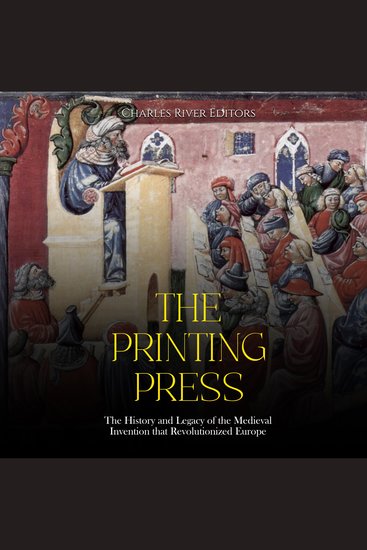
  • Printing Press The: The History and Legacy of the Medieval Invention that Revolutionized Europe - cover

    Printing Press The: The History...

    Editors Charles River

    • 0
    • 0
    • 0
    The history of printing was for ancient Asia an advancement in culture and communication, but for Europe in the 15th century, it was much more, plunging the continent into a new paradigm and aligning it for the modern world. Its importance is often overlooked, but the timeliness of the printing machine was equivalent to the invention of alphabets in antiquity and ranks up there with the digital revolution and the introduction of the internet. Put simply, it made the Renaissance possible and led to the modernization of Europe. 
    Long before the emergence of the modern world, paper was unknown in the West, and all documents were transcribed by hand onto clay, papyrus, and parchment. More importantly, few were allowed to express themselves through written media. Writing was for the most part theological in nature, reserved for scribes mostly living and working in monasteries. Books in the Middle Ages were owned almost exclusively by monasteries and educational institutions, and with reading material being such a rarity, content remained narrow and difficult to access. 
    	Based on earlier Asian principles, Johannes Gutenberg’s movable type printing press propelled an industry that led to the education of the West and ultimately removed the tight grip of the Vatican from daily European life. Within less than a century of Gutenberg’s device appearing on the scene, printing presses had churned out tens of millions of copies of books of all types, and as more people became educated, lower classes became wealthier while revolutionary principles spread across borders like wildfire. In addition to ushering in the Renaissance, the printing press also made the Reformation possible, and just as gunpowder was revolutionizing medieval warfare, the printing press led to battles over ideas and the rise of nationalism. For better and worse, after Gutenberg’s printing press became available, the world would never be the same.
    Show book
  • Roman Mythology - Tales From the Roman Pantheon - cover

    Roman Mythology - Tales From the...

    Adam Andino

    • 0
    • 0
    • 0
    ROMAN MYTHOLOGY 
    Why did the Roman Empire fall? 
    The theories are numerous, including the rise of Islam, lead in the drinking water, inflation with other economic problems, and even allowing vandals and barbarians to have positions of power. By far the most popular and widely believed is the rise of Christianity. Beforehand, Rome’s main religion was polytheistic, or involved the worshiping of many gods. It was the lifeblood of the Roman belief systems and culture. This culture dated back thousands of years, as far back enough to when the Etruscans were in power. 
    What was once the religion of Ancient Rome is now referred to Roman mythology and is the focus of this book. Inside, you will discover how the Ancient Romans lived and worshipped the many Gods and Goddesses they believed in. Also included are the most famous and interesting stories to emerge from the Roman pantheon that still captivate us today! 
    Inside, you will learn about:The 12 Main Gods of the Roman PantheonThe Creatures, Monsters, and Heroes of Roman MythologyLife in Ancient RomeHow the Gods Were WorshippedThe Founding of RomeAeneas and the Founding of LatiumJupiter and the BeeBacchus and AriadnePluto and the River StyxMuch, Much More! 
    So, what are you waiting for? 
    Scroll up and hit "Buy Now" to discover the fascinating world of Roman Mythology today!
    Show book