Join us on a literary world trip!
Add this book to bookshelf
Grey
Write a new comment Default profile 50px
Grey
Subscribe to read the full book or read the first pages for free!
All characters reduced
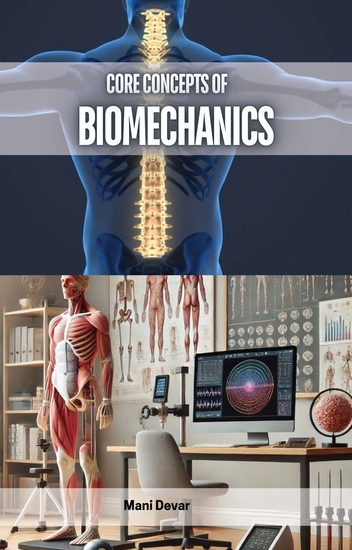
Core Concepts of Biomechanics - cover

Core Concepts of Biomechanics

Mani Devar

Publisher: Educohack Press

  • 0
  • 0
  • 0

Summary

"Core Concepts of Biomechanics" offers an insightful and detailed exploration into the foundational principles of biomechanics, bridging complex scientific concepts with real-world applications. Authored by experts, this book navigates key topics such as human motion mechanics, skeletal and muscular systems, and the forces and torques involved in biological movements. 

Written in a clear and accessible style, it unveils the intricacies of neuromuscular control, gait analysis, and biomechanics of various body parts, providing a comprehensive understanding of how the body functions and moves.

Richly illustrated and enhanced with practical case studies, "Core Concepts of Biomechanics" makes challenging biomechanical concepts approachable for both students and professionals. Its systematic organization and inclusion of real-world applications make it an invaluable resource for those studying kinesiology, sports science, or rehabilitation. Reviews highlight its balanced approach to theory and practice, making it useful as both a textbook and reference guide.

Ideal for academic and practical use, the book remains current with the latest research, offering a valuable tool for educators and a reliable guide for professionals in sports science, rehabilitation, and ergonomics.
Available since: 02/20/2025.
Print length: 309 pages.

Other books that might interest you

  • Why the Dose Matters - Assessing the Health Risk of Exposure to Toxicants - cover

    Why the Dose Matters - Assessing...

    Urs A. Boelsterli

    • 0
    • 0
    • 0
    Each day we are exposed to a myriad of natural and human-made chemicals in our food, drinking water, air, soil, at home or at the workplace—pesticide residues, food additives, drugs, household products—but how can we gauge the human health risk posed by these chemicals? Should we believe the somber headlines that depict a serious threat for humans and the environment, or should we follow the reassuring voices of others who claim that the angst is totally unfounded? 


    Why the Dose Matters: Assessing the Health Risk of Exposure to Toxicants uses a rational, science-based approach to explain in plain language that a quantitative view is key for understanding and predicting potentially toxic effects of chemicals. 


    Key Features: 


    ● Explains the basics of toxicology in easily understandable terms. 


    ● Includes numerous examples. 


    ● Clears up common misconceptions and dispels myths. 


    ● Provides take-home messages for each chapter.
    Show book
  • Facing America's Greatest Enemy - cover

    Facing America's Greatest Enemy

    Rich Germaine

    • 0
    • 0
    • 0
    "Facing America's Greatest Enemy" by Rich Germaine delves into the pervasive issue of apathy within American society, exploring its historical roots, psychological underpinnings, and extensive impact on various facets of life. The book opens with a compelling introduction that frames apathy and indifference as a silent yet formidable adversary threatening the foundations of democracy and societal progress. Germaine traces the emergence of apathy from post-revolutionary disinterest to contemporary political indifference, emphasizing how crises and prosperity alike have fostered disengagement. 
    Germaine provides historical examples, such as the rise of Nazi Germany and the low voter participation in recent U.S. elections, to underscore the dire consequences of public disengagement. 
    In the digital age, the paradox of connectivity is examined, where social media's potential to mobilize is countered by the overwhelming influx of information, leading to 'slacktivism'—a superficial form of engagement. The manuscript also addresses the role of education in combating apathy, advocating for curricula that foster critical thinking, empathy, and active citizenship. 
    Parental apathy is explored as a significant factor in children's moral and educational development, highlighting the need for active parental involvement despite modern challenges. The author also incorporates a biblical worldview, urging Christians to act against apathy through faith-driven engagement and community building. 
    Concluding with actionable steps, calling for a collective commitment to rekindle civic engagement and counter the inertia threatening American self-government. This comprehensive exploration offers a roadmap for individuals and communities to overcome apathy and foster a more involved, empathic, and active society.
    Show book
  • Nuclear Physics - Principles and Applications: An Introduction to Nuclear Physics - cover

    Nuclear Physics - Principles and...

    Mark Hedges

    • 0
    • 0
    • 0
    Nuclear physics is the branch of physics that studies the atomic nucleus, its constituents, and the interactions that govern its behavior. The field explores the fundamental forces that operate within the nucleus, particularly the strong nuclear force that binds protons and neutrons together, as well as the weak nuclear force that governs radioactive decay. Understanding the structure and dynamics of the nucleus provides insights into the origin of matter and the processes that drive the universe's evolution, including stellar nucleosynthesis and the formation of elements. 
    The history of nuclear physics began with the discovery of radioactivity by Henri Becquerel in 1896, followed by the identification of the electron by J.J. Thomson in 1897. The groundbreaking work of Ernest Rutherford in the early 20th century led to the discovery of the atomic nucleus, fundamentally altering the understanding of atomic structure. Rutherford’s gold foil experiment in 1911 demonstrated that atoms consist of a small, dense nucleus surrounded by a cloud of electrons. James Chadwick’s discovery of the neutron in 1932 further clarified the composition of the nucleus and laid the foundation for modern nuclear physics. 
    Nuclear physics encompasses several key areas of study, including nuclear structure, nuclear reactions, and nuclear decay. Nuclear structure focuses on understanding how protons and neutrons are arranged within the nucleus and how the strong nuclear force governs their interactions. Quantum mechanics plays a central role in modeling the energy levels and configurations of nucleons. Nuclear reactions involve the collision of nuclei, leading to the formation of new elements or the release of energy, as observed in nuclear fission and fusion. Nuclear decay describes the spontaneous transformation of unstable nuclei into more stable configurations, often accompanied by the emission of alpha, beta, or gamma radiation.
    Show book
  • Touchpad Plus Ver 40 Class 2 - cover

    Touchpad Plus Ver 40 Class 2

    Nidhi Gupta

    • 0
    • 0
    • 0
    Computer Science Textbook with New Pedagogical Approaches 
    
    KEY FEATURES 
    - National Education Policy 2020 
    - Tech Funda: This section provides a practical information or tip to the students. 
    - Clickipedia: This section provides interesting computer facts. 
    - Lab Session: This is a lab activity to develop practical skills. (Subject Enrichment) 
    - Explore More: This section contains supplement topics for add-on knowledge. 
    - QR Code: Scan the QR Code given on the first page of each chapter to start chapter animation. 
    - Mind Boggler: This section has puzzle or fun based activity to help understand the concepts better. 
    
    DESCRIPTION 
    Computer technology has become essential and an integral part of life at work, in recreation, social networking and education too. With the constant development of new technology, it has become more significant in helping and preparing students for jobs. Computers have revolutionised the way education is imparted to children. 
    
    Touchpad Plus Version 4.0 is a complete computer science curriculum solution for grades 1-8. It is based on Windows 10 and MS Office 2019, with new and future-ready content. Fun is the most important element of learning. Keeping in mind the concept of Joyful Learning, varied activities have been designed based on multiple intelligences and 21st century skills for holistic development. 
    
    The books have a conversational style introduction of each chapter to make learning fun and engaging. The topics and their approaches are integrated in different themes as per ICT learning. Grade I and II books have four-line writing space to enhance writing skills in children. Each book is accompanied by digital learning resources that offer interesting animation and interactive tests for the student to supplement classroom learning with independent learning. 
    
    The books are curated in a way that they make students and teachers equal partners in the learning process and take learning beyond classroom. We welcome and look forward to all meaningful and valuable suggestions for improving the book 
    
    WHAT WILL YOU LEARN 
    You will learn about: 
    - Digital World 
    - Cyber World 
    - Coding World 
    - Computational Thinking 
    - Artificial Intelligence 
    
    WHO THIS BOOK IS FOR 
    Grade 2 
    
    TABLE OF CONTENTS 
    1. More About a Computer 
    2. Working of a Computer 
    3. IPO Devices 
    4. The Keyboard and the Mouse 
    5. Introduction to Word 2019 
    6. Let’s Learn Paint 
    7. Reasoning and Analysis 
    8. More on ScratchJr 
    9. Artificial Intelligence Around Us 
    ADD-ONS 
    ASSESSMENTS
    Show book
  • High Conversions Bundle 2 in 1 Bundle - The Conversion Equation and High Conversion Online - cover

    High Conversions Bundle 2 in 1...

    Catherine Teal, Ralph Brekker

    • 0
    • 0
    • 0
    High Conversions Bundle, 2 in 1 Bundle: The Conversion Equation and High Conversion OnlineThere are millions of websites in the world. How can you make your own website stand out? These days, most people spend most of their time online. Online shopping numbers have skyrocketed because a lot of people now prefer to buy what they need online. If you have a business and don’t have an online presence, you are completely missing out on a massive opportunity. If you already have a website running but you just did the bare minimum and did not even put in the effort to make it look good and user-friendly, you’re going to lose to a lot of your competitors who had great websites. Increasing your website’s traffic is a must because traffic converts into sales, right?Thankfully, there are drop-dead simple ways of capturing attention, boosting conversion rates and ultimately, maximizing your profits without breaking the bank, or spending a lot of time tweaking your traffic campaigns.This bundle will teach you all the conversion boosting hacks that you can implement Into your existing website so that you can transform your business in just a matter of a few short days. It will also teach you tips on how to design your website so you can invite the most traffic to your site and convert them to sales.This 2 in 1 bundle includes the following audiobooks:1. The Conversion Equation: The Essential Guide on How to Increase Your Website's Traffic and Increase Your Conversion and Sales2. High Conversion Online: The Ultimate Guide on How to Design Your Website to Make it Easy to Use. Learn How a Great Website Can Attract the Most Clients and Convert Them to SalesIf you want to learn more, download your copy of High Conversions 2 in 1 Bundle today!
    Show book
  • Arthritis - Naturally Healing from Rheumatoid Arthritis - cover

    Arthritis - Naturally Healing...

    Lilly Richardsen

    • 0
    • 0
    • 0
    Rheumatoid arthritis (RA) is an autoimmune disorder that primarily affects the joints. In RA, the immune system mistakenly attacks the synovium, the lining of the membranes that surround the joints.  
    This causes inflammation that can lead to joint damage, pain, swelling, stiffness, and loss of function. RA commonly affects joints in the hands, wrists, and knees symmetrically, meaning both sides of the body are usually affected equally. It can also affect other organs and systems in the body. Treatment typically involves medication to reduce inflammation and pain, physical therapy, and sometimes surgery in advanced cases.  
    Early diagnosis and treatment can help manage symptoms and prevent joint damage.
    Show book