Join us on a literary world trip!
Add this book to bookshelf
Grey
Write a new comment Default profile 50px
Grey
Subscribe to read the full book or read the first pages for free!
All characters reduced
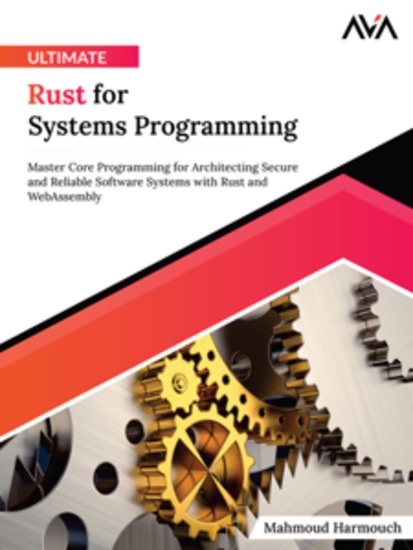
Ultimate Rust for Systems Programming: Master Core Programming for Architecting Secure and Reliable Software Systems with Rust and WebAssembly - cover

Ultimate Rust for Systems Programming: Master Core Programming for Architecting Secure and Reliable Software Systems with Rust and WebAssembly

Mahmoud Harmouch

Publisher: Orange Education Pvt Ltd

  • 0
  • 0
  • 0

Summary

Building Tomorrow's Systems Today the Rust Way 
 Key Features ● Learn how to use Rust libraries effectively for various applications and projects.● Go from basics to advanced system-building skills for stronger and more reliable outcomes.● Secure your Rust applications confidently with expert tips for enhanced protection. 
Book DescriptionThis book is your guide to mastering Rust programming, equipping you with essential skills and insights for efficient system programming. It starts by introducing Rust's significance in the system programming domain and highlighting its advantages over traditional languages like C/C++. You'll then embark on a practical journey, setting up Rust on various platforms and configuring the development environment. From writing your first "Hello, World!" program to harness the power of Rust's package manager, Cargo, the book ensures a smooth initiation into the language.Delving deeper, the book covers foundational concepts, including variables, data types, control flow, functions, closures, and crucial memory management aspects like ownership, borrowing, and lifetimes. Special attention is given to Rust's strict memory safety guarantees, guiding you in writing secure code with the assistance of the borrow checker.The book extends its reach to Rust collections, error-handling techniques, and the complexities of concurrency management. From threads and synchronization primitives like Mutex and RwLock to asynchronous programming with async/await and the Tokio library, you'll gain a comprehensive understanding of Rust's capabilities. This book covers it all. 
What you will learn● Learn how to set up the Rust environment effortlessly, ensuring a streamlined development process.● Explore advanced concepts in Rust, including traits, generics, and various collection types, expanding your programming expertise.● Master effective error-handling techniques, empowering you to create custom error types for enhanced code robustness.● Tackle the complexities of memory management, smart pointers, and delve into the complexities of concurrency in Rust.● Gain hands-on experience by building command-line utilities, sharpening your practical skills in real-world scenarios.● Master the use of iterators and closures, ensuring code reliability through comprehensive unit testing practices. 
Table of Contents1. Systems Programming with Rust2. Basics of Rust3. Traits and Generics4. Rust Built-In Data Structures5. Error Handling and Recovery6. Memory Management and Pointers7. Managing Concurrency8. Command Line Programs9. Working with Devices I/O in Rust10. Iterators and Closures11. Unit Testing in Rust12. Network Programming13. Unsafe Coding in Rust14. Asynchronous Programming15. Web Assembly with Rust       Index
Available since: 02/11/2025.
Print length: 740 pages.

Other books that might interest you

  • The Universe - Cosmic Inflation Dark Matter Galaxies Planetary Formation and Space Telescopes (5 in 1) - cover

    The Universe - Cosmic Inflation...

    Steff Jaywan

    • 0
    • 0
    • 0
    This book consists of 5 titles, which are the following: 
    Cosmic Inflation 
    Dark Matter 
    Galaxies 
    Planetary Formation 
    Space Telescopes 
    Enjoy this discounted bundle of books!
    Show book
  • The View from the Shoulder - A Portrait of Scottish Surfing - cover

    The View from the Shoulder - A...

    Roger Cox

    • 0
    • 0
    • 0
    The story of surfing in Scotland is defined by people who dared to dream in spite of the cold, from Neva MacDonald-Haig and the coffin-lid surfers of Machrihanish, who first took to the waves off the west coast in the 1930s with a little help from a local undertaker, to Andy Bennetts and the pioneers of the 1960s, who discovered many of the nation's best breaks, to contemporary big wave surfer Ben Larg, a native of the tiny island of Tiree who now travels the world riding skyscraper-sized walls of water for a living.
    Scotland is also home to a rich and distinctive surfing culture, with its own surfboard shapers, surf instructors, surf filmmakers, surf photographers and surf fashion brands, not to mention surf-inspired artists and musicians. Professional contests held at some of Scotland's best waves have drawn visits from surfing world champions including Tom Curren, Sunny Garcia and John John Florence, and in recent years Scotland's own surfers have begun to make their presence felt on the competitive stage, with the Scottish surf team featuring at the World Surfing Games and at Eurosurf after finally gaining official recognition in 2014.
    The View From the Shoulder draws together 20 years of surf journalism from the pages of The Scotsman newspaper, together with fresh context, to create a portrait of a wave-riding community like no other.
    Show book
  • Biomimetics - How Lessons from Nature can Transform Technology - cover

    Biomimetics - How Lessons from...

    Brian Clegg

    • 0
    • 0
    • 0
    An exploration of the transformative ways in which nature has inspired the technological advancement of humankind.
    
    Biomimetics literally means emulating biology - and in a broader sense the term covers technological advances where the original inspiration came from nature. The Earth is a vast laboratory where the mechanisms of natural selection have enabled evolutionary solutions to be developed to a wide range of problems.
    
    In this new title in the Hot Science series, science writer Brian Clegg looks at how humans have piggybacked on natural experimentation, redeploying a solution to create things that make our lives easier. He looks at how the hooks on burdock seeds inspired the creation of Velcro, how the stickiness of the feet of geckos and frogs has been used to create gripping surfaces, such as tyre treads, and how even the most basic optical enhancement in the form of spectacles is itself a form of biomimetics.
    Show book
  • The Girl Who Waited For The Sun - cover

    The Girl Who Waited For The Sun

    Proiti Seal Acharya

    • 0
    • 0
    • 0
    What happens to the girl who eagerly waited for the sun but kept facing boulders of difficulties at every step? Will she give up? Will she stop looking for the big ball of light altogether? Or will she come up with a new plan!
    Show book
  • Pandemic Perspectives - A filmmaker's journey in 10 essays - cover

    Pandemic Perspectives - A...

    Howard Burton

    • 0
    • 0
    • 0
    Directly inspired by award-winning author, physician and self-professed “biology watcher” Lewis Thomas, Howard Burton takes us on a thought-provoking tour of a wide range of social and scientific issues which he encountered through the process of making the documentary film, Pandemic Perspectives. Howard provides unique and fresh insights into a wide range of issues ranging from biology to politics to contemporary morality weaving together his interaction with a diverse array of international experts who participated in his film and his personal experiences as a physicist-turned-filmmaker.
    Show book
  • The First Three Minutes - A Modern View Of The Origin Of The Universe - cover

    The First Three Minutes - A...

    Steve Weinberg

    • 0
    • 0
    • 0
    A Nobel Prize-winning physicist explains what happened at the very beginning of the universe, and how we know“Science writing at its best.” ―New York Review of Books   Our universe has been growing for nearly fourteen billion years. But almost everything about it can be traced back to what happened in just the first three minutes of its existence. In this book, Nobel Laureate Steven Weinberg describes in wonderful detail what happened in these first three minutes. It is an exhilarating journey that begins with the Planck Epoch―the earliest period of time in the history of the universe―and goes through Einstein's Theory of Relativity, the Hubble red shift, and the detection of the cosmic microwave background. These incredible discoveries all form the foundation for what we now understand as the "standard model" of the origin of the universe. Clearly and accessibly written,The First Three Minutes is a modern-day classic, an unsurpassed explanation of where it is that everything really comes from.
    Show book