Join us on a literary world trip!
Add this book to bookshelf
Grey
Write a new comment Default profile 50px
Grey
Subscribe to read the full book or read the first pages for free!
All characters reduced
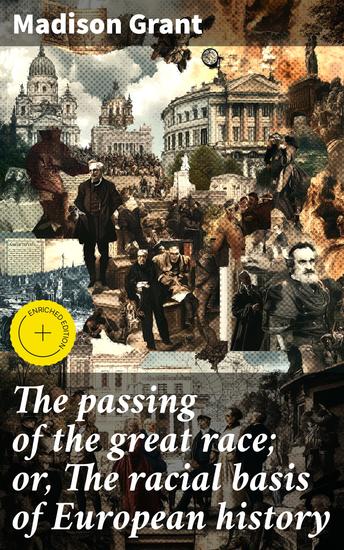
The passing of the great race; or The racial basis of European history - Enriched edition Unveiling the Racial Hierarchies of European Civilization - cover

The passing of the great race; or The racial basis of European history - Enriched edition Unveiling the Racial Hierarchies of European Civilization

Madison Grant

Publisher: Good Press

  • 0
  • 0
  • 0

Summary

In "The Passing of the Great Race; or, The Racial Basis of European History," Madison Grant presents a controversial examination of race as a dynamic force shaping European history. Published in 1916, this work employs a blend of historical narrative and pseudo-scientific analysis, reflecting the eugenics movement prevalent in early 20th-century America. Grant's literary style is characterized by a polemical tone, utilizing a mix of sociological argumentation and historical anecdotes, which captivates the reader while simultaneously challenging deeply ingrained societal beliefs. Grant posits that the success of Western civilization is fundamentally tied to the preservation of what he deems the 'Nordic' race, presenting a stark warning against the perceived dangers of racial mixing. Madison Grant, an American lawyer and prominent figure in the eugenics movement, wrote this book within a context marked by a burgeoning interest in racial purity and anthropology. His social standing and involvement with organizations such as the American Museum of Natural History influenced his ideologies, imbuing his arguments with a veneer of scientific legitimacy that would later foster debate and controversy. Grant's perspectives reveal the unsettling intersection of science, ideology, and social policy in the early 20th century. This book is essential for those seeking to understand the historical underpinnings of racial theory and its pervasive influence on modern thought. Although the ideas presented are contentious, they offer a critical lens through which to analyze the social constructs surrounding race. Readers interested in history, sociology, and the evolution of racial ideologies will find Grant's work both provocative and enlightening.

In this enriched edition, we have carefully created added value for your reading experience:
- A succinct Introduction situates the work's timeless appeal and themes.
- The Synopsis outlines the central plot, highlighting key developments without spoiling critical twists.
- A detailed Historical Context immerses you in the era's events and influences that shaped the writing.
- An Author Biography reveals milestones in the author's life, illuminating the personal insights behind the text.
- A thorough Analysis dissects symbols, motifs, and character arcs to unearth underlying meanings.
- Reflection questions prompt you to engage personally with the work's messages, connecting them to modern life.
- Hand‐picked Memorable Quotes shine a spotlight on moments of literary brilliance.
- Interactive footnotes clarify unusual references, historical allusions, and archaic phrases for an effortless, more informed read.
Available since: 08/21/2022.
Print length: 356 pages.

Other books that might interest you

  • Cape Cod - cover

    Cape Cod

    Henry David Thoreau

    • 0
    • 0
    • 0
    Henry David Thoreau was an American naturalist, essayist, poet, and philosopher. A leading transcendentalist, he is best known for his book Walden, a reflection upon simple living in natural surroundings, and his essay "Civil Disobedience" (originally published as "Resistance to Civil Government"), an argument for disobedience to an unjust state. 
      
    Thoreau's books, articles, essays, journals, and poetry amount to more than 20 volumes. Among his lasting contributions are his writings on natural history and philosophy, in which he anticipated the methods and findings of ecology and environmental history, two sources of modernday environmentalism. His literary style interweaves close observation of nature, personal experience, pointed rhetoric, symbolic meanings, and historical lore, while displaying a poetic sensibility, philosophical austerity, and attention to practical detail. He was also deeply interested in the idea of survival in the face of hostile elements, historical change, and natural decay; at the same time he advocated abandoning waste and illusion in order to discover life's true essential needs. 
      
    Thoreau was a lifelong abolitionist, delivering lectures that attacked the fugitive slave law while praising the writings of Wendell Phillips and defending the abolitionist John Brown. Thoreau's philosophy of civil disobedience later influenced the political thoughts and actions of such notable figures as Leo Tolstoy, Mahatma Gandhi, and Martin Luther King Jr. 
      
    Cape Cod chronicles Henry David Thoreau’s journey of discovery along this evocative stretch of Massachusetts coastline, during which time he came to understand the complex relationship between the sea and the shore. He spent his nights in lighthouses, in fishing huts, and on isolated farms. He passed his days wandering the beaches, where he observed the wide variety of life and death offered up by the ocean.
    Show book
  • Turning Points - Crisis and Change in Modern Britain from 1945 to Truss - cover

    Turning Points - Crisis and...

    Steve Richards

    • 0
    • 1
    • 0
    The Times Best Politics and Current Affairs Books of the YearAn entertaining and revealing history of modern British politics from Steve Richards, broadcaster, journalist, and author of The Prime Ministers We Never Had.'Through wonderful vignettes, Richards offers a masterful, clear-eyed and, above all, entertaining history of British politics. To pilot a better future, we need to learn how not to repeat the mistakes of the past. The book is a lesson in just that' – Will HuttonEvery few weeks in British politics, a columnist will reach for the word ‘unprecedented’ as a cabinet minister resigns or yet another inquiry is called. We have become so accustomed to turmoil that it is impossible to take a breath and see where we are headed. In this magisterial history, respected broadcaster and journalist Steve Richards puts the recent chaos into context and takes a step back to explore ten critical moments that have shaped modern Britain.From the Suez Crisis of 1956 to the Covid-19 pandemic, from 1945 to Thatcher, Richards argues that it is only with distance that we can perceive the tectonic plates shifting – and events that may seem earth-shattering in the moment might be a passing tremor with the perspective of history.With his trademark insight, forged over several decades as one of the UK’s foremost political commentators, Richards blends anecdote and analysis to explore the biggest events in British political history. A must-read for anyone seeking to understand our nation, this landmark work is enlightening and entertaining in equal measure.'An engaging canter through postwar Britain . . . shaped by a lifetime of reading' – Prospect
    Show book
  • Ancient Egyptians’ Diet The: The History of Eating and Drinking in Egypt - cover

    Ancient Egyptians’ Diet The: The...

    Editors Charles River

    • 0
    • 0
    • 0
    Perhaps the most intriguing aspect of ancient Egyptian civilization was its inception from the ground up, as the Egyptians themselves had no prior civilization which they could use as a template. In fact, Egypt itself became a template for the civilizations that followed. The Greeks and the Romans were so impressed with Egyptian culture that they often attributed many aspects of their own culture to the Egyptians. With that said, some minor elements of ancient Egyptian culture were, indeed, passed on to later civilizations. Egyptian statuary appears to have had an initial influence on the Greek version, and the ancient Egyptian language continued long after the pharaonic period in the form of the Coptic language.  
    	Despite the strides made in understanding Egyptian history, there are obvious difficulties in assessing what ancient societies ate and drank, even as advances in technology continue to open up new methods of analysis for food deposits in human remains and archaeological sites. In general, the majority of what ancient individuals ate did not last long, and in the case of ancient Egypt, there is an even greater additional time factor. Ancient Egyptian civilization lasted over 3,000 years, a time period that if applied to Europe encompasses the time before Rome was even founded right up to the present day. Within such a lengthy period a great deal happens in any society, and in Egypt, numerous dynasties came and went, with constant invasions both by Egyptians into nearby regions and back into Egypt by neighboring civilizations. All of these different groups presumably had their own preferences for food and drink. Population migrations, especially the ones led by the Sea Peoples into the region around 1250 BCE, combined with other factors such as climate to impact the food and drink consumed by Egyptians.  
    Show book
  • Linguistics and Symbols - Exploring Language and Meaning (3 in 1) - cover

    Linguistics and Symbols -...

    Mike Crawford

    • 0
    • 0
    • 0
    Linguistics and Symbols provides an in-depth look into how language, values, and symbols shape our understanding of the world. This 3-in-1 volume explores three key areas—Phonology, Axiology, and Symbology—that are foundational to the study of language, communication, and meaning. 
    The first section, Phonology, delves into the sound systems of language, examining how phonemes, tones, and patterns of speech create meaning and influence communication. It explores how different cultures and languages use sound to convey emotions, ideas, and information, showing the power of phonetics in shaping human interaction. 
    In the second section, Axiology, readers will explore the role of values in language and communication. Axiology focuses on the study of values—what people deem important and how these values influence societal structures, ethics, and language. This section highlights how language is often a reflection of the moral and cultural values of a community, shaping how we express judgments, preferences, and ideals. 
    The final section, Symbology, investigates the system of symbols and their meaning across various cultures. Symbols are powerful tools of communication, often carrying deep cultural, emotional, and historical significance. By examining symbols—whether in written form, visual representations, or gestures—this section reveals how they help convey complex ideas and how they are interpreted by different societies. 
    Linguistics and Symbols is an essential guide for anyone seeking to understand how language and symbols shape human cognition, culture, and society. It provides key insights into the fundamental components of language and meaning, offering readers a deeper appreciation of how we communicate, understand, and connect with one another through sounds, values, and symbols.
    Show book
  • Our story of Atlantis: written down for the Hermetic Brotherhood - cover

    Our story of Atlantis: written...

    William P Phelon

    • 0
    • 0
    • 0
    Why is this book written? Authorities pointing to the existence of a former Continent and City. Definite assertions of destruction by deluge, of an island Continent, positively declared. Testimony of the whirling straws, the flotsam and jetsam of the day. Concurrent evidence of the existence and influence of these people on our civilization. Poem, "Atlantian Memories." Continued cross- examination of witnesses, human and divine, concerning the facts in evidence of the existence of Atlantis Island and City. Description of mountains, cities, caves, and other evidences of occupation by civilized and enlightened people. Speculations and deductions of the Past, Present and Future. Beginning of a voyage. The attractive stranger. Acquaintance ripens rapidly. "Such a face as children love and scoundrels hate." An eloquent and instructive talker. Atlantian memories seem to the new friend, personal experiences. The wonderful cities of the Past that have disappeared. The little black-lettered manuscript in a strange language. History of Atlantis. "Your desire for information on these lines will be gratified
    Show book
  • Age of Reason - The Crucial Time in Which the Renaissance and Transformation in Knowledge Took Place (3 in 1) - cover

    Age of Reason - The Crucial Time...

    Kelly Mass

    • 0
    • 0
    • 0
    This is a 3 in 1 combo, with the following topics: 
    1 - Age of Enlightenment: Finally… finally, humanity began to wake up. Finally, they decided to take science, knowledge, politics, development, multiple angles and perspectives, and the details of our everyday lives a bit more seriously. For centuries, raw and primal urges and principles had taken hold of conquerors, officials, and governments. But there was a light at the end of the tunnel. Humanity just needed to acknowledge knowledge. It needed to value the art of studying phenomena and learning, not just spiritual notions and religion. Welcome to the book about how this happened. Welcome to a glimmer of hope in humanity’s realization of what this world is and what lies in the elements yet to be discovered. 
    2 - Renaissance: The Renaissance is a time in European history marking the shift from the Middle Ages to modernity and covering the 15th and 16th centuries, identified by an effort to restore and exceed ideas and accomplishments of classical antiquity. It happened after the Crisis of the Late Middle Ages and was related to great social change. Aside from the basic periodization, advocates of a "long Renaissance" might put its start in the 14th century and its end in the 17th century. 
    3 - Dutch East India Trading Company: Did you know that the Dutch were some of the first who came up with stocks? They were also known for their gigantic fleet, their ships, their colonies, and so much more. The 17th century was a golden age, a golden century for the Dutch, who discovered how to go to the new world in Asia, America, and other continents to transport spices, minerals, and other materials. 
    The Dutch East India Company, officially the United East India Company (Dutch: Vereenigde Oost Indische Compagnie; VOC), was a megacorporation created in the early 17th century by a government-directed merger of many competing Dutch trade services.
    Show book