Unisciti a noi in un viaggio nel mondo dei libri!
Aggiungi questo libro allo scaffale
Grey
Scrivi un nuovo commento Default profile 50px
Grey
Iscriviti per leggere l'intero libro o leggi le prime pagine gratuitamente!
All characters reduced
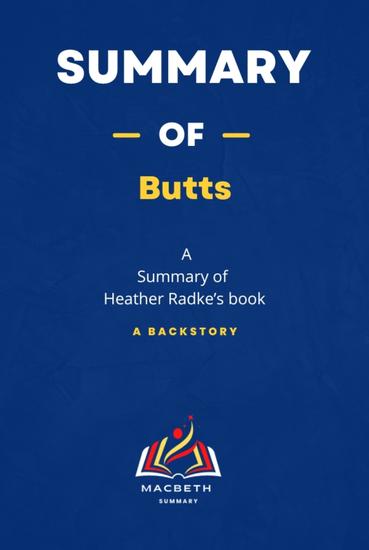
Summary of Butts A Backstory Summary by Heather Radke'book - cover

Summary of Butts A Backstory Summary by Heather Radke'book

MACBETH Summary

Casa editrice: BookRix

  • 0
  • 0
  • 0

Sinossi

DISCLAIMER
 
This book does not in any capacity mean to replace the original book but to serve as a vast summary of the original book.
Summary of Butts A Backstory Summary by Heather Radke'book
IN THIS SUMMARIZED BOOK, YOU WILL GET:
 

- Chapter astute outline of the main contents.
- Fast & simple understanding of the content analysis.
- Exceptionally summarized content that you may skip in the original book 
Butts: A Backstory by Heather Radke is one of the most anticipated books of 2022. She explores how butts have come to signify so much more: sex, desire, comedy, shame. The book spans nearly two centuries and examines the central importance of race through figures like Sarah Bartmann and Josephine Baker.
Disponibile da: 03/12/2022.
Lunghezza di stampa: 10 pagine.

Altri libri che potrebbero interessarti

  • Ecclesiastes - The World English Bible Book 21 (Unabridged) - cover

    Ecclesiastes - The World English...

    Various Authors

    • 0
    • 0
    • 0
    Ecclesiastes is one of the Ketuvim ("Writings") of the Hebrew Bible and one of the "Wisdom" books of the Christian Old Testament. The title commonly used in English is a Latin transliteration of the Greek translation of the Hebrew word קֹהֶלֶת (Kohelet, Koheleth, Qoheleth or Qohelet). An unnamed author introduces "The words of Kohelet, son of David, king in Jerusalem" (1:1) and does not use his own voice again until the final verses (12:9-14), where he gives his own thoughts and summarises the statements of Kohelet; the main body of the text is ascribed to Kohelet himself.
    Mostra libro
  • 10 Ways the World Could End - From Natural Disasters to Man-Made Catastrophes - cover

    10 Ways the World Could End -...

    John Harpoon

    • 0
    • 0
    • 0
    Our planet is an extraordinary place, teeming with life and natural wonders. Yet, beneath the beauty and stability of our world lies an inherent fragility that we must never overlook. From the forces of nature to the actions of humanity, numerous threats exist that could drastically alter the course of life on Earth. These dangers range from natural disasters such as volcanic eruptions and asteroid impacts to man-made catastrophes like nuclear war and the consequences of climate change. While these events may seem distant or improbable, they are very real and have the potential to affect us all in profound ways. 
    To fully grasp the magnitude of these threats, it is crucial to understand how they arise and their potential consequences. Many of the dangers that could lead to the end of the world are rooted in forces that have shaped our planet for millions of years. However, modern society faces new, unique risks that previous generations never imagined. Natural disasters, though unpredictable, are part of the Earth's natural cycles, while human actions—whether through pollution, warfare, or technological mismanagement—have introduced entirely new categories of risk. As technology advances and our global interconnectedness grows, the potential for widespread disaster becomes more complex and difficult to anticipate. 
    When examining the ways the world could end, it is essential to distinguish between natural and man-made catastrophes. Natural disasters, like earthquakes, tsunamis, and pandemics, have been occurring throughout Earth's history, long before humans arrived on the scene. These events have shaped ecosystems, driven evolutionary processes, and, at times, caused mass extinctions. On the other hand, man-made catastrophes, such as nuclear warfare or the unchecked expansion of artificial intelligence, are unique to modern civilization.
    Mostra libro
  • Imitation - The Basics - cover

    Imitation - The Basics

    Naomi Van Bergen, Bertjan...

    • 0
    • 0
    • 0
    Imitation: The Basics is an engaging introduction to the topic of imitation behavior in humans, providing a summary of existing scientific research on imitation, covering everything from examples of imitation across each developmental stage to animal imitation such as monkeys imitating each other. 


    The authors argue that imitation forms the foundation of long-lasting relationships, including those between children and parents, as well as intimate partners. Structured to resemble a human lifetime, chapters explore the reasons behind why people imitate, and address imitation across all phases of life, starting from infancy, childhood, adolescence, adulthood and ending with late adulthood. The authors describe characteristic forms of imitation that occur in these life stages and provide answers to the following important questions: Who do humans imitate? Who is more likely to imitate others? What kind of behaviors do humans imitate? Is there a dark side of imitation? When do humans imitate each other? And are there cultural differences in imitation? 


    Written in a clear and accessible style, this book is perfect for undergraduate students of social psychology, developmental psychology and neuroscience, as well as professionals, academics and any general listeners interested in research about human social behavior.
    Mostra libro
  • Surviving the 21st Century - cover

    Surviving the 21st Century

    Saúl Alvídrez, Noam Chomsky,...

    • 0
    • 0
    • 0
    Explore freedom, power, and the biggest challenges of the twenty-first century with two extraordinary thinkersTwo world-renowned figures of contemporary politics come together to debate alternatives for the future: José "Pepe" Mujica, former President of Uruguay and an ex-guerrilla who acquired an international following for his message of sustainability and common sense, and Noam Chomsky, who revolutionized linguistics and has become a beacon for radical thinking around the world. From the meeting of these peerless figures emerge reflections on the major global issues of our time: climate change, corruption, populism, the crisis of capitalism, and the logic of the market economy, among many others. Speaking especially to younger generations who inherited an unstable world, Chomsky and Mujica emphasize the values required to survive the challenges of the twenty-first century and to build a new world: democracy, freedom, humility, and friendship. Brought together by Mexican activist Saúl Alvídrez, Chomsky and Mujica offer a wise and passionate guide to salvaging the future.
    Mostra libro
  • Summary of Edward Bernays’s Propaganda - cover

    Summary of Edward Bernays’s...

    Falcon Press

    • 0
    • 0
    • 0
    Buy now to get the main key ideas from Edward Bernays’s Propaganda 
      
    People talk about “propaganda” all the time. Although the word seems to have negative connotations, whether it is good or bad depends entirely on the cause behind it and the correctness of the information it carries. 
    In Propaganda (1928), Edward Bernays explores the structure of systems that control the public mind and public opinion, and examines how propaganda affects all political and social practices. He explains how people are controlled by hidden governments that try to achieve public acceptance of certain concepts. Bernays also attempts to establish the role of intelligent propaganda in society.
    Mostra libro
  • Clitophon - The Unfinished Conversation – Plato’s Mysterious and Brief Challenge to Socrates’ Teaching - cover

    Clitophon - The Unfinished...

    Plato, Tim Zengerink

    • 0
    • 0
    • 0
    What if the most admired teacher in philosophy couldn’t show you how to live well? 
    In Clitophon, Plato gives voice to a disillusioned disciple. Clitophon, once captivated by Socrates’ speeches, now questions their value—arguing that Socrates inspires but never instructs. In this brief yet bold exchange, the roles of teacher and student are reversed. 
    This modern translation captures the tension, ambiguity, and unresolved nature of Plato’s shortest dialogue—offering a powerful look at the limits of inspiration without action. 
    What you'll discover inside: 
    •	A Direct Challenge to Socratic Philosophy – Clitophon accuses Socrates of failing to guide others to virtue 
    •	A Dialogue Unlike Any Other – Brief, mysterious, and unresolved—leaving interpretation open 
    •	The Limits of Inspiration – Explore the gap between admiration and transformation 
    •	A Clear, Thoughtful Translation – Perfect for anyone studying the role of philosophy in real-life virtue 
    Experience Clitophon, Plato’s most cryptic confrontation, and decide for yourself—can words alone lead to wisdom?
    Mostra libro