

Join us on a literary world trip!
Add this book to bookshelf
Grey
Write a new comment Default profile 50px
Grey
Subscribe to read the full book or read the first pages for free!
All characters reduced
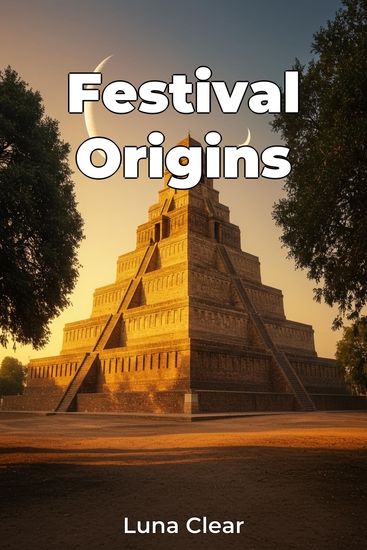
Festival Origins - cover

Festival Origins

Luna Clear

Translator A AI

Publisher: Publifye

  • 0
  • 0
  • 0

Summary

Festival Origins explores the historical and religious roots of seasonal festivals, revealing how these celebrations are deeply intertwined with mythology and ancient civilizations. It examines how early societies marked time, honored deities, and maintained social order through rituals, offering a factual perspective on festival development. Many festivals have astronomical origins, linked to solstices and equinoxes, while others find their basis in agricultural cycles like planting and harvesting. The book argues that festivals are not merely spontaneous traditions but carefully constructed events that reinforce social structures.

 
Examining ancient Mesopotamia, Egypt, Greece, and Rome, it analyzes historical development and religious significance, drawing on archaeological records and ancient texts. The book progresses by first introducing seasonal time, then examining specific festivals across different regions, and finally tracing their evolution over time. By connecting history, religious studies, and anthropology, Festival Origins provides a comprehensive understanding of these celebrations. Its interdisciplinary approach and accessible tone make it valuable for anyone interested in cultural identity, ritual, or the history of religion. This exploration fosters a greater appreciation for cultural diversity and encourages critical reflection on the meaning and purpose of festivals today.
Available since: 05/06/2025.
Print length: 58 pages.
Other books that might interest you

  • The Lion House - The Coming of a King - cover

    The Lion House - The Coming of a...

    Christopher de Bellaigue

    • 0
    • 0
    • 0
    "Christopher de Bellaigue has a magic talent for writing history. It is as if we are there as the era of Suleyman the Magnificent unfolds." —Orhan Pamuk, Winner of the Nobel Prize for Literature Narrated through the eyes of the intimates of Suleyman the Magnificent, the sixteenth-century sultan of the Ottoman Empire, The Lion House animates with stunning immediacy the fears and stratagems of those brought into orbit around him: the Greek slave who becomes his Grand Vizier, the Venetian jewel dealer who acts as his go-between, the Russian consort who becomes his most beloved wife.Within a decade and a half, Suleyman held dominion over twenty-five million souls, from Baghdad to the walls of Vienna, and with the help of his brilliant pirate commander Barbarossa placed more Christians than ever before or since under Muslim rule. And yet the real drama takes place in close-up: in small rooms and whispered conversations, behind the curtain of power, where the sultan sleeps head to toe with his best friend and eats from wooden spoons with his baby boy.In The Lion House, Christopher de Bellaigue tells not just the story of rival superpowers in an existential duel, nor of one of the most consequential lives in human history, but of what it means to live in a time when a few men get to decide the fate of the world.A Macmillan Audio production from Farrar, Straus and Giroux.
    Show book
  • Vedanta or The Science of Reality - cover

    Vedanta or The Science of Reality

    K. A. Krishnaswami Ayer

    • 0
    • 0
    • 0
    Vedanta different from philosophical speculations and Theology, in its study based on the Three States. Vedantic method. The source of Vedanta is the Upanishads, in the main. Vedanta not depending for its truth on Authority, but on reason and experience. Vedanta is a study of the three independent expressions of Life.
    Show book
  • Lavender Scare The: The History of the Federal Government’s Persecution of the Gay Community in the 20th Century - cover

    Lavender Scare The: The History...

    Editors Charles River

    • 0
    • 0
    • 0
    While the fight over gay marriage has been bitterly contested and debated for much of the 21st century, it’s still somewhat difficult to believe that just 50 years ago, homosexual activity was illegal in nearly every state in America. Homosexuals faced discrimination that surpassed that of even African-Americans or suspected Communists, and their lifestyles were so taboo that they were typically considered to be a security risk because it would be so easy for someone who wished to harm the country to blackmail them. In 1950, a Senate Subcommittee on Investigations reported, “In further considering the general suitability of perverts as Government employees, it is generally believed that those who engage in overt acts of perversion lack the emotional stability of normal persons. In addition there is an abundance of evidence to sustain the conclusion that indulgence in acts of sex perversion weakens the moral fiber of an individual to a degree that he is not suitable for a position of responsibility. Most of the authorities agree and our investigation has shown that the presence of a sex pervert in a Government agency tends to have a corrosive influence upon his fellow employees. These perverts will frequently attempt to entice normal individuals to engage in perverted practices. This is particularly true in the case of young and impressionable people who might come under the influence of a pervert. Government officials have the responsibility of keeping this type of corrosive influence out of the agencies under their control. It is particularly important that the thousands of young men and women who are brought into Federal jobs not be subjected to that type of influence while in the service of the Government. One homosexual can pollute a Government office.” Indeed, in the decades that followed, the FBI kept lists of known homosexuals, and law enforcement agencies regularly raided known gay bars and other similar establishments.
    Show book
  • Fading Footprints - In search of South Africa's first people - cover

    Fading Footprints - In search of...

    José Manuel de Prada-Samper

    • 0
    • 0
    • 0
    That summer afternoon, I had no way of knowing the book would radically alter my existence. Yet that proved to be the case. A wind that had begun to blow from a faraway place a long time ago had finally caught up with me.
    So writes folklorist José Manuel de Prada-Samper about a chance discovery more than thirty years ago of an obscure book called Specimens of Bushman Folklore in a second-hand bookshop in England.
    Part historical detective story, part memoir, Fading Footprints traces the author's journey into the magical folklore of the /xam hunter-gatherers of the Upper Karoo. Through archival research and on field trips in South Africa, de Prada-Samper reveals the tragic scope of the genocide of the /xam San by European colonisers. However, he is also able to humanise the /xam as he delves into the work and lives of researchers Wilhelm Bleek and Lucy Lloyd, who recorded the stories of San prisoners in Cape Town over more than a decade in the late 1800s.
    Determined to seek out the ancient folklore tales, the author travels to forgotten corners of the Northern Cape. There he learns that many stories are still told to this day by farm workers and that, contrary to common belief, the culture and traditions of South Africa's first people are still very much alive. Their footprints may have faded but they have not been erased.
    Show book
  • Passion for Compasses - Medieval Master Builders and their Cathedral Building Plans - cover

    Passion for Compasses - Medieval...

    Klug Sonja Ulrike

    • 0
    • 0
    • 0
    How medieval architects drew cathedral building plans
    The architectural history of the Middle Ages is full of surprises. It is difficult for us to imagine today that relatively few construction plans have been found for the impressive churches and cathedrals of the Romanesque and Gothic periods. Where did most of the drawings go? Have the plans been destroyed in Europe or lost over time? Or were they not made at all? 
    Although hardly any architectural drawings exist, there were numerous compasses. What were they used for and how? Was it possible to design complex buildings such as churches and cathedrals without blueprints? 
    The author takes her readers on an exciting cultural and historical journey through time. 
    She looks at the spread of papyrus, parchment and paper and traces the ability to write and calculate in Europe. She also looks at the construction process in historical illustrations and draws comparisons with Arabic architecture. Last but not least, she shows what types of compasses existed and how the drawing skills of master builders developed up to the Renaissance. 
    The insights into the history of architecture lead to surprising findings: The architects of the Middle Ages thought and planned very differently than we imagine today.
    Show book
  • Widespread Panic in the Streets of Athens Georgia - cover

    Widespread Panic in the Streets...

    Gordon Lamb

    • 0
    • 0
    • 0
    In April 1998, legendary southern jam band Widespread Panic held a free open-air record release show in downtown Athens, Georgia, its home base. No one involved could have known that the predicted crowd of twenty thousand would prove to be nearly five times that size. The show, now known as "Panic in the Streets," went on to become a cult favorite of fans and a decisive moment in Athens music history. This event holds the record for the world's largest record release party, but the story of how the it came to be has not been told until now. 


    Widespread Panic in the Streets of Athens, Georgia places listeners at the historic event, using in-depth investigation and interviews with the band, city officials, and "Spread Heads" who were there. Music journalist Gordon Lamb's narrative takes the listener from conception to aftermath and uncovers the local controversies and efforts that nearly stopped the show from happening altogether. 


    This deeply researched and richly sourced book follows every stage of the concert's development from the spark of an idea to approximately one hundred thousand people packing the streets of a legendary music town. Taking us back to 1990s Athens through vibrant, on-the-scene writing, Lamb gives us the story of a band on the verge of greatness and a town reckoning with its significant place in music history.
    Show book
