Join us on a literary world trip!
Add this book to bookshelf
Grey
Write a new comment Default profile 50px
Grey
Subscribe to read the full book or read the first pages for free!
All characters reduced
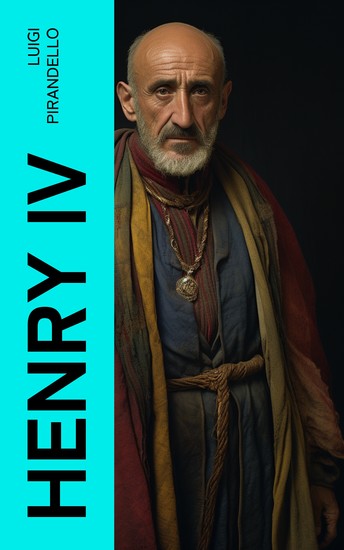
Henry IV - cover

Henry IV

Luigi Pirandello

Publisher: e-artnow

  • 0
  • 0
  • 0

Summary

The play 'Henry IV(Enrico IV)  is an Italian play by Luigi Pirandello written in 1921 and premiered to general acclaim at the Teatro Manzoni in Milan on 24 February 1922. A study on madness with both comic and tragic elements, it is about a man who believes himself to be Henry IV, Holy Roman Emperor. An unnamed Italian aristocrat falls off his horse while playing the role of Henry IV during carnevale festivities, which take place annually before Lent. After he comes to, he believes himself to be Henry. This then forces his family to engage in an elaborate charade for his sake, with comical results…
Available since: 12/10/2023.
Print length: 51 pages.
Other books that might interest you

  • What You Are Now - cover

    What You Are Now

    Sam Chanse

    • 0
    • 0
    • 0
    Are we stuck with our memories – or can we fix them? Pia is a neuroscientist whose research focuses on changing the way we process traumatic experiences. Will Pia’s emotionally distant mother - who survived the Khmer Rouge in 1970’s Cambodia – benefit from her daughter’s work? Or are some things just too terrible to remember? 
     
    Includes a conversation with Dr. Daniela Schiller, a Professor of Neuroscience and Psychiatry at the Ichan School of Medicine at Mount Sinai in New York City. 
     
    “What You Are Now” is part of L.A. Theatre Works’ Relativity Series of science-themed plays. Lead funding for the Relativity Series is provided by the Alfred P. Sloan Foundation, bridging science and the arts in the modern world. 
     
    Recorded at The Invisible Studios, West Hollywood in November 2022 
     
    Directed by Anna Lyse Erikson 
    Producing Director: Susan Albert Loewenberg 
     
    An L.A. Theatre Works full-cast recording starring:  
     
    Carie Kawa as Pia 
    Tess Lina as Chantrea  
    Joe Ngo as Darany  
    Samantha Quan as Siobhan  
    Mark Jude Sullivan as Evan 
    Greg Watanabe as the Narrator. 
     
    Senior Producer: Anna Lyse Erikson 
    Prepared for Audio by Mark Holden for The Invisible Studios, West Hollywood 
    Recording Engineer, Editor and Mixer: Charles Carroll 
    Sound Design by Charles Carroll and David Wilson 
    Senior Radio Producer: Ronn Lipkin 
    Foley Artist: Jeff Gardner 
     
    The original song “What You Are Now” is by Him Sophy, founder of the Him Sophy School of Music in Pnomh Penh. 
     
    Special thanks to Professor Craig Woodson and Dr. Terry Miller for their recording of “The Sorrowful King” from “Roots of Rhythm.net.”
    Show book
  • Rhyme A Dozen A - 12 Poets 12 Poems 1 Topic ― Churchyards - 12 Poets 12 Poems 1 Topic - cover

    Rhyme A Dozen A - 12 Poets 12...

    Thomas Gray, Alexander Anderson,...

    • 0
    • 0
    • 0
    ‘A dime a dozen’ as known in America, is perhaps equal to the English ‘cheap as chips’ but whatever the lingua franca of your choice in this series we hereby submit ‘A Rhyme a Dozen’ as 12 poems on many given subjects that are a well-rounded gathering, maybe even an essential guide, from the knowing pens of classic poets and their beautifully spoken verse to the comfort of your ears. 
     
    1 - A Rhyme A Dozen - 12 Poems, 12 Poets, 1 Topic - Churchyards - An Introduction 
    2 - Elegy Written in a Country Churchyard by Thomas Gray 
    3 - In Kirkonnel Old Churchyard by Alexander Anderson 
    4 - Contemplative Verses on the Tombs in Drumcondra Church Yard by Thomas Dermody 
    5 - Reflections in a Churchyard by Jane Timbury 
    6 - Lines Written Beneath An Elm in the Churchyard of Harrow On The Hill Sept 2nd 1807 by George Gordon Byron 
    7 - A Summer Evening Churchyard by Percy Bsysshe Shelley 
    8 - Scenes in London IV - The City Churchyard by Letitia Elizabeth Landon 
    9 - Elegy - Supposed To Be Written in Barnet Churchyard by George Townsend 
    10 - In a Christian Churchyard by James Thomson 
    11 - Eastnor Churchyard by Radclyffe Hall 
    12 - Epitaph for a Roman Catholic Churchyard by John Kenyon 
    13 - Church Monuments by George Herbert
    Show book
  • The Poetry of John Milton - Sparkling poems from the famed man behind Paradise Lost - cover

    The Poetry of John Milton -...

    John Milton

    • 0
    • 0
    • 0
    John Milton was born in Bread Street, London, on December 9th, 1608.  His early years were privately tutored before gaining a place at St Paul’s School and in 1625 he matriculated at Christ's College, Cambridge, earning a BA in 1629 and an MA in 1632. At Cambridge he had developed a reputation for poetic skill but also experienced alienation from his peers and university life as a whole.  
    The next 6 years were spent in private study. He read both ancient and modern works of theology, philosophy, history, politics, literature and science, in preparation for a poetical career.  Milton mastered Latin, Greek, Hebrew, French, Spanish, and Italian. To these he would add Old English (whilst researching his History of Britain) and also acquired more than a passing acquaintance in Dutch.  
    Although he was studying, some of his poetry from this time is remarkable; L’Allegro and Il Penseroso in 1631 and Lycidias in 1638. 
    In May 1638, Milton embarked upon a 15 month tour of France and Italy. These travels added a new and direct experience of artistic and religious traditions, especially Roman Catholicism.  He cut the journey short to return home during the summer of 1639 because of what he claimed were "sad tidings of civil war in England."  
    Once home, Milton wrote prose tracts against episcopacy, in the service of the Puritan and Parliamentary cause.  
    He married 16-year-old Mary Powell in June 1643 but she left him after only a few months during which he wrote and published several writings on divorce. Mary did return after 3 years and their life thereafter seemed harmonious.  Milton received a hostile response to the divorce tracts and drove him to write Areopagitica, his celebrated attack on pre-printing censorship.  
    With the parliamentary victory in the Civil War, Milton wrote The Tenure of Kings and Magistrates (1649) which defended popular government and implicitly sanctioned the regicide which led to his appointment as Secretary for Foreign Tongues by the Council of State.  
    On 24 February 1652 Milton published his Latin defense of the English People, Defensio Pro Populo Anglicano, also known as the First Defense. Milton's Latin prose and intellectual sweep, quickly gained him a European reputation.  
    Tragically his first wife, Mary, died on May 5th, 1652 following the birth of their fourth child.   The following year Milton had become totally blind, probably due to glaucoma.  He then had to dictate his verse and prose to helpers, one of whom was the poet Andrew Marvell. 
    He married again to Katherine Woodcock but she died in February 1658, less than four months after giving birth to a daughter, who also tragically died.  
    Though Cromwell’s death in 1658 caused the English Republic to collapse Milton stubbornly clung to his beliefs and in 1659 he published A Treatise of Civil Power, attacking the concept of a state-dominated church. Upon the Restoration in May 1660, Milton went into hiding for his life. An arrest warrant was issued and his writings burnt. He re-emerged after a general pardon was issued, but was nevertheless arrested and briefly imprisoned before influential friends, such as Marvell, now an MP, intervened 
    His third marriage was to Elizabeth Mynshull. Despite a 31-year age gap, the marriage seemed happy and Milton spent the remaining decade of his life living quietly in London, apart from a short spell in Chalfont St. Giles, during the Great Plague of London.  
    Milton was to now publish his greatest works, which had been gestating for many years.
    Show book
  • The Invisible World Is in Decline Book IX - cover

    The Invisible World Is in...

    Bruce Whiteman

    • 0
    • 1
    • 0
    The stunning conclusion to a 40-year poetic project
    		 
    In the tradition of earlier modernist long poems like Ezra Pound’s Cantos and bp Nichol’s The Martyrology, The Invisible World Is in Decline: Book IX is full of startling poetic music and imagery while addressing concerns to which every reader will respond: the life of the heart as well as life during COVID-19, love as well as death, philosophy as well as emotion. The poems are deeply responsive to what an epigraph from Virgil calls “vows and prayers,” i.e., those things that we desire and promise. Like previous books of Whiteman’s long poem, Book IX is largely in the form of the prose poem. But the book also contains a moving series of translations in traditional form of texts taken from songs by composers like Schubert and Beethoven, songs that are by turns tragic, meditative, lyrical, and touching. The concluding section focuses on an obsession that poets have had for 2,500 years: inspiration, in the form of the nine Muses. At the heart of this book is what Whiteman calls “the bright articulate world,” something visionary but accessible to every thoughtful reader.
    Show book
  • Woman at the Crossing - cover

    Woman at the Crossing

    Susan Okie

    • 0
    • 0
    • 0
    In the poem that opens her debut collection, Susan Okie recounts an evening in the anatomy lab. Here we witness the depths of her curiosity toward her subject's inner workings. When I tugged on the flexor digitorum tendons, / her fingers partly closed and her thumb /crooked in. I seemed to see the two of us / as if from outside, and could no longer / name the tendons. I felt my fingers / from inside her hand." What to some might feel like harrowing proximity, Okie delivers, in astonishing verse, with wonder and even intimacy. To be sure, Woman at the Crossing is the work of a seasoned practitioner.
    Show book
  • Mastering the French Accent and Pronunciation - Professional Techniques for Actors for Stage and Screen Performance - cover

    Mastering the French Accent and...

    Oscar Stanley

    • 0
    • 0
    • 0
    Are you an actor preparing for a role that requires a convincing French accent? Do you need to refine your pronunciation, rhythm, and intonation for an audition? Mastering the French Accent and Pronunciation: Professional Techniques for Actors is the ultimate audio course designed to help performers perfect their French-accented English for stage and screen.
     
    This immersive training program, created specifically for English-speaking actors, provides expert guidance on the nuances of French phonetics, vowel and consonant shifts, speech rhythm, and intonation patterns. You'll learn how to soften consonant clusters, pronounce the signature uvular 'R,' and master the melodic cadence of a true French accent. The course also includes in-depth pronunciation drills, practical exercises, dialogue practice, and listening exercises modeled after authentic French-accented English.
     
    Beyond speech training, this course explores non-verbal communication, including body language and gestures essential for embodying a French-speaking character. You’ll also gain insight into regional variations—from the refined Parisian accent to the lyrical southern tones of Provence—allowing you to adapt your accent to different characters and settings.
     
    By the end of this course, you’ll have the confidence and precision needed to deliver a natural, compelling French-accented performance. Whether you're preparing for a major film role, a theatrical production, or a voice-over gig, this training will enhance your range and credibility as an actor.
     
    Perfect your French accent today—immerse yourself in expert training and bring authenticity to every performance!
    Show book