

Join us on a literary world trip!
Add this book to bookshelf
Grey
Write a new comment Default profile 50px
Grey
Subscribe to read the full book or read the first pages for free!
All characters reduced
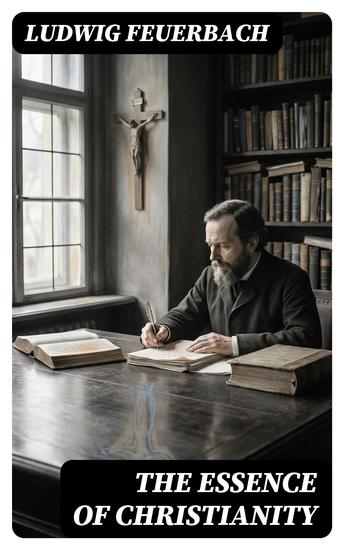
The Essence of Christianity - Enriched edition - cover

The Essence of Christianity - Enriched edition

Ludwig Feuerbach

Translator George Eliot

Publisher: DigiCat

  • 0
  • 0
  • 0

Summary

In "The Essence of Christianity," Ludwig Feuerbach presents a profound critique of religious orthodoxy by analyzing the essence of Christian beliefs. Through a nuanced blend of philosophy and theology, Feuerbach examines the projection of human qualities onto the divine, arguing that God is essentially a reflection of human nature. His literary style is marked by eloquent prose and a deeply analytical approach, situating his work within the broader context of 19th-century German philosophy, particularly in the wake of Hegelian thought. Feuerbach's radical ideas challenge the metaphysical foundations of religion, positing that understanding humanity is essential to comprehending the divine. Ludwig Feuerbach, a pivotal figure in the Munich Circle of philosophers, was deeply influenced by his upbringing in a religious environment, which fueled his inquiry into the intersection of faith and reason. His transition from a theologian to a philosopher epitomizes the tensions of his time—an era characterized by Enlightenment skepticism and the emergence of secular humanism. His work laid the groundwork for subsequent developments in existentialism and atheism, marking him as a crucial thinker in the philosophical landscape. "The Essence of Christianity" is essential reading for anyone interested in the philosophical foundations of religion and the critique of belief systems. Scholars, students, and curious readers alike will find Feuerbach's insights both challenging and enlightening, encouraging a reconsideration of the relationship between humanity and the divine.

In this enriched edition, we have carefully created added value for your reading experience:
- A succinct Introduction situates the work's timeless appeal and themes.
- The Synopsis outlines the central plot, highlighting key developments without spoiling critical twists.
- A detailed Historical Context immerses you in the era's events and influences that shaped the writing.
- A thorough Analysis dissects symbols, motifs, and character arcs to unearth underlying meanings.
- Reflection questions prompt you to engage personally with the work's messages, connecting them to modern life.
- Hand‐picked Memorable Quotes shine a spotlight on moments of literary brilliance.
- Interactive footnotes clarify unusual references, historical allusions, and archaic phrases for an effortless, more informed read.
Available since: 05/17/2022.
Print length: 394 pages.
Other books that might interest you

  • A Rare Recording of Gertrude Stein Reading Her Own Writing - cover

    A Rare Recording of Gertrude...

    Gertrude Stein

    • 0
    • 0
    • 0
    Gertrude Stein (February 3, 1874 - July 27, 1946) was an American novelist, poet, playwright, and art collector. Born in Allegheny, Pennsylvania, and raised in Oakland, California, Stein moved to Paris in 1903, and made France her home for the remainder of her life. She hosted a Paris salon, where the leading figures of modernism in literature and art, such as Pablo Picasso, Ernest Hemingway, F. Scott Fitzgerald, Sinclair Lewis, Ezra Pound, Sherwood Anderson and Henri Matisse, would meet. The following three recordings are from Stein's novel, The Making of Americans (1925), and her poems, How She Bowed to her Brother (1931) and If I Told Him - A Completed Portrait of Picasso (1923)
    Show book
  • Relationship Communication & No More Codependency 2-in-1 - Stay Away from Abusive Relationships + Learn to Communicate with Your Partner to Reach New Relationship Levels and Resolve Any Conflict - cover

    Relationship Communication & No...

    Tyler Cross

    • 0
    • 0
    • 0
    Do you constantly seek approval and feel hurt whenever your efforts are not recognized? Will you do anything and everything to preserve a relationship? Are you afraid of being alone and unloved? Then you need to keep listening... 
    This includes two books:Relationship Communication: Discover How to Resolve Any Conflict with Your Partner & Create Deeper Intimacy in Your RelationshipCodependency: Healthy detachments strategies to break the patterns. Discover how to stop struggling with codependent relationships, obsessive jealousy, and narcissistic abuse 
    Here's a short preview of what you'll discover:Ten communication mistakes you have absolutely no idea you're making. (Identify the REAL problems that are killing your relationship and start eliminating them immediately!)Nine less-known communication habits that save relationships.Five statements to instantly defuse a heated conversation.Expert-known tips for bringing up difficult conversations with NO pain and drama.The EXACT formula for recognizing if you are in a codependent relationship.Why it's possible to love a person too much and risk losing yourself in a relationship.The little-known destructive habits that you need to quit NOW for your mental health and physical safety.How to BREAK FREE from persistent and damaging relationships once and for all (even if you think you can't live without that person) 
    And much, much more... 
    If you want to unlock access to this potent information about relationships and emotional healing, then you should start this book today!
    Show book
  • Splitting the Confederacy: The History of the Union Campaigns to Take the Mississippi River - cover

    Splitting the Confederacy: The...

    Editors Charles River

    • 0
    • 0
    • 0
    Given its importance, it’s somewhat surprising in retrospect that the Union managed to capture New Orleans in an easier manner than places like Vicksburg and Atlanta. Admiral David Farragut’s naval forces battered their shaky Confederate counterparts and were able to get over a dozen ships upriver past a couple of crucial Confederate forts along the Mississippi. By May 1862, Union forces occupied the city and General Benjamin Butler became its military governor, leaving the last true bastion of Confederate defenses on the Mississippi at Vicksburg. 
    At the start of 1863, Robert E. Lee’s Army of Northern Virginia had been frustrating the Union in the Eastern theater for several months, but the situation in the West was completely different. The Confederates had lost control of several important states throughout 1862, and after New Orleans was taken by the Union, the North controlled almost all of the Mississippi River, which Confederate general James Longstreet called “the lungs of the Confederacy”. By taking control of that vital river, the North would virtually cut the Confederacy in two, putting the South in a dire situation. 
    The only domino left to fall was the stronghold of Vicksburg, and both sides knew it. The Union Army of the Tennessee, led by Ulysses S. Grant, would spend months trying to encircle the army and eventually force John Pemberton’s Confederate army to surrender. Grant eventually succeeded on July 4, 1863, but since it came a day after the climactic finish of the Battle of Gettysburg, Vicksburg was (and still is) frequently overlooked as one of the turning points of the Civil War. In fact, had the Confederate’s military leadership listened to Longstreet, who advocated detaching soldiers from Lee’s army to head west and help the Confederates deal with Grant or Rosecrans in that theater, the Battle of Gettysburg might never have happened.
    Show book
  • Liberty in America Past Present and Future - A Prescription for America - cover

    Liberty in America Past Present...

    Willeam Choby

    • 0
    • 0
    • 0
    In Liberty in America: Past, Present, and Future, renowned dentist and healthy policy expert, Dr. Bill Choby, presents how America, as the empire of liberty, has achieved freedom through the Godliness and goodness of its citizens. 
    Providing an essential insight into America's past, it demonstrates how the country's great forefathers fought against an oppressive government and sought freedom from political bondage through their selflessness and God-fearing personalities. 
    Dr. Choby also seeks to distinguish liberalism from liberty and define what true liberty is by highlighting what made the American government unique in all of history-faith, courage, discipline, and personal sacrifice. 
    In this book, he offers the ongoing challenges faced by freedom in the present and how the American people can secure the blessings of liberty for the future generation.
    Show book
  • A Rare Recording of Poet John Ciardi - cover

    A Rare Recording of Poet John...

    John Ciardi

    • 0
    • 0
    • 0
    John Anthony Ciardi (June 24, 1916 - March 30, 1986) was an American poet, translator, and etymologist. While primarily known as a poet, Ciardi pursued etymology, contributed to the Saturday Review as a columnist and long-time poetry editor, directed the Bread Loaf Writers' Conference in Vermont, and recorded commentaries for National Public Radio. In 1959, Ciardi published a book on how to read, write, and teach poetry, How Does a Poem Mean?, which has proven to be among the most-used books of its kind. The following recording is from a speech Ciardi gave in 1965.
    Show book
  • Jewish Space Lasers - The Rothschilds and 200 Years of Conspiracy Theories - cover

    Jewish Space Lasers - The...

    Mike Rothschild

    • 0
    • 0
    • 0
    The strange tale of how one Jewish family—the Rothschilds—became a lightning rod for conspiracy theories over the course of the last two centuries . . .  


    In 2018 Congresswoman Marjorie Taylor Greene took to social media to share her suspicions that the California wildfires were started by 'space solar generators' which were funded by powerful, mysterious backers. Instantly, thousands of people rallied around her, blaming the fires on "Jewish space lasers" and, ultimately, the Rothschild family. 


    For more than 200 years, the name "Rothschild" has been synonymous with two things: great wealth, and conspiracy theories about what they're "really doing" with it. Almost from the moment Mayer Amschel Rothschild and his sons emerged from the Jewish ghetto of Frankfurt to revolutionize the banking world, the Rothschild family has been the target of myths, hoaxes, bizarre accusations, and constant, virulent antisemitism. Over the years, they have been blamed for everything from the sinking of the Titanic, to causing the Great Depression, and even creating the COVID-19 pandemic. 


    Jewish Space Lasers is a deeply researched dive into the history of the conspiracy industry around the Rothschild family.
    Show book
