

Join us on a literary world trip!
Add this book to bookshelf
Grey
Write a new comment Default profile 50px
Grey
Subscribe to read the full book or read the first pages for free!
All characters reduced
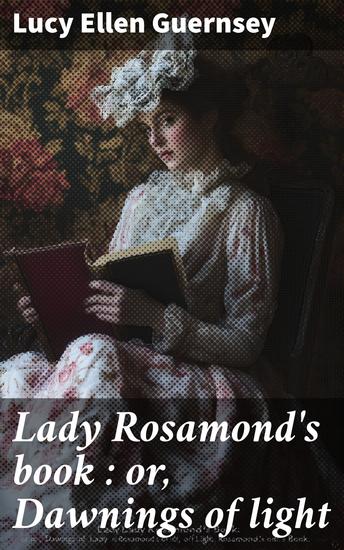
Lady Rosamond's book : or Dawnings of light - cover

Lady Rosamond's book : or Dawnings of light

Lucy Ellen Guernsey

Publisher: Good Press

  • 0
  • 0
  • 0

Summary

In "Lady Rosamond's Book: or, Dawnings of Light," Lucy Ellen Guernsey presents a compelling narrative interwoven with themes of self-discovery, moral fortitude, and the pursuit of knowledge. Set against a backdrop of Victorian sensibilities, the novel employs a rich, lyrical prose that challenges readers to ponder the societal constraints imposed on women of the era. Through the character of Lady Rosamond, Guernsey delves into the philosophical underpinnings of virtue and enlightenment, emphasizing the importance of intellectual empowerment and personal growth amidst the rigid expectations of her time. Lucy Ellen Guernsey, a prominent figure in 19th-century literature, was known for her advocacy of women's rights and education, which profoundly influenced her writing. As a product of her time, Guernsey was deeply engaged in the social issues surrounding gender equality and intellectual freedom, experiences that shaped the narrative arc of "Lady Rosamond's Book." Her commitment to illuminating the inner lives of her characters and addressing societal norms reflects her desire to inspire change and elevate women's roles both in literature and society. This book is highly recommended for readers interested in exploring the intersection of feminism and literature during the Victorian era. Guernsey's richly drawn characters and thought-provoking themes offer a timeless exploration of the struggles faced by women in their quest for autonomy and respect within a patriarchal society. Readers will find themselves captivated by Lady Rosamond's journey, making this novel a significant addition to any literary collection.
Available since: 03/02/2025.
Print length: 210 pages.

Other books that might interest you

  • Middlemarch (Book 4: Three Love Problems) - cover

    Middlemarch (Book 4: Three Love...

    George Eliot

    • 0
    • 0
    • 0
    Middlemarch (Book 4: Three Love Problems), A Study of Provincial Life is a novel by English author George Eliot, the pen name of Mary Ann Evans. It appeared in eight installments (volumes) in 1871 and 1872. Set in Middlemarch, a fictional English Midlands town, from 1829 to 1832, it follows distinct, intersecting stories with many characters. Issues include the status of women, the nature of marriage, idealism, self-interest, religion, hypocrisy, political reform, and education. Leavened with comic elements, Middlemarch approaches significant historical events in a realist mode: the Reform Act 1832, early railways, and the accession of King William IV. It looks at medicine of the time and reactionary views in a settled community facing unwelcome change. Eliot began writing the two pieces that formed the novel in 1869–1870 and completed it in 1871. Initial reviews were mixed, but it is now seen widely as her best work and one of the great English novels.
    Show book
  • Ella D'Arcy - A Short Story Collection - An anthology from underrated female author D'Arcy her sparkling psychologically realist style covered themes such as marriage family and society - cover

    Ella D'Arcy - A Short Story...

    Ella D'Arcy

    • 0
    • 0
    • 0
    Ella D'Arcy was born on 23rd August 1857 in London, one of nine children.  
     
    Her education spanned London, Germany, France and the Channel Islands. A student of fine art, her poor eyesight meant a switch to literature was needed and with this she had hopes to be an author. 
     
    She worked as a contributor and unofficial editor, alongside Henry Harland, to The Yellow Book, Aubrey Beardsley’s sensational quarterly magazine that combined art, stories, poetry, essays and much else besides.  D'Arcy wrote several stories for the magazine and her stories have an undeniable psychological and realist style through her engagement with various themes from marriage, the family, imitation through to deception.  
     
    Recognition of her talents grew after the publication of ‘Irremediable’, in the Yellow Book, where it received much praise from critics.   
     
    She also wrote and published in the Argosy, Blackwood's Magazine, and Temple Bar.  
     
    However, D’Arcy’s canon was small and, apart from her magazine stories, her book publishing was limited to ‘Monochromes’ (1895), ‘Modern Instances’ and ‘The Bishop’s Dilemma’ (1898). She also translated André Maurois's biography of Percy Bysshe Shelley entitled ‘Ariel’ (1924). 
     
    Her diligence with work aside she was notorious for her inability to maintain relationships with friends.  When she did appear to them it was often unannounced.  This earned her the sobriquet 'Goblin Ella.' 
     
    D'Arcy spent much of her life living alone, though she had a constant urge to travel, but usually she resided on the edge of poverty. Her writing was often motivated by this need. 
     
    Much of her later life was spent in Paris before returning to London in 1937, where she died, in hospital, on 5th September 1937. 
     
    01 - Ella D'Arcy - A Short Story Collection - An Introduction 
    02 - At Twickenham by Ella D'Arcy 
    03 - White Magic by Ella D'Arcy 
    04 - Irremediable by Ella D'Arcy 
    05 - The Death Mask by Ella D'Arcy 
    06 - Sir Julian Garve by Ella D'Arcy
    Show book
  • The Sand-Man - cover

    The Sand-Man

    E. T. A. Hoffman

    • 0
    • 0
    • 0
    "The Sand-Man" (German: Der Sandmann, 1816) is a short story written in German by E. T. A. Hoffmann. It was the first in an 1817 book of stories titled “Die Nachtstücke” (The Night Pieces).
    The story is told by a narrator who claims to have known Lothar. It begins by quoting three letters...
    Show book
  • The Adventure of Black Peter - cover

    The Adventure of Black Peter

    Arthur Conan Doyle

    • 0
    • 0
    • 0
    The Adventure of Black Peter is a Sherlock Holmes story by Arthur Conan Doyle. This tale is in the collection The Return of Sherlock Holmes, but was published originally in 1904 in the Strand Magazine and Collier's.Forest Row in the Weald is the scene of a harpoon murder, and a young police inspector, Stanley Hopkins, asks Holmes, whom he admires, for help. Holmes has already determined that it would take a great deal of strength and skill to run a man through with a harpoon and embed it in the wall behind him.Peter Carey, the 50-year-old victim and former master of the Sea Unicorn of Dundee, who lived with his wife and daughter, had a reputation for being violent. Carey did not sleep in the family house, but in a small cottage that he built some distance from the house, whose interior he had decorated to look like a sailor's cabin on a ship. This is where he was found harpooned. Hopkins could find no footprints or other physical evidence. However, a tobacco pouch made of sealskin and with the initials "P.C." was found at the scene, which was full of strong ship's tobacco. This is rather unusual, as Peter Carey—or "Black Peter" as people called him—seldom smoked. Indeed, Hopkins found no pipe in the cabin. Carey was found fully dressed, suggesting that he was expecting a visitor, and there was some rum laid out along with two dirty glasses...Famous works of the author Arthur Conan Doyle: A Study in Scarlet, The Sign of the Four, The Adventures of Sherlock Holmes, The Memoirs of Sherlock Holmes, The Hound of the Baskervilles, The Return of Sherlock Holmes, The Valley of Fear, His Last Bow, The Case-Book of Sherlock Holmes, Stories of Sherlock Holmes, The Lost World.
    Show book
  • Vincent O'Sullivan - A Short Story Collection - Underrated American author and friend to Oscar Wilde - cover

    Vincent O'Sullivan - A Short...

    Vincent O'Sullivan

    • 0
    • 0
    • 0
    Vincent O'Sullivan was born on the 28th November 1868 in New York City.  He was initially educated through the New York public school system before finishing his studies in England.  As a young man he remained in London and travelled often to Paris.  
    O’Sullivan lived a very comfortable life with income from the family coffee business.  He had no real need to work but decided that a literary lifestyle was for him.   
    In 1896 he released his first volume of supernatural fiction ‘A Book of Bargains’.  Within its pages were classic stories that involved pacts with the Devil, reanimated corpses and psychic vampires. 
    Over the course of his career, he wrote a mere 10 volumes of short stories, novels, poetry together with some occasional criticism. 
    In 1909 his brother, who ran the company, entered its resources into some terribly mis-timed trades in coffee futures and ruin for both the company and the family quickly followed. 
    From now until his death O’Sullivan was destitute, life was exceedingly difficult. 
    Vincent O’Sullivan died on the 18th July 1940 in Paris.  He was 71.  He was buried in a paupers grave along with the remains of others.
    Show book
  • Heart of Darkness & The Metamorphosis - cover

    Heart of Darkness & The...

    Joseph Conrad, Franz Kafka

    • 0
    • 0
    • 0
    Dual Descent: Heart of Darkness & The Metamorphosis 
    A Digital Listening Experience of Psychological Transformation 
     
    Step into the shadows of the human psyche with this gripping two-title collection of literary masterpieces. 
     
    Joseph Conrad’s Heart of Darkness Venture deep into the Congo as Marlow recounts his haunting journey upriver in search of the enigmatic Mr. Kurtz. This atmospheric tale explores the thin line between civilization and savagery, exposing the darkness that lies within us all. Our immersive narration brings Conrad’s brooding prose to life, pulling you into a world of imperial ambition, moral ambiguity, and existential dread. 
     
    Franz Kafka’s The Metamorphosis Awaken to a surreal nightmare as Gregor Samsa finds himself transformed into a monstrous insect. Kafka’s chilling novella captures the alienation, absurdity, and quiet tragedy of a man discarded by society — and even his own family. This performance-driven adaptation captures every nuance of Kafka’s bleak brilliance. 
     
    Two journeys. One into the jungle. One into the self. Perfect for fans of psychological fiction, existential literature, and dark classics.
    Show book
