Join us on a literary world trip!
Add this book to bookshelf
Grey
Write a new comment Default profile 50px
Grey
Subscribe to read the full book or read the first pages for free!
All characters reduced
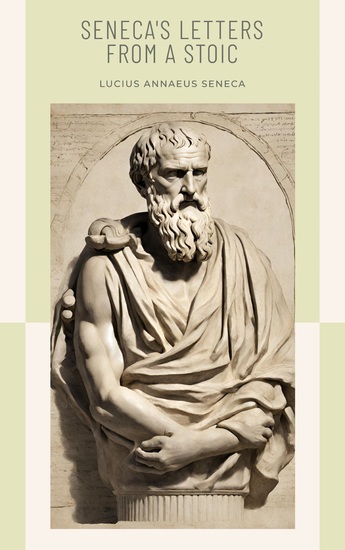
Seneca's Letters from a Stoic - A Journey Through Timeless Virtues - cover

Seneca's Letters from a Stoic - A Journey Through Timeless Virtues

Lucius Annaeus Seneca, Bookish

Publisher: Bookish

  • 0
  • 0
  • 0

Summary

Embark on an enlightening voyage through the ages with "Wisdom of the Ages: Seneca's Letters from a Stoic." This cherished collection of letters from one of the most revered Stoic philosophers, Seneca, unfolds a treasure trove of timeless wisdom that resonates with the seekers of truth even today.

With each page, you'll traverse through a myriad of profound thoughts, learning to navigate life's tempests with grace, courage, and equanimity. The letters, written with a sense of camaraderie and heartfelt advice, unveil the essence of a good life, touching upon themes of virtue, friendship, and the human condition.

Esteemed scholars and everyday readers alike have found solace and guidance in Seneca's words, praising the timeless relevance and profound insights contained within. The serenity and clarity that emanate from Seneca's counsel have proven to be a beacon of light for countless souls navigating the human experience.

Your expedition into the heart of Stoicism begins with the first letter, leading you on a path of reflection, acceptance, and a deeper understanding of life's intricacies. The golden threads of wisdom woven through "Wisdom of the Ages: Seneca's Letters from a Stoic" are awaiting your perusal, promising not just a read, but a journey towards an enlightened existence.

Answer the calling of timeless wisdom and embrace the teachings that have illuminated the path of many. Uncover the profound truths embedded in Seneca's letters and let the voyage of self-discovery commence. Your quest for a life of purpose, tranquility, and enduring wisdom begins here.
Available since: 10/08/2023.
Print length: 483 pages.


Other books that might interest you

  • Portraits as Animal - Poems - cover

    Portraits as Animal - Poems

    Victoriano Cárdenas

    • 0
    • 0
    • 0
    Portraits as Animal is a gallery of self-becoming in a "sunbaked house as tiny as a heart." With a toothy lyricism at turns sly and forthright, Cárdenas's hunger to belong carries us from a stove "bleeding a hundred kinds of caldo" to his "determined mitochondrial ancestors''-a journey framed by generational struggles with addiction, a queerphobic church, and the always-transforming land. 
    In conversation with Taos's rich artistic tradition and the brutal, binding legacy of colonization, Cárdenas writes through his transition, acknowledging that "to become a man means a lifetime of needles like the man who raised me." Here is pain and violence, but here, too, is the assurance that we are "built for this metamorphosis" and can follow our past incarnations "over scorched earth neon with new grass" to a future of our own making.
    Show book
  • British Empire The: An Enthralling Guide to the Rise and Fall of the World’s Largest Superpower in History - cover

    British Empire The: An...

    Billy Wellman

    • 0
    • 0
    • 0
    Dive into the epic saga of global dominance in The British Empire.  
    In this riveting journey, you’ll explore how a tiny island nation ascended to rule nearly a quarter of the globe. From the Age of Discovery to the poignant end of Queen Elizabeth II’s reign, this audiobook is a masterful tapestry of history, power, and ambition. 
    Discover Its Origins 
    Unearth the roots of the British Empire. How did a small island transform into a colossal titan of power and influence? 
    From Conquest to Collapse 
    Witness the breathtaking expanse of an empire on which the sun never set. Learn about the pivotal moments, the grand victories, and the stark realities of colonization and trade that sculpted the world. 
    Power and Downfall 
    Delve into the dual narratives of triumph and tragedy. Understand the complex interplay of historical events and internal dynamics that led to the zenith of British power and its inevitable decline. 
    A Story of Ambition 
    Grasp the consequences of imperial dreams. What did it mean for the world, and what were the lasting impacts of this colossal empire? 
    A Compact Chronicle 
    Designed as a quick yet comprehensive read, this audiobook is perfect for those seeking to grasp the essence of Britain’s imperial history without being overwhelmed. 
    Essential Learning 
    Whether you’re a history buff, a student, or simply curious, this guide offers a balanced, engaging perspective on one of history’s most influential empires. 
    Don’t miss the chance to unravel the story of one of the world’s greatest empires. Click the “add to cart” button to embark on a historical journey today!
    Show book
  • Start of World War I The: The History of the Events at the Beginning of the Great War - cover

    Start of World War I The: The...

    Editors Charles River

    • 0
    • 0
    • 0
    By the 20th century, warfare was nothing new to the European powers, especially when it came to fighting each other. Conflicts had been a mainstay on the European continent for over two millennia. Even after the Napoleonic wars had enveloped Europe in large scale war for nearly 20 years in the 19th century, the Europeans’ imperialism continued unabated. It would take the devastation of World War I to shock Europe and jolt the world’s superpowers out of their imperialistic tendencies.  
    	 The final straw came June 28, 1914, when a Serbian assassinated Archduke Franz Ferdinand, the heir to the throne of Austria-Hungary, in Sarajevo, Bosnia. Austria-Hungary immediately issued ultimatums to Serbia. When they declared war on Serbia July 28, 1914, Russia mobilized for war as well. The Germans mobilized in response to Russia on July 30, and the French, still smarting from the Franco-Prussian War, mobilized for war against Germany. The British also declared war on Germany on August 4. Thus, in the span of one week, six nations had declared war, half of which had no interest in the Balkans.  
    	Needless to say, the First World War came at an unfortunate time for those who would fight in it. After an initial period of relatively rapid maneuver during which the German forces pushing through Belgium and the French and British forces attempting to stymie them made an endless series of abortive flanking movements that extended the lines to the sea, a stalemate naturally tended to develop. The infamous trench lines soon snaked across the French and Belgian countryside, creating an essentially futile static slaughterhouse whose sinister memory remains to this day, but if trench warfare was an inevitability during the war, it is only because the events leading up to the initial battles were quite different.
    Show book
  • Progress and poverty: Book Summary & Analysis - cover

    Progress and poverty: Book...

    Henry George

    • 0
    • 0
    • 0
    "Progress and Poverty" is a seminal work written by Henry George, first published in 1879. The book addresses economic and social issues, particularly focusing on the unequal distribution of wealth and the causes of poverty in the midst of progress and economic growth. In "Progress and Poverty," Henry George explores the relationship between economic progress and the persistence of poverty. He critiques the existing economic system and advocates for a single tax on land as a solution to address wealth inequality and eradicate poverty. George argues that land, as a resource, should be treated as a common good, and the benefits of land value increases should be shared by the community. The book gained widespread attention and sparked discussions on economic reform and social justice.
    Show book
  • The Princes in the Tower - Solving History's Greatest Cold Case - cover

    The Princes in the Tower -...

    Philippa Langley

    • 0
    • 0
    • 0
    Philippa Langley took the world by storm when, against all the odds and a seven-year investigation, she discovered the grave of King Richard III (1452-1485) in a Leicester car park. A king finally laid to rest, the rediscovery and reburial of Richard III was watched by an estimated global audience of over 366 million. 
     
    Now, Langley reveals the findings of a remarkable new research initiative: ‘The Missing Princes Project’. In the summer of 1483, Edward V (aged 12) and his brother Richard Duke of York (aged 9), disappeared from the Tower of London. For over 500 years, history has judged that they were murdered on the orders of their uncle Richard III. 
     
    Following years of intensive research in UK, American and European archives, astonishing new archival discoveries have been uncovered that change what we know about the fate of the Princes in the Tower. Established by Langley in 2016, ‘The Missing Princes Project’ employed the methods of a cold-case police enquiry. Using investigative methodology, it aimed to place this most enduring of mysteries under a forensic microscope for the first time. 
     
    In The Princes in the Tower: Solving History's Greatest Cold Case, Langley records the painstaking investigative work and research of the project. By questioning received wisdom, she and her team shed light upon one of history's greatest miscarriages of justice, revealing a phenomenal untold story.
    Show book
  • Ghost Ship - The Mysterious True Story of the Mary Celeste and Her Missing Crew - cover

    Ghost Ship - The Mysterious True...

    Brian Hicks

    • 0
    • 0
    • 0
    On December 4th, 1872, a 100-foot brigantine was discovered drifting through the North Atlantic without a soul on board. Not a sign of struggle, not a shred of damage, no ransacked cargo—and not a trace of the captain, his wife and daughter, or the crew. What happened on board the ghost ship Mary Celeste has baffled and tantalized the world for 130 years. Brian Hicks plumbs the depths of this fabled nautical mystery and uncovers the truth. 


    The Mary Celeste was cursed as soon as she was launched on the Bay of Fundy in 1861. Her first captain died before completing the maiden voyage. In London she accidentally rammed and sank an English brig. Later she was abandoned after a storm drove her ashore at Cape Breton. But somehow the ship was recovered and refitted, and in 1872 she fell to the reluctant command of a seasoned mariner named Benjamin Spooner Briggs. It was Briggs who was at the helm when the Mary Celeste sailed into history. 


    The story of the Mary Celeste becomes the quintessential tale of men lost at sea. Hicks vividly recreates the events leading up to the crew's disappearance and then unfolds the complicated and bizarre aftermath. Brian Hicks reveals the truth is actually grounded in the combined tragedies of human error and bad luck.
    Show book