Join us on a literary world trip!
Add this book to bookshelf
Grey
Write a new comment Default profile 50px
Grey
Subscribe to read the full book or read the first pages for free!
All characters reduced
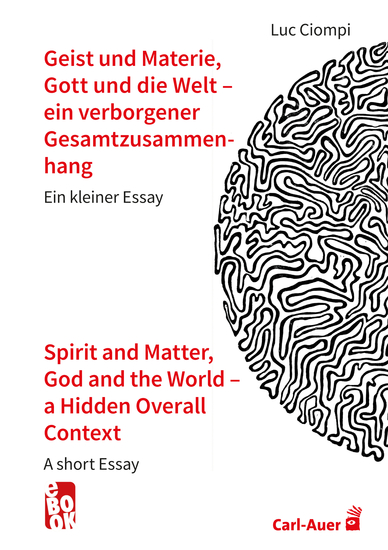
Geist und Materie Gott und die Welt – ein verborgener Gesamtzusammenhang Spirit and Matter God and the World – a Hidden Overall Context - Ein kleiner Essay A short Essay - cover

Geist und Materie Gott und die Welt – ein verborgener Gesamtzusammenhang Spirit and Matter God and the World – a Hidden Overall Context - Ein kleiner Essay A short Essay

Luc Ciompi

Publisher: Carl-Auer Verlag

  • 0
  • 0
  • 0

Summary

… "Wenn ich also das Ergebnis meiner Untersuchung in knappster Form zusammenfassen müsste, so ergäbe sich etwa Folgendes: Energie ist eine Urkraft unbekannter Herkunft mit einem ungeheuren Differenzierungspotenzial. 'Tote' wie lebende Materie ist zunehmend raffiniert organisierte Energie. Das organisierende Prinzip ist der Weltgeist, ein grenzenloses abstraktes Potenzial von Kombinationsmöglichkeiten, welche im Lauf der Evolution vom Big Bang bis heute immer differenzierter realisiert und materialisiert worden sind. Aspekte des Weltgeists werden von lebendigen Organismen sukzessive entdeckt und genutzt. Sowohl der Weltgeist wie auch die Energie können wahlweise als göttlichen oder natürlichen Ursprungs aufgefasst werden."

… "So if I had to summarize the result of my investigation in the briefest form, it would be something like the following: energy is a primal force of unknown origin with a tremendous potential for differentiation. 'Dead' and living matter is increasingly sophisticatedly organized energy. The organizing principle is the world spirit, a limitless abstract potential of possible combinations, which has been realized and materialized in an increasingly differentiated way in the course of evolution from the Big Bang to the present day. Aspects of the world spirit are successively discovered and utilized by living organisms. Both the world spirit and the energy can be understood to be either of divine or natural origin."
Der Autor:
Luc Ciompi, Prof. em.; Studium der Medizin, Facharzt für Psychiatrie und Psychotherapie; psychoanalytische und systemisch-familientherapeutische Ausbildung; 1977–1994 Ordentlicher Professor an der medizinischen Fakultät der Universität Bern, Mit-Vorsteher des Departements der Universität Bern und ärztlicher Direktor der Sozialpsychiatrischen Universitätsklinik Bern; 1984–1998 Begründer und erster ärztlicher Leiter der therapeutischen Wohngemeinschaft "Soteria Bern"; seit 1995 freier wissenschaftlicher Buchautor und Publizist; psychotherapeutische Beratungs- und Supervisionstätigkeit, Computerforschung zum Konzept der Affektlogik.
Available since: 11/22/2024.
Print length: 111 pages.
Other books that might interest you

  • Trauma and Ecstasy - How Psychedelics Made My Life Worth Living - cover

    Trauma and Ecstasy - How...

    Alex Abraham

    • 0
    • 0
    • 0
    Forget everything you think you know about psychedelics. They’re not punchlines. They’re not party favors for aging hippies. Instead, as Alex Abraham discovered, they are an innovative approach that can help heal trauma and chronic pain.Trauma and Ecstasy takes a long, hard look at pain, from the sudden unexplained pelvic floor discomfort that afflicted Alex at the end of a trip abroad to the deeply rooted anxiety and shame of a childhood robbed of innocence. In this powerful and courageous memoir, Alex takes you on his journey of healing from sexual abuse while searching for answers to his health issues that traditional medicine failed to explain or treat.Trauma and Ecstasy is quite likely the most engaging, honest, and compelling memoir of surviving childhood sexual trauma you’ll ever read. It offers the hope of real help for healing from the emotional and physical aftermath of abuse and chronic pain.
    Show book
  • On the Motion of Animals - cover

    On the Motion of Animals

    Aristotle

    • 0
    • 0
    • 0
    "On the Motion of Animals" is a scientific work by Aristotle that explores the principles of motion in living beings. In this treatise, Aristotle observes and analyzes the movements of various animals, from insects to humans, in order to understand the mechanics of motion and the physiological and psychological factors that drive it. Aristotle begins by examining the different types of motion, including natural, violent, and voluntary, and how they relate to the movements of animals. He then delves into the anatomy and physiology of different animals, looking at their skeletal structures, muscular systems, and nervous systems, and how they work together to produce motion. Read in English, unabridged.
    Show book
  • Voices of Evangelical Preachers - Volume 2 - cover

    Voices of Evangelical Preachers...

    Gypsy Smith, J. Wilbur Chapman,...

    • 0
    • 0
    • 0
    Gipsy Smith (1860-1947) was an English evangelist who made over forty evangelistic trips abroad to such countries as the United States, Australia and South Africa. J. Wilber Chapman (1859-1918), a Presbyterian, had great success in four pastorates, but is best remembered as a powerful evangelist. William Booth (1829 –1912) was a British Methodist preacher who founded The Salvation Army. The Christian movement with a quasi-military structure and government founded in 1865 has spread from London, England to many parts of the world and is known for being one of the largest distributors of aid.
    Show book
  • Taking Charge of ADHD Bundle 2 in 1 Bundle - Adult ADHD and Thriving with ADHD - cover

    Taking Charge of ADHD Bundle 2...

    Ruby Spangley, C.A. Ripley

    • 0
    • 0
    • 0
    Taking Charge of ADHD Bundle, 2 in 1 bundle: Adult ADHD and Thriving with ADHDAccording to the World Health Organization, one in four people suffers from a mental disorder. But some are not even getting diagnosed which makes it harder for them to overcome their issues. The whole subject of ADHD is not short on controversy - some people insist that ADHD is a "manufactured disorder" intended as a ploy to sell more Ritalin; others point out that ADHD is a real disorder with discernable brain wave activity that is correlative to symptoms. Amid all the discussion is the quiet voice that questions the disciplinary practices of some parents with ADHD-positive children. This bundle will discuss all the important information pertaining to ADHD. If you are a parent of a child who you suspect has ADHD or was already diagnosed with the disorder, the audiobooks in this bundle will be a good guide on how to manage the disorder and to learn more about all treatments available.This 2 in 1 bundle includes the following audiobooks:1. Adult ADHD: The Essential Guide to Mental Health Management, Discover Ways on How to Deal With Mental Disorders Such as ADHD and Bipolar Disorder2. Thriving with ADHD: Learn All About ADHD, the Signs and Symptoms and Treatments Available to Successfully Manage This DisorderIf you want to learn more, download your copy of Taking Charge of ADHD 2 in 1 Bundle today!
    Show book
  • Cleopatra’s Needles - The Lost Obelisks of Egypt - cover

    Cleopatra’s Needles - The Lost...

    PhD Bob Brier

    • 0
    • 0
    • 0
    In the half-century between 1831 and 1881 three massive obelisks left Egypt for new lands. Prior to these journeys, the last large obelisk moved was the Vatican obelisk in 1586—one of the great engineering achievements of the Renaissance. Roman emperors moved more than a dozen, but left no records of how they did it. The nineteenth-century engineers entrusted with transporting the obelisks across oceans had to invent new methods, far from certain that they would work. As the three obelisks, bound for Paris, London, and New York, sailed towards their new homes, the world held its breath. Newspapers reported the obelisks' daily progress, complete with illustrations of the heroic deeds of the engineers and crews struggling under nearly impossible conditions. When the obelisks arrived safely in their new homes, bands played Cleopatra's Needle Waltz and silver obelisk pencils dangled from fashionable ladies' necks. 


    This turbulent era, caught up in obelisk mania, is recreated by Bob Brier in all its glory. Amid tales of engineering dexterity and naval endurance, the individuals involved in transporting the obelisks and receiving them in their future homes are brought to life through their letters, diaries, and newspaper articles. This book will fascinate all those interested in Egypt, its iconic monuments, and the history of great endeavor.
    Show book
  • Medieval Monasticism - Centers of Faith and Learning - cover

    Medieval Monasticism - Centers...

    Harris Ropes

    • 0
    • 0
    • 0
    Monasticism, as a religious way of life, emerged from the desire for spiritual purity and devotion. Its origins can be traced to the early centuries of Christianity, when individuals sought solitude and asceticism to deepen their faith. These early monks and hermits withdrew from the distractions of society, dedicating themselves to prayer, fasting, and contemplation. Their practices laid the foundation for organized monastic communities that would later shape religious life in medieval Europe. 
    Christian asceticism had its roots in the teachings of Jesus and the apostles, who emphasized humility, self-denial, and devotion to God. In the first few centuries after Christ, some Christians chose to live apart from society, embracing a life of solitude in the deserts of Egypt, Syria, and Palestine. Among the most influential of these early ascetics were the Desert Fathers, such as Anthony the Great, who became a model for monastic life. These individuals practiced extreme self-discipline, often enduring harsh conditions to strengthen their spiritual resolve. Their writings and teachings inspired many others to follow their example, leading to the formation of small groups of hermits living near one another. 
    Over time, these solitary ascetics began to form more structured communities. One of the key figures in this transition was Pachomius, an Egyptian monk who, in the fourth century, established one of the earliest known monastic rules. His guidelines emphasized communal living, regular prayer, and shared labor. Unlike the isolated lifestyle of the early hermits, Pachomian monasteries promoted a balance between solitude and community, setting a precedent for later monastic traditions. This model of coenobitic monasticism—where monks lived together under a common rule—spread throughout the Christian world, influencing later monastic developments.
    Show book