Join us on a literary world trip!
Add this book to bookshelf
Grey
Write a new comment Default profile 50px
Grey
Subscribe to read the full book or read the first pages for free!
All characters reduced
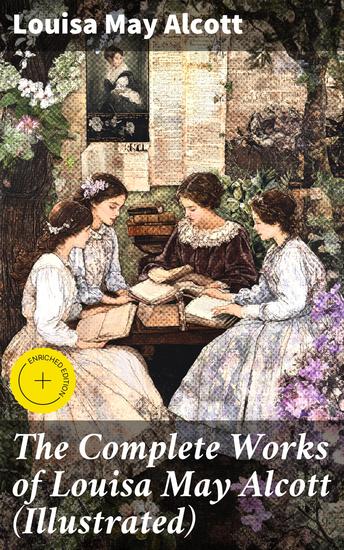
The Complete Works of Louisa May Alcott (Illustrated) - Enriched edition Timeless Tales of Family Friendship and Empowerment in 19th Century America - cover

The Complete Works of Louisa May Alcott (Illustrated) - Enriched edition Timeless Tales of Family Friendship and Empowerment in 19th Century America

Louisa May Alcott

Publisher: Good Press

  • 0
  • 0
  • 0

Summary

The Complete Works of Louisa May Alcott (Illustrated) curates a rich palette of Alcott's literary oeuvre, showcasing her profound ability to intertwine personal experience with social commentary. This collection encompasses her renowned novels, such as 'Little Women' and 'Little Men', alongside her lesser-known yet equally poignant writings. Alcott's narrative style is characterized by its vivid realism and emotional depth, reflecting the intricate dynamics of family life and the challenges faced by women in the 19th century. With illustrated editions, the text comes alive, providing not only a visual feast but also enriching the reader's engagement with Alcott's themes of autonomy, identity, and societal constraints. Louisa May Alcott (1832-1888), an early feminist and pioneer of children's literature, was deeply influenced by her own upbringing in a transcendentalist household, where conversations about social justice and women's rights were commonplace. Her formative experiences'—being raised by an unconventional family and her close relationships with her sisters'—infused her writing with authentic representation of women's lives. Alcott's dedication to her craft was driven by a desire to empower women and inspire young readers, making her works resonate with timeless relevance. This illustrated edition is a must-read for anyone interested in 19th-century literature, feminism, and the evolution of children's narratives. Alcott's insightful reflections on womanhood, interconnectedness, and moral integrity make this collection not only a significant artistic achievement but also a heartfelt invitation to engage with the complexities of life. Whether you are revisiting her works or encountering them for the first time, this compilation promises to enrich your understanding of both the author and her enduring legacy.

In this enriched edition, we have carefully created added value for your reading experience:
- A comprehensive Introduction outlines these selected works' unifying features, themes, or stylistic evolutions.
- The Author Biography highlights personal milestones and literary influences that shape the entire body of writing.
- A Historical Context section situates the works in their broader era—social currents, cultural trends, and key events that underpin their creation.
- A concise Synopsis (Selection) offers an accessible overview of the included texts, helping readers navigate plotlines and main ideas without revealing critical twists.
- A unified Analysis examines recurring motifs and stylistic hallmarks across the collection, tying the stories together while spotlighting the different work's strengths.
- Reflection questions inspire deeper contemplation of the author's overarching message, inviting readers to draw connections among different texts and relate them to modern contexts.
- Lastly, our hand‐picked Memorable Quotes distill pivotal lines and turning points, serving as touchstones for the collection's central themes.
Available since: 01/10/2024.
Print length: 2470 pages.

Other books that might interest you

  • The Sun Also Rises - cover

    The Sun Also Rises

    Ernest Hemingway

    • 0
    • 0
    • 0
    The Sun Also Rises (previously titled Fiesta) is a seminal text that established Ernest Hemmingway as part of the literary canon. Its timeless themes of love, identity, and integrity continue to speak to our hearts today. 
    In a conversation with Ernest Hemmingway, Gertrude Stein once made the comment: “You are all a lost generation.” She was referring to the young adults who struggled to find their purpose in the wake of World War I, yet showed incredible resilience against all odds. 
    Jake Barnes, Lady Brett Ashley, and their group of fellow expatriates are members of this Lost Generation. As they wander through Paris, they turn to alcohol and a series of love affairs to cope with their inner struggles. Then, they decide to go to Spain for the Fiesta de San Fermín to witness the running of the bulls. This brutal, violent sport captures their interest and becomes the backdrop for the romantic tensions that build between the characters.
    Show book
  • The Lost World - cover

    The Lost World

    Arthur Conan Doyle

    • 0
    • 0
    • 0
    "The Lost World" is a science fiction novel published in 1912 by Sir Arthur Conan Doyle, the renowned creator of Sherlock Holmes. This story revolves around an expedition to a plateau in South America, where Professor Challenger claims to have discovered living dinosaurs. Accompanied by journalist Edward Malone, adventurer Lord John Roxton, and skeptic Professor Summerlee, the group embarks on a thrilling journey to verify Challenger's claims. Beyond the initial challenges, they encounter prehistoric creatures and indigenous tribes, blending action, adventure, and a touch of humor. The novel is considered one of the pioneering works of the "lost world" genre.
    Show book
  • Adam Bede - cover

    Adam Bede

    George Eliot

    • 0
    • 0
    • 0
    Adam Bede is the first novel by English author George Eliot, first published in 1859. The novel is set in the fictional community of Hayslope—a rural, pastoral, and close-knit community—in 1799. It revolves around a love "rectangle" among the beautiful but self-absorbed Hetty Sorrel; Captain Arthur Donnithorne, the young squire who seduces her; Adam Bede, her unacknowledged suitor; and Dinah Morris, Hetty's cousin, a fervent, virtuous, and beautiful Methodist lay preacher.
    Show book
  • Short History Of England A (Unabridged) - cover

    Short History Of England A...

    G. K. Chesterton

    • 0
    • 0
    • 0
    G.K. Chesterton was one of the towering figures of British literature in the early twentieth century. A man of massive size, massive personality, and massive appetite, Chesterton famous personality, dress, and personality gave rise to an eponymous adjective: Chestertonian. Although he is renowned for the Father Brown detective series, Chesterton also wrote volumes of nonfiction. First published in 1917, A Short History of England is exactly that, serving Chesterton's goal of publishing "a popular book of history written from the standpoint of a member of the public." Filled with Chestertonian wit, the fast-moving history includes such gemlike observations as, Henry VIII "was almost as unlucky in his wives as they were in their husband." Of the great late Victorian/Edwardian trio of wits: George Bernard Shaw, Oscar Wilde, and Chesterton himself, it is Chesterton whose body of work -- writing in an unassuming manner, without great pretension may well persist for future generations far longer than its charming, genial author ever imagined.
    Show book
  • Love of Life - cover

    Love of Life

    Jack London

    • 0
    • 0
    • 0
    Jack London — a writer whose works are enthusiastically read all over the world. His collection "Love of Life" is one of the brilliant pearls of his Northern stories cycle. Alaska is the place where each person should reveal their own real features. The North makes equal the poor and the rich; the intense cold does not take into account the infirmity; harsh, biting wind is indifferent to the social status, and a wild beast does not discriminate between social standings. In the confrontation with the severe nature, the heroes of the adducted works vanquish not only thanks to their courage, endurance, energy, but first and foremost, due to the strength of mind, an obsession with life, the capability even in the extreme situations to remain a Human.
    Show book
  • Esme - From their pens to your ears genius in every story - cover

    Esme - From their pens to your...

    Saki Saki

    • 0
    • 0
    • 0
    Hector Hugh Munro, more familiarly known by his pen-name ‘Saki’ was born in what was then Akyab in British Burma on 18th December 1870. His father was an Inspector General for the Indian Imperial Police, and his mother the daughter of a Rear Admiral. 
    When he was 2 his mother died and he and his siblings were sent back to England to be raised by their grandmother and paternal maiden aunts in a strict, puritanical household near Barnstaple, Devon. Educated by governesses Saki used many of these women as character models for his later writing. 
    At 17 his father retried and returned to England and then embarked on a series of European travels with Saki and his siblings. 
    After a short stint working in Burma with the Indian Imperial Police Saki decided to move to London to make a living as a writer. Initially he wrote as a journalist for a number of newspapers and magazines before attempting an historical study, ‘The Rise of the Russian Empire’, whose real value lay in directing him to writing short stories instead, the first of which, ‘Dogged’, he published in 1899. 
    From here it was a short stab of the pen to writing political satire before in 1902 he became the foreign correspondent for The Morning Post, first in the Balkans, then Russia, Paris and back to London in 1908, where 'the agreeable life of a man of letters with a brilliant reputation awaited him.'  
    Collections of his short stories full of witty, mischievous and often macabre stories that satirized Edwardian society and two novels now appeared in the years up to the Great War.  At its’ outbreak he was 43 but managed to join as an ordinary trooper. More than once he returned to the battlefield when officially too sick or injured.  
    On 14th November 1916 Hector Hugh Munro was sheltering in crater during the Battle of the Ancre, when he was shot and killed by a German sniper. According to several sources, his last words were "Put that bloody cigarette out!"
    Show book