¡Acompáñanos a viajar por el mundo de los libros!
Añadir este libro a la estantería
Grey
Escribe un nuevo comentario Default profile 50px
Grey
Suscríbete para leer el libro completo o lee las primeras páginas gratis.
All characters reduced
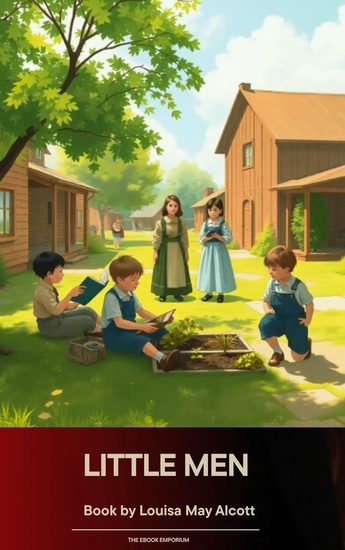
Little Men - cover

Little Men

Louisa May Alcott

Editorial: The Ebook Emporium

  • 0
  • 0
  • 0

Sinopsis

"It takes a long time to grow a soul, but it's a fascinating process."

Jo March has found her true calling. Alongside her husband, Professor Bhaer, she has opened the doors of Plumfield, an estate turned school where "naughty" boys are given the freedom to grow, learn, and find their better selves. Moving away from the rigid discipline of the Victorian era, Plumfield is a place of pillow fights, gardening, and deep moral lessons, where every child—from the street-smart orphan Nat to the rebellious "wild boy" Dan—is treated with the love and respect they deserve.

A New Generation of the March Family: While Jo remains the beating heart of the story, Little Men introduces a delightful new cast. Watch as Meg's twins, the studious Demi and the domestic Daisy, navigate their childhoods alongside a ragtag group of students. The novel captures the humor and heartache of growing up, proving that the lessons learned on the playground are often as important as those learned from books.

The Philosophy of Kindness: Alcott draws on her own transcendentalist upbringing to create a story that championed progressive education long before it was mainstream. Little Men is a celebration of character-building, gender equality, and the redemptive power of a second chance. It remains a comforting, essential read for anyone who believes that every child has a "gold mine" of potential waiting to be discovered.

Step back into the world of the Marches. Purchase "Little Men" today and experience the joy of Plumfield.
Disponible desde: 06/01/2026.
Longitud de impresión: 175 páginas.

Otros libros que te pueden interesar

  • Northanger Abbey - cover

    Northanger Abbey

    Jane Austen

    • 0
    • 0
    • 0
    "Northanger Abbey" is one of Jane Austen's earlier works, published posthumously in 1818. The novel is a coming-of-age story that follows the naive and imaginative Catherine Morland during her adventures in Bath and, later, at the eponymous Northanger Abbey. While the book embraces elements of the Gothic novel—a popular genre of its time—it also satirizes the genre's excesses and the naivety of its young heroine. Themes of social class, wealth, and morality are explored against a backdrop of Regency England manners and mores.
    Ver libro
  • My Own True Ghost Story - From their pens to your ears genius in every story - cover

    My Own True Ghost Story - From...

    Rudyard Kipling

    • 0
    • 0
    • 0
    Joseph Rudyard Kipling was born in Mumbai, India on 30th December 1865.   
    As was the custom in those days, he and his sister were sent back to England when he was 5.  The ill-treatment and cruelty by the Portsmouth couple they boarded with Kipling said contributed to the onset of his literary life.  
    At 16 he returned to India to work on a local paper where he was soon contributing and writing.  It also exposed him to the issues of identity and national allegiance which pervade much of his work.  
    In 1886, his ‘Departmental Ditties’, collection of verse appeared in print followed by 39 short stories for his newspaper over only 8 months.  These were then published as ‘Plain Tales from the Hills’, shortly after his 22nd birthday.  
    He continued his prolific pace of writing before being dismissed in a dispute and, taking his pay-off and the profits from the sale of some publishing rights, decided to return to London, travelling via Rangoon, Hong Kong, Japan and the United States, all the while writing articles, and arriving at Liverpool in October 1889. 
    Over the next two years he saw further works published as books and in magazines, as well as a nervous breakdown for which he was prescribed a sea voyage, to South Africa, Australia, New Zealand and India.  
    Happier times came with marriage to Caroline Starr Balestier in January 1892.  The honeymoon began in Vermont and ended in Yokahama where they heard their bank had failed.  They returned to Vermont and settled.  Caroline was now pregnant and he was planning the ‘Jungle Books’.  
    A failed arbitration between the US and England resulted in an argument between Caroline’s brother and Kipling, and then his arrest.  At the hearing he was mortified by the exposure of his private life and after settling the matter they returned to England and life in Torquay.  ‘Kim’ was published in 1902, and ‘Just So Stories for Little Children’, a year later.  
    In 1907 he was awarded the Nobel Prize for Literature with the citation “in consideration of the power of observation, originality of imagination, virility of ideas and remarkable talent for narration which characterise the creations of this world-famous author”.   
    When the Great War erupted, he scorned those who refused conscription.  His son enlisted and was killed at the Battle of Loos in September 1915, at 18, an exploding shell had ripped his face apart.  This death inspired Kipling’s writing thereafter, but the tragedy broke his life and by 1930 his prolific pen had almost ceased. 
    Rudyard Kipling died on 18th January 1936 from a perforated duodenal ulcer.  He was 70.  His ashes are buried at Poets’ Corner in Westminster Abbey.
    Ver libro
  • A Study in Scarlet - The Classic Mystery Detective Fiction Masterpiece of Murder and Deduction - cover

    A Study in Scarlet - The Classic...

    Arthur Conan Doyle

    • 0
    • 0
    • 0
    The Game is Afoot...
     
    In the murky, fog-drenched streets of Victorian London, a killer prowls, leaving behind no clues but an empty house, a dead man, a woman's wedding ring, and the word RACHE scrawled in blood upon a wall. Scotland Yard's finest are utterly baffled. The brilliant but eccentric consulting detective Sherlock Holmes, however, sees the truth clearly hidden in the dust.
     
    A Study in Scarlet is the seminal work that birthed a literary legend. Written by Sir Arthur Conan Doyle in 1887, this gripping novel marks the very first appearance of Sherlock Holmes and his steadfast companion, Dr. John H. Watson. Here, Watson—an army doctor freshly returned from the horrors of the Afghan War—takes up lodgings at the iconic 221B Baker Street, only to find himself swept into a sinister web of international revenge, secret societies, and brilliant forensic deduction.
    A Masterpiece of Mystery/Detective Fiction
     
    From the meticulous analysis of cigar ashes and muddy footprints to the dramatic capture of a desperate killer, A Study in Scarlet laid the unshakeable foundation for the modern detective genre. Conan Doyle's incredible narrative seamlessly blends a chilling procedural thriller with a tragic, sweeping backstory, exploring the darkest corners of human nature and vengeance.
     
    With an unforgettable, high-drama performance by Andre Reaves, this classic audiobook transports listeners directly to the gaslit cobblestones of 19th-century crime solving. Grab your deerstalker, sharpen your wits, and prepare to isolate the scarlet thread of murder running through the colourless skein of life.
    Ver libro
  • Mr Weston's Good Wine - cover

    Mr Weston's Good Wine

    T. F. Powys

    • 0
    • 0
    • 0
    Mr. Weston is a mysterious character - a wealthy man who has a reputation for selling a special kind of wine that has a unique and almost magical quality. The wine seems to bring out the hidden desires and darker sides of those who consume it, leading them to act in mysterious ways.
    
    Exploring ideas of greed, temptation, and the corrupting influence of power, Mr. Weston's Good Wine is a darkly comedic novel which critiques the fragility of human conciousness and explores the consequences of giving into our most base temptations.
    Ver libro
  • A Horse's Tale - cover

    A Horse's Tale

    Mark Twain

    • 0
    • 0
    • 0
    "A horse is a good judge of character; he will never betray you."
    
    First published in two instalments in Harper's Monthly Magazine in 1906, this delightful short story follows Soldier Boy, the pride of the military cavalry, and his touching relationship with Buffalo Bill's young niece, Cathy. Mark Twain crafts a narrative that skilfully weaves together adventure, humour, and social criticism, capturing the spirit of loyalty, friendship and the extraordinary bonds that form between humans and animals. A Horse's Tale deeply moved readers of its time, sparking important conversations about animal welfare and challenging societal attitudes toward animals in military service.
    Samuel Langhorne Clemens, better known by his pen name Mark Twain (1835–1910), grew up along the banks of the Mississippi River, and his early experiences inspired many of his most famous works, including The Adventures of Tom Sawyer and Adventures of Huckleberry Finn. Widely celebrated as America's greatest humorist, Twain captured the spirit of a rapidly changing nation, and his sharp wit, keen eye for human nature, and gift for storytelling made him not only a beloved novelist but also a popular lecturer and essayist.
    
    Twain's innovative style, character-driven storytelling and ability to interweave humour with profound social critique laid the groundwork for modern American literature and has inspired countless authors, including Ernest Hemingway and F. Scott Fitzgerald. Indeed, Hemingway famously declared that "all modern American literature comes from one book by Mark Twain called Huckleberry Finn."
    Ver libro
  • A Dead Woman's Secret - From their pens to your ears genius in every story - cover

    A Dead Woman's Secret - From...

    Guy de Maupassant

    • 0
    • 0
    • 0
    Henri René Albert Guy de Maupassant was born on August 5th, 1850 near Dieppe in France.  
    Maupassant’s early life was badly torn when at age 11 (his younger brother Hervé was then five) his mother, Laure, a headstrong and independent-minded woman, risked social disgrace in order to obtain a legal separation from her husband. 
    After the separation, Laure kept custody of her two boys. With the father now forcibly absent, Laure became the most influential and important figure in the young boy's life.   
    Maupassant’s education was such that he rebelled against religion and other societal norms but a developing friendship with Gustave Flaubert began to turn his mind towards creativity and writing. 
    After graduation he volunteered for the Franco-Prussian war. With its end he moved to Paris to work as a clerk in the Navy Department.  Gustave Flaubert now took him under his wing.  Acting as a literary guardian to him, he guided the eager Maupassant to debuts in journalism and literature.  For Maupassant these were exciting times and the awakening of his creative talents and ambitions. 
    In 1880 he published what is considered his first great work, ‘Boule de Suif’, (translated as as ‘Dumpling’, ‘Butterball’, ‘Ball of Fat’, or ‘Ball of Lard’) which met with a success that was both instant and overwhelming.  Flaubert at once acknowledged that it was ‘a masterpiece that will endure.’ Maupassant had used his talents and experiences in the war to create something unique.  
    This decade from 1880 to 1891 was to be the most pivotal of his career.  With an audience now made available by the success of ‘Boule de Suif’ Maupassant organised himself to work methodically and relentlessly to produce between two and four volumes of work a year.  The melding of his talents and business sense and the continual hunger of sources for his works made him wealthy. 
    In his later years he developed a desire for solitude, an obsession for self-preservation, and a fear of death as well as a paranoia of persecution caused by the syphilis he had contracted in his youth.  
    On January 2nd, 1892, Maupassant tried to commit suicide by cutting his throat.  Unsuccessful he was committed to the private asylum of Esprit Blanche at Passy, in Paris.  It was here on July 6th, 1893 that Henri René Albert Guy de Maupassant died at the age of only 42.
    Ver libro