Begleiten Sie uns auf eine literarische Weltreise!
Buch zum Bücherregal hinzufügen
Grey
Einen neuen Kommentar schreiben Default profile 50px
Grey
Jetzt das ganze Buch im Abo oder die ersten Seiten gratis lesen!
All characters reduced
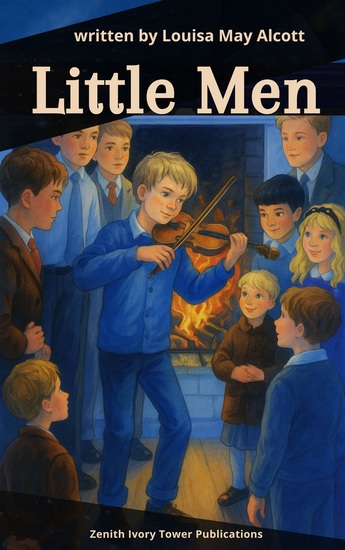
Little Men - Louisa May Alcott's Heartwarming Sequel to Little Women — A Story of Growth Kindness and Second Chances - cover

Little Men - Louisa May Alcott's Heartwarming Sequel to Little Women — A Story of Growth Kindness and Second Chances

Louisa May Alcott, Zenith Ivory Tower Publications

Verlag: Zenith Ivory Tower Publications

  • 0
  • 0
  • 0

Beschreibung

👦 From the beloved author of Little Women comes a tender tale of boys, books, and becoming.

In Little Men, Louisa May Alcott continues the story of Jo March—now Jo Bhaer—as she transforms Plumfield, her inherited estate, into a progressive school for boys. Filled with laughter, learning, mischief, and moral lessons, this touching sequel explores the joys and trials of childhood through the eyes of a spirited and diverse group of young students.

🏡 At Plumfield, every child matters—and every mistake is a lesson.
Jo and her husband Fritz create a warm and accepting home where boys like Nat, Dan, Tommy, and Demi can grow not just in knowledge but in character. As they navigate friendship, temptation, mischief, and redemption, each boy's story becomes a window into the values of compassion, integrity, and perseverance.

🌱 A tale of nurturing hearts and shaping futures.
Alcott's gentle wisdom and joyful storytelling celebrate the power of second chances and the belief that every child can blossom with the right care and guidance.

🌟 What Critics and Readers Say:
"A moving and wholesome continuation of the March family legacy." — The Atlantic

"Louisa May Alcott's most underrated gem." — The New York Times

"Warm, witty, and timeless—perfect for readers of all ages." — Amazon Reviewer

🎯 Why You'll Love This Book:
A joyful, uplifting sequel to Little Women

Perfect for readers of family fiction, children's classics, and coming-of-age stories

Offers meaningful insights into education, discipline, and kindness

A wonderful read-aloud or gift for young readers and nostalgic adults

🛒 Click Buy Now to Revisit Plumfield and Be Inspired by Jo's Little Men.
Let Louisa May Alcott remind you that every child can shine when given love, patience, and purpose.
👉 Click Buy Now to read Little Men—a heartwarming classic of growth, learning, and hope.
Verfügbar seit: 17.07.2025.
Drucklänge: 175 Seiten.

Weitere Bücher, die Sie mögen werden

  • Catriona - cover

    Catriona

    Robert Louis Stevenson

    • 0
    • 0
    • 0
    "Catriona, also known as David Balfour, is an 1893 novel written by Robert Louis Stevenson as a sequel to his earlier work, Kidnapped (1886) 1. The novel continues the story of the central character, David Balfour.    The plot unfolds in two distinct parts:      Edinburgh    Edinburgh, Scotland (1751): The book begins precisely where Kidnapped ends, at 2 pm on August 25, 1751, outside the British Linen Company in Edinburgh, Scotland. David Balfour endeavors to seek justice for James Stewart (James of the Glens), who has been arrested and charged with complicity in the Appin Murder. Despite his efforts, David is once again kidnapped and confined on the Bass Rock, an island in the Firth of Forth, until James' trial concludes, resulting in James being condemned to death. During this time, David falls in love with Catriona MacGregor Drummond, the daughter of James More, also held in prison. Catriona engineers her father's escape 1.    Holland    Holland: In the second part, David and Catriona travel to Holland, where David studies law at the University of Leyden. Catriona, having no money, is under David's protection. James More eventually arrives but proves to be a disappointment, living off David's largesse. David learns of his uncle Ebenezer's death and discovers that he has inherited a substantial fortune. Despite misunderstandings, David and Catriona remain fast friends. James and Catriona eventually find their way to Dunkirk in northern France. Meanwhile, Alan Breck joins David in Leyden and imparts his wisdom on understanding women 1.  Catriona weaves together adventure, romance, and the complexities of human relationships, making it a captivating continuation of David Balfour's journey"
    Zum Buch
  • Emma - cover

    Emma

    Jane Austen

    • 0
    • 0
    • 0
    Emma, is a novel about youthful hubris and romantic misunderstandings. It is set in the fictional country village of Highbury and the surrounding estates of Hartfield, Randalls and Donwell Abbey, and involves the relationships among people from a small number of families. The novel was first published in December 1815, with its title page listing a publication date of 1816. As in her other novels, Austen explores the concerns and difficulties of genteel women living in Georgian–Regency England. Emma is a comedy of manners, and depicts issues of marriage, sex, age, and social status.Before she began the novel, Austen wrote, "I am going to take a heroine whom no one but myself will much like."  In the first sentence, she introduces the title character as "Emma Woodhouse, handsome, clever, and rich, with a comfortable home and a happy disposition... had lived nearly twenty-one years in the world with very little to distress or vex her." Emma is spoiled, headstrong, and self-satisfied; she greatly overestimates her own matchmaking abilities; she is blind to the dangers of meddling in other people's lives; and her imagination and perceptions often lead her astray.Emma, written after Austen's move to Chawton, was her last novel to be published during her lifetime, while Persuasion, the last complete novel Austen wrote, was published posthumously.The novel has been adapted for a number of films, television programmes and stage plays.Jane Austen was an English novelist known primarily for her six major novels, which interpret, critique, and comment upon the British landed gentry at the end of the 18th century. Austen's plots often explore the dependence of women on marriage in the pursuit of favorable social standing and economic security. Her works critique the novels of sensibility of the second half of the 18th century and are part of the transition to 19th-century literary realism.
    Zum Buch
  • Great Expectations - cover

    Great Expectations

    Charles Dickens

    • 0
    • 0
    • 0
    "Great Expectations" intricately portrays the transformative journey of Pip as he matures from a naïve child into a complex adult, navigating through a series of often tumultuous and painful experiences. Starting in the desolate, foggy marshes of Kent, Pip's life takes a dramatic turn as he ventures into the bustling, vibrant streets of commercial London. Along the way, he encounters an eclectic array of extraordinary characters that leave indelible marks on his life.  
    Among these figures is Magwitch, the fearsome escaped convict whose unexpected influence steers Pip’s fate, and the enigmatic Miss Havisham, who lives trapped in the shadows of her own heart-wrenching past, surrounded by the remnants of her once-grand life. Living with her is the strikingly beautiful and haughty Estella, whose cold demeanor captivates and torments Pip, fueling his desires and aspirations. 
    As Pip navigates through the complexities of social class, ambition, and personal disappointment, he embarks on a profound quest for self-discovery. He must come to terms with his true identity and examine his values and priorities, ultimately seeking to understand what truly defines his worth and happiness.
    Zum Buch
  • The Complete Oz Collection - cover

    The Complete Oz Collection

    L. Frank Baum

    • 0
    • 0
    • 0
    Noted as one of the most popular series in American literature, the works of L. Frank Baum have been brought together in this singular collection that ensures the fun never stops! Embark on the journey that has capitated audiences for over a century. This collection contains the following: The Wonderful Wizard of Oz The Marvelous Land of Oz Ozma of Oz Dorothy and the Wizard of Oz The Road to Oz The Emerald City of Oz The Patchwork Girl of Oz Tik-Tok of Oz The Scarecrow of Oz Rinkitink of Oz The Lost Princess of Oz The Tin Woodman of Oz The Magic of Oz Glinda of Oz
    Zum Buch
  • Smile - cover

    Smile

    D H Lawrence

    • 0
    • 0
    • 0
    ‘Smile’ is one of Lawrence's shorter pieces, a thumbnail sketch of an idea. A man is relieved that his wife is dead and struggles to hide his relief when confronted with his wife's body. The relief breaks out in a smile which he struggles to excuse. How much better it would have been, Lawrence seems to be saying, if he had just laughed out loud!
    Zum Buch
  • Blood - From their pens to your ears genius in every story - cover

    Blood - From their pens to your...

    Hanns Heinz Ewers

    • 0
    • 0
    • 0
    Hanns Heinz Ewers was born on 3rd November 1871 in Düsseldorf, Germany. 
    His first published poem was at 17 on the death, after a reign of only 99 days, of the German Emperor Frederick III. 
    A stint in the German military was cut short after only 44 days because of his myopia.  Writing was to be the way forward for him with a book of satiric verse published in 1901. At the same time he co-founded a literary vaudeville troupe that toured central and eastern Europe before censors and expenses forced its closure.  An inveterate traveller he was in South America when the Great War enveloped Europe and he relocated to New York. 
    From here his story darkens. Although by now a successful and admired author he was arrested in the U S in 1918 as a German Agent on the pretext of his travels and a falsified Swiss passport. Interned, he was released in 1921 and returned to Germany.  He claimed only to be raising money for the German Red Cross. 
    His literary fame is decidedly easier to clarify. His novels beginning with ‘The Sorcerer’s Apprentice’ in 1910 are dark, they bristle with evil intent and are littered with characters who have a dubious moral compass and yet, along with his short stories, are brazen, brilliant feats of literary narrative. 
    He also wrote and published plays, fairy tales, opera librettos, critical essays and lectured for many years on ‘The Religion of Satan’ and was one of the first to write scripts for the cinema, which he considered a legitimate art form. 
    As the Weimar republic began its chaotic death throes Ewers became attracted to the rising Nazi Party.  At first he was warmly received despite disagreeing with its anti-semitism (his most famed literary character had a Jewish mistress) and he was even commissioned by Hitler to write a biography of the Nazi martyr Horst Wessel.  This together with his own homosexuality culminated with his works being banned in 1934 and his assets and property seized.  It took him many years to have the ban lifted.  This association rightfully clouds his personal reputation but has meant his literary contributions are also overlooked and neglected. 
    Hanns Heinz Ewers died of tuberculosis on 12th June 1943 in his Berlin apartment.
    Zum Buch