Join us on a literary world trip!
Add this book to bookshelf
Grey
Write a new comment Default profile 50px
Grey
Subscribe to read the full book or read the first pages for free!
All characters reduced
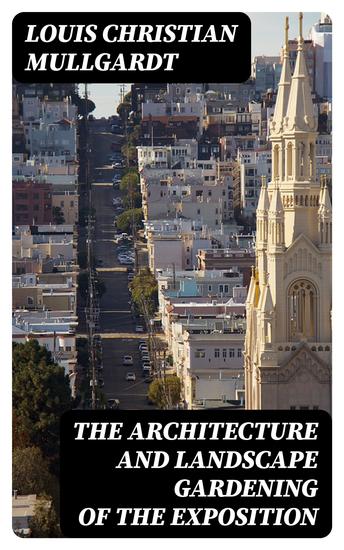
The Architecture and Landscape Gardening of the Exposition - A Pictorial Survey of the Most Beautiful Achitectural Compositions of the Panama-Pacific International Exposition - cover

The Architecture and Landscape Gardening of the Exposition - A Pictorial Survey of the Most Beautiful Achitectural Compositions of the Panama-Pacific International Exposition

Louis Christian Mullgardt

Publisher: DigiCat

  • 0
  • 0
  • 0

Summary

In "The Architecture and Landscape Gardening of the Exposition," Louis Christian Mullgardt presents a comprehensive exploration of the architectural innovations and landscape designs that characterized the early 20th-century exposition. The book meticulously details the aesthetic principles, spatial arrangements, and cultural significances of the structures and gardens that defined the exposition, utilizing a blend of evocative prose and analytical rigor. Mullgardt engages with contemporary architectural movements, embedding his observations within the broader discourse of landscape architecture, and invites readers to consider the interplay between nature and built environments in shaping public spaces. Louis Christian Mullgardt, a prominent architect and landscape designer himself, was deeply influenced by the arts and crafts movement and the burgeoning American architecture scene of his time. His first-hand experiences working on the Panama-Pacific International Exposition in 1915 provided him with valuable insights, informing both his theoretical perspectives and practical applications in the book. Mullgardt's appreciation for harmony between nature and structure shines through his examination of the exposition's design philosophy. For anyone intrigued by the nexus of architecture and landscape design, this scholarly work serves as an essential text. Mullgardt's insights not only enrich our understanding of the exposition but also serve to inspire current and future generations of architects and urban planners. This book is highly recommended for students, professionals, and scholars alike who wish to delve into the legacy and implications of exposition-era design.
Available since: 08/15/2022.
Print length: 121 pages.
Other books that might interest you

  • Potong: To Care Cut - cover

    Potong: To Care Cut

    Johnny Jon Jon

    • 0
    • 0
    • 0
    In Johnny Jon Jon’s plays, seemingly ordinary events are turned into hauntingly profound exchanges when the individual’s sense of self comes under scrutiny. 
     
    In Hawa, a new Muslim convert finds herself tasked with overseeing the funeral arrangements of her partner. 
     
    In Potong, a son is sent away by a mother to return to Singapore to undergo the coming-of-age rites of passage that await him: circumcision and conscription. 
     
    Deftly alternating between beats of humour and tension, Jon Jon reveals how these characters contend with the paradigms, manifest or otherwise, that shape their existence.
    Show book
  • Albertus - The Biography of a Typeface - cover

    Albertus - The Biography of a...

    Simon Garfield

    • 0
    • 0
    • 0
    A compact and charming history of the beloved handcrafted font by the New York Times bestselling author of Just My Type. 


    Albertus, first carved on a bronze tablet in the 1930s by German Jewish refugee Berthold Wolpe, has proved to be one of the most enduring handcrafted typefaces in the world. It is at once modern and timeless, authoritative and whimsical—renowned as the typeface of London Street signs, David Bowie albums, and Star Wars movie posters. In this unique celebration, bestselling author Simon Garfield charts the story of the creation of Albertus, its innumerable and vibrant uses, and the erratic brilliance of its designer, as recounted by Wolpe's children. Through his exploration of this singular font, Garfield grapples with one of the most fundamental artistic questions: what makes great art not only survive but flourish in each new age and medium?
    Show book
  • Looking for the H Chord - cover

    Looking for the H Chord

    Monte Dwyer

    • 0
    • 0
    • 0
    "...he is ultimately an entertainer, and he writes to delight." Peter FitzSimons 
    Beautifully rounded stories from some little-known regions of Australia.
    Show book
  • Kids and Practicing - How to Help Your Child Become Outstanding - cover

    Kids and Practicing - How to...

    Stan Munslow

    • 0
    • 0
    • 0
    In my thirty-five years as a private music instructor, the question I'm asked the most by parents is: "How can I get my child to practice?" And, in this crazy-busy time, it gets asked even more! In this discussion, I will give you answers to this question, as well as a heap of advice on helping your young musician/singer/dancer become the very best s/he can be! Put these strategies to use and you will be helping your child maintain an endeavor that will last a lifetime and provide joy, satisfaction, and a sense of accomplishment along the way!
    Show book
  • Pala Empire - Guardians of Buddhism and the Legacy of Nalanda - cover

    Pala Empire - Guardians of...

    Rolf Hedger

    • 0
    • 0
    • 0
    The Pala Empire emerged in the eastern regions of the Indian subcontinent during the eighth century, marking the beginning of a powerful dynasty that would shape the cultural and political landscape of Bengal and Bihar for nearly four centuries. The empire was established in a period of political fragmentation and instability following the decline of the earlier Gupta Empire and the subsequent rule of smaller, competing kingdoms. This power vacuum set the stage for the rise of a strong and centralized authority under the leadership of Gopala, the first ruler of the Pala dynasty. 
    Gopala's ascent to power is believed to have been unique for the time, as he was reportedly chosen by local chieftains and influential figures through a process of election, rather than simply inheriting his position through lineage. This suggests that his leadership was recognized as a unifying force in a region that had suffered from prolonged disorder and internal conflicts. Once in power, Gopala took significant steps to stabilize his realm, laying the foundation for what would become one of the most enduring dynasties in Indian history. He consolidated his rule over Bengal and expanded his influence into neighboring territories, establishing control over strategic trade routes and fertile agricultural lands that contributed to the empire’s prosperity. 
    Gopala’s son, Dharmapala, proved to be an even more ambitious ruler. Under his leadership, the Pala Empire reached its zenith, with its influence stretching far beyond Bengal into northern and central India. Dharmapala was not only a military leader but also a great patron of Buddhism, playing a crucial role in the expansion of Buddhist institutions, including the famed Nalanda University. His military campaigns brought him into direct conflict with two of the other major powers of the time, the Gurjara-Pratiharas and the Rashtrakutas.
    Show book
  • Wrath of the Dragon - The Real Fights of Bruce Lee - cover

    Wrath of the Dragon - The Real...

    John Little

    • 0
    • 0
    • 0
    NO RULES. NO PROBLEM. 


    Bruce Lee remains the gold standard that all martial artists are compared to. But could he actually fight? World Champions in karate competition have gone on record to point out that he never once competed in tournaments. Were his martial abilities merely a trick of the camera? 


    For the first time ever, Bruce Lee authority and bestselling author John Little takes a hard look at Bruce Lee's real-life fights to definitively answer these questions with over thirty years of research that took him thousands of miles. Little has tracked down over thirty witnesses to the real fights of Bruce Lee as well as those who were present at his many sparring sessions (in which he was never defeated) against the very best martial artists in the world. 


    From the mean streets of Hong Kong, to challenge matches in Seattle and Oakland, to the sets of his iconic films where he was challenged repeatedly, this is the incredible real-life fighting record of the man known as the "Little Dragon," who may well have been the greatest fighter of the twentieth century.
    Show book