Join us on a literary world trip!
Add this book to bookshelf
Grey
Write a new comment Default profile 50px
Grey
Subscribe to read the full book or read the first pages for free!
All characters reduced
Mentalism: How to Read People Like a Book Predict Their Next Move and Become a Mentalist (The Step-by-step Beginner’s Guide for Becoming a Mentalist Learning Your First Magic Tricks and Making a Living) - cover

Mentalism: How to Read People Like a Book Predict Their Next Move and Become a Mentalist (The Step-by-step Beginner’s Guide for Becoming a Mentalist Learning Your First Magic Tricks and Making a Living)

Loren Dye

Publisher: Griffeth Mark

  • 0
  • 0
  • 0

Summary

Dive into the captivating world of Mental Alchemy, where you'll uncover the secrets of mind reading, hypnotism, persuasion, and mentalism. This enthralling guide to understanding human behavior will take you on a thrilling journey through the depths of non-verbal communication, persuasion tactics, and NLP (neuro-linguistic programming), revealing the hidden power within the human mind.Have you ever imagined the possibilities if you could decipher the thoughts and emotions of others? In this transformative book, you'll learn how to interpret the unspoken language of body cues to unveil people's deepest intentions.In this guide, you will learn:Essential techniquesThe power of body languageMind-bending tricksBuilding a captivating performanceCareer opportunitiesBegin your journey into the realm of mentalism today and unlock your true potential as a master of mind reading and magic tricks. Get ready to dazzle and mystify those around you with your newfound skills and abilities.
Available since: 03/19/2025.
Print length: 70 pages.

Other books that might interest you

  • Boris Flies To The Moon - cover

    Boris Flies To The Moon

    Kerry Kennedy

    • 0
    • 0
    • 0
    Children's story book for up to 6 years of age 
    Suitable 0-6 years 
    A short story about a cat named Boris who falls asleep one night and wakes up on a magic rug. 
    Follow the adventure of Boris and his magic rug. 
    Introducing his cat family, Bonnie, Zeus and Pirate 
    A magical tale of what dreams are made of
    Show book
  • Leadership for Sustainability - Saving the planet one school at a time - cover

    Leadership for Sustainability -...

    David Dixon

    • 0
    • 0
    • 0
    Mobilised by the rousing words and protests of Greta Thunberg, young people all over the globe are calling for more action to combat climate change and better protect their futures. Yet they cannot do this alone. They are reliant on people in positions of power to set the necessary changes in motion - and these people include their own school leaders operating within their own local communities.This book is a rallying cry for all schools to unleash their potential to deliver a brighter future for both their pupils and society at large.David Dixon draws on both his doctoral research and his 20 years' experience as a head teacher to set out how school leaders can embed eco-friendly practices in the day-to-day running of their schools that will also contribute to overall school improvement, including that recognised by inspectors.David weaves his guidance around the 'five Cs of sustainability' - captaincy, curriculum, campus, community and connections - to position sustainability as a natural vehicle for developing a type of fully integrated learning ecology and culture for the benefit of all.The book provides a detailed analysis of where we are now in terms of environmental impact, and lays out a road map to help schools move towards more effective eco-friendly provision. It shares practical examples of sustainability in schools and how these contribute to school improvement in the wider, more conventional sense too. Furthermore, each chapter concludes with a series of suggested strategies to encourage further thought and discussions among school stakeholders.Suitable for school leaders, teachers and teacher trainers - in both primary and secondary settings - and for any professionals who work in schools on environmental education or improvement projects.
    Show book
  • Kakatiya Dynasty - Fortresses Flourishing Trade and Administrative Genius - cover

    Kakatiya Dynasty - Fortresses...

    Rolf Hedger

    • 0
    • 0
    • 0
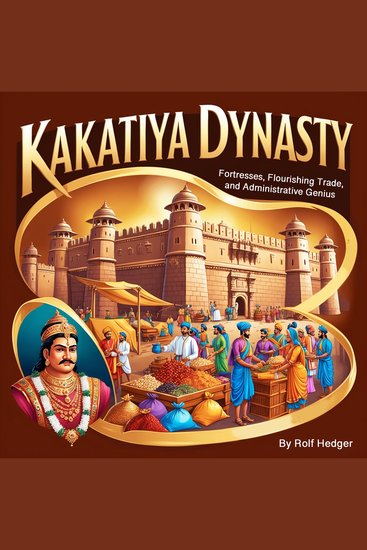
    The Kakatiya Dynasty emerged as a formidable power in the Deccan region of India, leaving behind a rich legacy of military strength, administrative brilliance, and cultural contributions. Their origins can be traced back to the 10th century, though historical records regarding their early rulers remain scarce. Initially, the Kakatiyas served as feudatories under the Rashtrakutas and later the Western Chalukyas, gradually expanding their influence over the Telugu-speaking region. 
    The name "Kakatiya" is believed to have originated from their association with the goddess Kakati, a form of Durga, who was worshipped as their family deity. The earliest known ruler, Venna or Beta I, established the dynasty’s foundation, but it was during the reign of Prola I that the Kakatiyas started asserting their independence. Prola II played a crucial role in strengthening their foothold by resisting Chalukyan dominance and expanding Kakatiya control over the eastern Deccan. 
    During this period, the Deccan was a contested space where multiple regional powers sought dominance. The Kakatiyas capitalized on the declining influence of the Western Chalukyas, strategically aligning themselves with or resisting various rulers to carve out an independent identity. Their stronghold was initially located in Hanamkonda, which later evolved into the grand city of Warangal, a center of Kakatiya power and cultural patronage.
    Show book
  • Urban Design - Principles Practices and Innovations - cover

    Urban Design - Principles...

    Lyric Vale

    • 0
    • 0
    • 0
    Urban design is the process of shaping the physical features of cities, towns, and villages. It is a discipline that integrates various elements such as architecture, planning, landscaping, and sociology to create functional, aesthetically pleasing, and sustainable urban spaces. As cities continue to grow and evolve, urban design becomes increasingly important in ensuring that urban areas meet the needs of both current and future generations. This chapter introduces the concept of urban design, its historical development, and its significant role in modern cities. 
    The history of urban design can be traced back to ancient civilizations where urban planning was guided by principles of geometry, religion, and governance. The layout of cities such as Ancient Rome and Greek cities was often designed with grand structures, forums, and public spaces to reflect social hierarchies and civic values. Over time, as cities grew larger and more complex, the role of urban design evolved. In the modern era, the Industrial Revolution brought about rapid urbanization, with a focus on accommodating large populations and facilitating economic growth. However, this period also led to overcrowded, unsanitary conditions that highlighted the need for better planning and design to improve quality of life. 
    Urban design today is centered around creating environments that are not only functional but also enhance the well-being of their inhabitants. It involves a multidisciplinary approach that considers various factors such as traffic flow, pedestrian access, environmental sustainability, and social equity. The goals of urban design are to create places that are safe, accessible, inclusive, and beautiful. This requires careful consideration of the built environment, including buildings, streets, public spaces, and infrastructure, as well as the natural environment, such as green spaces, waterways, and ecosystems.
    Show book
  • Ending The Cycle Of Inherited Family Trauma - cover

    Ending The Cycle Of Inherited...

    Mark Wolynn

    • 0
    • 0
    • 0
    Inherited family traumas may be at the core of our inability to succeed in life. Wolynn’s research has shown that unresolved traumatic events in our families can hinder how success flows to us and how well we are able to receive it.
    Show book
  • Invested - How Three Centuries of Stock Market Advice Reshaped Our Money Markets and Minds - cover

    Invested - How Three Centuries...

    Paul Crosthwaite, Peter Knight,...

    • 0
    • 0
    • 0
    Invested examines the perennial and nefarious appeal of financial advice manuals. Who hasn’t wished for a surefire formula for riches and a ticket to the good life? For three centuries, investment advisers of all kinds, legit and otherwise, have guaranteed that they alone can illuminate the golden pathway to prosperity—despite strong evidence to the contrary. In fact, too often, they are singing a siren song of devastation. And yet we keep listening. Invested tells the story of how the genre of investment advice developed and grew in the United Kingdom and the United States, from its origins in the eighteenth century through today, as it saturates our world. The authors analyze centuries of books, TV shows, blogs, and more, all promising techniques for amateur investors to master the ways of the market: from Thomas Mortimer’s pathbreaking 1761 work, Every Man His Own Broker, through the Gilded Age explosion of sensationalist investment manuals, the early twentieth-century emergence of a vernacular financial science, and the more recent convergence of self-help and personal finance. Invested asks why, in the absence of evidence that such advice reliably works, guides to the stock market have remained perennially popular. The authors argue that the appeal of popular investment advice lies in its promise to level the playing field, giving outsiders the privileged information of insiders. As Invested persuasively shows, the fantasies sold by these writings are damaging and deceptive, peddling unrealistic visions of easy profits and the certainty of success, while trying to hide the fact that there is no formula for avoiding life’s economic uncertainties and calamities.
    Show book