Join us on a literary world trip!
Add this book to bookshelf
Grey
Write a new comment Default profile 50px
Grey
Subscribe to read the full book or read the first pages for free!
All characters reduced
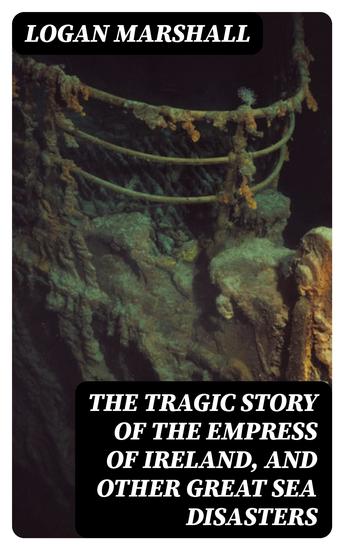
The Tragic Story of the Empress of Ireland and Other Great Sea Disasters - Enriched edition - cover

The Tragic Story of the Empress of Ireland and Other Great Sea Disasters - Enriched edition

Logan Marshall

Publisher: DigiCat

  • 0
  • 0
  • 0

Summary

In 'The Tragic Story of the Empress of Ireland, and Other Great Sea Disasters,' Logan Marshall meticulously recounts the harrowing tale of the Empress of Ireland, which sank in 1914, claiming over a thousand lives. Through his compelling prose, Marshall weaves a rich tapestry of maritime history, utilizing vivid imagery and firsthand accounts to paint a somber picture of human tragedy at sea. The work resonates within the literary context of early 20th-century disaster narratives, blending factual reporting with poignant storytelling, bringing to light not just the events, but the profound emotional landscapes of loss and resilience that accompany such maritime catastrophes. Logan Marshall, a prominent journalist and historian, possessed a keen interest in uncovering the overlooked narratives of maritime disasters. His background in journalism instilled in him a passion for detailed accounts and human stories, and his desire to educate the public about these tragedies led him to pen this profound exploration. Marshall's extensive research and firsthand interviews with survivors and family members provide critical insights into both the events and the impact on society at large. For readers drawn to tales of both historical significance and emotional depth, 'The Tragic Story of the Empress of Ireland' offers a poignant exploration of human fragility in the face of nature's unpredictability. This book is not just a chronicle of disasters; it is a tribute to the lives lost and a reminder of our collective history, making it essential reading for anyone interested in maritime history and the human experience.

In this enriched edition, we have carefully created added value for your reading experience:
- A succinct Introduction situates the work's timeless appeal and themes.
- The Synopsis outlines the central plot, highlighting key developments without spoiling critical twists.
- A detailed Historical Context immerses you in the era's events and influences that shaped the writing.
- A thorough Analysis dissects symbols, motifs, and character arcs to unearth underlying meanings.
- Reflection questions prompt you to engage personally with the work's messages, connecting them to modern life.
- Hand‐picked Memorable Quotes shine a spotlight on moments of literary brilliance.
- Interactive footnotes clarify unusual references, historical allusions, and archaic phrases for an effortless, more informed read.
Available since: 05/29/2022.
Print length: 213 pages.
Other books that might interest you

  • The Rooster House - My Ukrainian Family Story: A Memoir - cover

    The Rooster House - My Ukrainian...

    Victoria Belim

    • 0
    • 0
    • 0
    A timely and deeply moving story of family, history, and Ukraine 
     
    In 2014, the landmarks of Victoria Belim’s personal geography were plunged into tumult at the hands of Russia. Her hometown, Kyiv, was gripped by protests and violence. Crimea, where she’d once been sent to school to avoid radiation from the nuclear disaster at Chernobyl, was invaded. Kharkiv,  
    where her grandmother Valentina studied economics and fell in love; Donetsk, where her father once worked; and Mariupol, where she and her mother bought a cherry tree for Valentina’s garden, all became battlegrounds. 
     
    Victoria, by then an American citizen living in Brussels, felt she had to go back. She had to spend time with her aging grandmother and her cousin Dima. She had to unravel a family mystery spanning several generations. And she needed to understand how a century of her country’s tragic history had  
    changed the course of their lives. 
     
    The Rooster House is a beautifully written memoir of a family, a country’s past, and its dangerous present. It is about parents and children, true believers and victims, gardens and art, secrets and tragedy. Compulsively readable, deeply moving, and at times laugh-out-loud funny, it is a stunning debut  
    book by an experienced, expressive, and gifted writer.
    Show book
  • The Magus of Strovolos - The Extraordinary World Of A Spiritual Healer - cover

    The Magus of Strovolos - The...

    Kyriacos Markides

    • 0
    • 0
    • 0
    Ever since his childhood, Kyriacos C. Markides has heard mysterious rumors concerning the Magus of Strovolos, Cyprus's "specialist of the netherworld."
    
    When he returns to Cyprus as an adult, Markides seeks out this master healer and spiritual teacher, to discover the old man for himself. Armed with the skepticism he learned as a sociologist, combined with his passion to explore the inner world and beliefs of this strange Magus, Markides soon learns to appreciate the power and wisdom of this peaceful and humorous soul.
    
    From his exorcism of a Jewish girl haunted by Nazi ghosts to his theory of reincarnation, the Magus reveals to Markides the extraordinary secrets of his philosophy, challenging Western materialism and science, and pointing towards vast domains we normally cannot see.
    
    In writing The Magus of Strovolos, Markides seeks to bring the master healer's teachings to the world. By reading it, we too undertake his spiritual journey.
    Show book
  • Hypnosis and Mind Reading - How to Hypnotize Anyone Analyze People Through Body Language and Use NLP to Reprogram Your Subconscious - cover

    Hypnosis and Mind Reading - How...

    Vincent Decker

    • 0
    • 0
    • 0
    They think you're just listening. But you're already inside their mind. 
    What if every conversation gave you an advantage? 
    What if you could spot lies, insecurities, and desires—before a single word is said? 
    What if you could plant ideas so smoothly that people think they came up with them? 
    Inside, you’ll discover the real mechanics of hypnosis, mind reading, and subtle psychological influence. Nothing mystical. No need for special powers. Just proven techniques grounded in human behavior. 
    Whether you want to reprogram your own habits, influence others, or instantly read a room, this isn’t theory. It’s application. And it works. 
    Here’s what you’ll get: 
    •	How to hypnotize anyone without swinging a watch or snapping fingers 
    •	Why most people are immune to influence—and how to bypass their mental filters 
    •	How to use self-hypnosis to kill anxiety, break bad habits, and boost focus 
    •	The fastest way to read someone’s emotional state without them saying a word 
    •	Micro-signals in facial expressions that reveal what people really feel 
    •	Techniques for speed reading people in seconds (yes, really) 
    •	How to influence behavior subtly using NLP without sounding weird or salesy 
    •	How to decode body language in high-stakes moments (interviews, dates, deals) 
    •	The truth about manipulation—how to spot it, use it, and protect yourself from it 
    •	Simple mental switches to gain instant confidence and authority in any roomIf you've ever wanted to have the upper hand in a conversation, this is how it starts. If you've ever wanted to know what they’re not saying, this is where you learn how. You don’t need to control anyone—you just need to understand how people work.
    Show book
  • The Origin and Development of the Atomic Theory - cover

    The Origin and Development of...

    Maynard Shipley

    • 0
    • 0
    • 0
    The Origin and Development of the Atomic Theory is a concise and illuminating journey through one of the most important ideas in human thought: the nature of matter itself. 
    Written in the early twentieth century, Maynard Shipley traces the evolution of atomic theory from its philosophical beginnings in the ancient world to its emergence as a cornerstone of modern science. Beginning with the Pythagoreans and early Greek and Indian thinkers, Shipley explores how number, geometry, and speculation first shaped humanity’s attempts to understand the structure of reality. 
    The narrative follows the development of atomism through Leucippus and Democritus, examining atoms and the void, causal necessity, sensory perception, and the physical properties of shape, size, and arrangement. Shipley contrasts these ideas with competing schools of thought, including the Eleatics’ denial of motion and Anaxagoras’ theory of “seeds,” before turning to Epicurus and Lucretius, whose writings defended atomism against superstition and divine design. 
    In its final chapters, the book connects ancient philosophy to modern science, charting the revival of atomism through thinkers such as Descartes and Gassendi and culminating in John Dalton’s quantitative laws of chemistry. Shipley concludes by linking these early models to modern discoveries—electrons, nuclei, isotopes, and atomic number—showing how a speculative idea became a measurable scientific reality. 
    Clear, thoughtful, and accessible, The Origin and Development of the Atomic Theory offers a timeless overview of how human reason slowly uncovered the hidden structure of matter—and laid the foundations of chemistry and physics as we know them.
    Show book
  • How to Become a Special Education Teacher Career Professional Development Planning Audio Book - With Job Interview Preparation & Coaching Guide for Men Women Teens & Young Adults - cover

    How to Become a Special...

    Brian Mahoney

    • 0
    • 0
    • 0
    End Money Worries! 
    How to Become a Special Education Teacher Career Professional Development Planning Audio Book 
    With Job Interview Preparation & Coaching Guide for Men, Women, Teens & Young Adults 
    by Brian Mahoney 
           Discover... 
    * What a Special Education Teacher does 
         * How to Become a Special Education Teacher 
          * What is the salary of a Special Education Teacher 
             * What is the Special Education Teacher Work Environment like 
                 * What is the future Job outlook for a Special Education Teacher 
             * how long does it take to become a Special Education Teacher 
          * How to Prepare for Your Job Interview 
       * Tips the pros use to Ace their Job Interview 
    * You'll be confident with the best answers for the toughest job interview questions 
    The knowledge and ability to change your life all for less than the cost of 1 movie ticket! 
     If you are ready to get started & want the knowledge, help & motivation to change your life now!... 
    Then this Book is for you!!! 
                         So Don't wait. You'll wait your life away...
    Show book
  • Egyptian Monuments and Their Mysteries - Exploring the Wonders of the Past - cover

    Egyptian Monuments and Their...

    Omar Khalil

    • 0
    • 0
    • 0
    The origins of ancient Egyptian civilization can be traced back to the unification of Upper and Lower Egypt around 3100 BCE. This pivotal event, credited to the legendary Pharaoh Narmer (also known as Menes), set the stage for one of the most enduring and influential cultures in human history. The unification marked the beginning of the Early Dynastic Period, a time when Egypt's first pharaohs established the framework for the country’s political, religious, and social systems. 
    The Early Dynastic Period laid the foundation for the powerful centralized government that would come to define Egypt. The kings of this era solidified their authority by consolidating control over both the Upper and Lower Nile Valleys, establishing cities and building monumental architecture, such as the earliest royal tombs. This period was characterized by the development of hieroglyphic writing, which enabled the preservation of royal decrees, religious texts, and monumental inscriptions. 
    As Egypt's civilization evolved, it entered the Old Kingdom period, often referred to as the "Age of the Pyramids." During this time, Egypt reached its peak in terms of architectural achievements, most notably the construction of the Great Pyramids at Giza. The Old Kingdom saw the consolidation of the pharaohs’ divine status as intermediaries between the gods and the people. The power of the pharaohs was reinforced by their role in overseeing monumental construction projects and religious rituals that were believed to sustain cosmic order.
    Show book