Join us on a literary world trip!
Add this book to bookshelf
Grey
Write a new comment Default profile 50px
Grey
Subscribe to read the full book or read the first pages for free!
All characters reduced
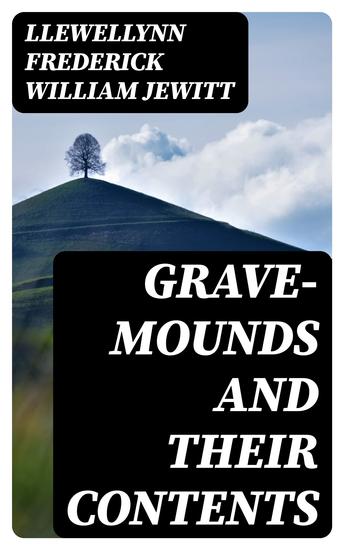
Grave-mounds and Their Contents - A Manual of Archæology as Exemplified in the Burials of the Celtic the Romano-British and the Anglo-Saxon Periods - cover

Grave-mounds and Their Contents - A Manual of Archæology as Exemplified in the Burials of the Celtic the Romano-British and the Anglo-Saxon Periods

Llewellynn Frederick William Jewitt

Publisher: DigiCat

  • 0
  • 0
  • 0

Summary

In "Grave-mounds and Their Contents," Llewellynn Frederick William Jewitt presents a meticulous exploration of prehistoric burial mounds across Britain, weaving together archaeological detail with a keen sense of historical narrative. The book deftly employs a blend of narrative nonfiction and rich descriptive passages, reflecting Jewitt's deep commitment to both science and storytelling within the Victorian archaeological revival. Through rigorous examination of artifacts and their contexts, Jewitt illuminates the cultural significance of burial practices, offering insights that resonate with contemporary archaeological discourse while carefully positioning his findings within the larger tapestry of human history. Jewitt, a prominent figure in Victorian archaeology and art conservation, drew upon his extensive experience with historic sites and antiquities. His background as a skilled engraver and historian provided him with the tools to observe and interpret the nuanced interactions between culture and material remains. Jewitt's passion for preserving 'the past' is evident throughout his work, suggesting a profound desire to connect modern audiences with their ancestral heritage. Readers interested in archaeology, anthropology, or the intricate tapestry of human history are highly encouraged to delve into this seminal work. Jewitt's passion and precision foster a deeper appreciation for the complexities of ancient burial practices, making "Grave-mounds and Their Contents" not just a scholarly text but a bridge to understanding our shared past.
Available since: 09/16/2022.
Print length: 389 pages.

Other books that might interest you

  • Cocoa Saves The Day - cover

    Cocoa Saves The Day

    Rekha Balakrishna

    • 0
    • 0
    • 0
    How cocoa farming has helped these women farmers improve their livelihoods and increase income
    Show book
  • Ancient Mesopotamia: A Captivating Introduction to the Rise and Fall of Mesopotamian Civilizations and Empires - cover

    Ancient Mesopotamia: A...

    Captivating History

    • 0
    • 0
    • 0
    Did you know that the first early battery and diving apparatus were invented in ancient Mesopotamia?  
    The land between the Tigris and Euphrates Rivers is called the “cradle of civilization,” and for good reason! Although Mesopotamia’s first civilization, Sumer, developed parallel with those of Egypt and nearby Elam, it was a place of many firsts for humanity. Some of them are well known, such as the wheel and the writing script. But it was the ancient Mesopotamians who first came up with the concept of time, the mathematical sexagesimal system, and a calendar with twelve months. It is all these inventions and ideas that set Mesopotamia apart from other civilizations that developed at approximately the same time.  
    There are so many interesting facts about the history and life of the people in Mesopotamia. By listening to this audiobook, you will find out:How agriculture and the domestication of animals led to the development of the world’s earliest civilizationWho were the peoples that occupied the region of Mesopotamia and came up with epics such as Gilgamesh?Who was Sargon of Akkad, and how did he rise to power to unite the cities and form one of the world’s first empires?How the first cuneiform script was invented and how it changed over time to fit the many languages spoken in the Akkadian EmpireWhy a new local ruler was needed to found the Third Dynasty of UrWho was Hammurabi, and why was he so important for the history of humankind?Why was Babylon obscured by Assyria?What role the Chaldeans played in the Assyrian EmpireAnd so much more! 
    Scroll up and click the “add to cart” button today to learn more about this incredible time in history!
    Show book
  • Politics and the English Language - cover

    Politics and the English Language

    George Orwell

    • 0
    • 0
    • 0
    This audiobook is narrated by an AI Voice.   
    MOST people who bother with the matter at all would admit that the English language is in a bad way, but it is generally assumed that we cannot by conscious action do anything about it. Our civilization is decadent, and our language—so the argument runs—must inevitably share in the general collapse. It follows that any struggle against the abuse of language is a sentimental archaism, like preferring candles to electric light or hansom cabs to aeroplanes. Underneath this lies the half-conscious belief that language is a natural growth and not an instrument which we shape for our own purposes. 
    Now, it is clear that the decline of a language must ultimately have political and economic causes: it is not due simply to the bad influence of this or that individual writer. But an effect can become a cause, reinforcing the original cause and producing the same effect in an intensified form, and so on indefinitely. A man may take to drink because he feels himself to be a failure, and then fail all the more completely because he drinks. It is rather the same thing that is happening to the English language. It becomes ugly and inaccurate because our thoughts are foolish, but the slovenliness of our language makes it easier for us to have foolish thoughts. The point is that the process is reversible. Modern English, especially written English, is full of bad habits which spread by imitation and which can be avoided if one is willing to take the necessary trouble. If one gets rid of these habits one can think more clearly, and to think clearly is a necessary first step towards political regeneration: so that the fight against bad English is not frivolous and is not the exclusive concern of professional writers. I will come back to this presently, and I hope that by that time the meaning of what I have said here will have become clearer. Meanwhile, here are five specimens of the English language as it is now habitually written.
    Show book
  • Imaginative Communities - Admired cities regions and countries - cover

    Imaginative Communities -...

    Robert Govers

    • 0
    • 0
    • 0
    Americans are loud. Amsterdam equals sex, drugs, and rock & roll. Mexicans are lazy and Germans are boring, but punctual. Paris is romantic, Wuhan infectious, Ukrainians heroic, and New Zealand untouched.  
    This is the way people around the world think about cities, regions and countries and the communities that live there; through cliches and stereotypes. It can be frustrating and hindering trade, diplomacy, investment, tourism, or talent attraction. Many believe that such image problems can be resolved with advertising campaigns, but the classic tourism promotion model is broken and insufficient. This book explains what works and what doesn’t when it comes to improving the reputation of cities, regions, and countries. It does so without the use of jargon and with reference to numerous case-studies. The book primarily aims to inspire readers and offer them a broad overview of an issue in modern society that is of interest and relevance to all of us: the reputation of our communities. 
    Tables and figures: download from www.imaginativecommunities.com/tables
    Show book
  • Battle of Myriokephalon The: The History of the Byzantine Empire’s Last Campaign to Take Anatolia from the Seljuk Turks - cover

    Battle of Myriokephalon The: The...

    Editors Charles River

    • 0
    • 0
    • 0
    The Byzantine Empire existed for over a thousand years, with a history spanning from the division of the Roman Empire in 395 until the Ottoman conquest of Constantinople in 1453. It was formed from the previous Eastern Roman Empire, and during its long existence, the Byzantine inhabitants were very proud to call themselves Romans.  
    	However, many things changed during the long lifespan of the Byzantine Empire, starting with its Hellenization in the 6th century. The use of the Latin language diminished and Greek took its place, while the typical Roman culture gave way to a more Hellenistic one. The Hellenization of Byzantium was detrimental to the relationship with the Holy Roman Empire, and the Christian world from that point would be split in two. The subsequent strengthening of the Orthodox Church caused many civil wars and conflicts to arise during the centuries, which shattered and reshaped the territory time after time. By the end of the Byzantine Empire’s existence, the old age had weakened both the state and church, making it an easy target for invading forces.  
    	The most notable invaders were the the Turkish-speaking Seljuks, led through a series of battles by Kutalmishouglu Suleiman, who supported different usurpers against the Byzantine emperor. The expansion of the Seljuks was so successful that when Suleiman died, he had put all of Bithynia under his control as well as several important harbor towns along the shores on the Asian side of Bosphorus. With that accomplishment, he had managed to separate the Byzantines living in Anatolia from their emperor in Constantinople. This immediately weakened the unity of the Byzantine Empire. 
    Show book
  • Atomic Changes - The Science of Transformative Habits - cover

    Atomic Changes - The Science of...

    Alex Somerset

    • 0
    • 0
    • 0
    Transform Your Life with the Power of Science-Based Habits 
    Ready for lasting personal transformation? Now available as an audiobook, "Atomic Changes: The Science of Transformative Habits" blends scientific research with practical strategies to guide you toward improved habits and enduring success—all through the convenience of audio. 
    Discover the fundamentals of habit formation—the critical roles of cue, routine, and reward. Understanding these elements provides the insight needed to enact meaningful behavioral changes. With engaging narration, you'll learn how small, consistent steps lead to significant transformations through the compound effect. Whether aiming to boost productivity, enhance health, or develop new skills, consistency is key—and now you can absorb these insights on the go. 
    Struggling with negative habits? This audiobook offers strategies to identify, disrupt, and replace them using psychological insights and practical techniques. Simultaneously, master cultivating positive habits, creating effective triggers, and leveraging reinforcement and motivation—all delivered in an accessible audio format. 
    Explore the neuroscience of habits to harness neuroplasticity for your goals. Learn about habit stacking and designing your environment to support desired behaviors while avoiding unwanted triggers—all while listening during your daily routine. 
    Enhance willpower and self-control with proven methods. Overcome obstacles with resilience, understand the influence of social networks, and celebrate milestones to sustain lasting change. 
    Take control of your habits—and your life. With "Atomic Changes" in audiobook format, you have an actionable guide to achieving and maintaining profound, lasting change—ready to inspire you anytime, anywhere.
    Show book