Join us on a literary world trip!
Add this book to bookshelf
Grey
Write a new comment Default profile 50px
Grey
Subscribe to read the full book or read the first pages for free!
All characters reduced
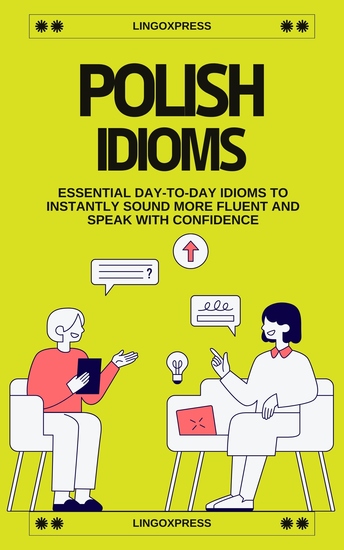
Polish Idioms - Essential Day-to-Day Idioms to Instantly Sound More Fluent and Speak with Confidence - cover

Polish Idioms - Essential Day-to-Day Idioms to Instantly Sound More Fluent and Speak with Confidence

lingoXpress

Publisher: lingoXpress

  • 0
  • 0
  • 0

Summary

Learn to speak Polish like a pro with Polish Idioms: Essential Day-to-Day Idioms to Instantly Sound More Fluent and Speak with Confidence.
 
This book is perfect for anyone who wants to sound more natural when speaking Polish. It’s packed with common idioms used in everyday conversations, making it easier to understand the Polish people, and express yourself like a native.
 
Each idiom comes with a simple explanation, there are also exercises and examples to show you how to use it. Whether you’re learning Polish for fun, travel, or work, this book will boost your confidence and fluency.
 
Inside, you’ll find:
 
Useful idioms explained in plain English.
 
Practice exercises to help you learn faster and memorize the idioms.
 
Easy examples so you can start using the idioms in real-life situations.
 
Get your copy today and start sounding more fluent in Polish right away!
Available since: 12/19/2024.
Print length: 20 pages.


Other books that might interest you

  • Rude Awakenings - Two Englishmen on Foot in Buddhism's Holy Land - cover

    Rude Awakenings - Two Englishmen...

    Ajahn Sucitto, Nick Scott

    • 0
    • 0
    • 0
    No one walks around the Buddhist holy places in India. Not today. They travel by bus with good reason. The Buddha’s homeland is now one of the most desperately overcrowded and poverty ridden places on the planet. It is also very dangerous. But Nick Scott and Ajahn Sucitto decided to do just that: to walk for six months and for over one thousand miles, sleeping out at night and living on alms food, just as the Buddha would have done. 
    “Armchair pilgrims take note! This book will provide blisters, backaches, frights, absurd laughter and all night meditation. Result? Exhaustion tinged with grace. In the age of the pop-epiphany, Rude Awakenings is a throwback to what began it all: the slow road to enlightenment. It’s also a badminton in play between the Odd Couple of Spirituality, and one lovely read.” Tad Wise, author of Blessings in the Wind and Circling the Sacred Mountain. 
    “As the clarity and candour of the writing draw us into this remarkable journey, we soon experience an inner landscape of two extraordinary hearts and minds. This is a wonderful book.” Joseph Goldstein, meditation teacher and author of The Emerging Western Buddhism
    Show book
  • Wild Atlantic Women - Walking Ireland's West Coast - cover

    Wild Atlantic Women - Walking...

    Gráinne Lyons

    • 0
    • 0
    • 0
    At a crossroads in her life, Gráinne Lyons set out to travel Ireland's west coast on foot. She set a simple intention: to walk in the footsteps of eleven pioneering Irish women deeply rooted in this coastal landscape and explore their lives and work along the way. As a Londoner born to Irish parents, she also sought answers in her own identity.
    
    
    As Gráinne heads north from Cape Clear Island where her great-grandmother was a lacemaker, she considers Ellen Hutchins, Maude Delap, Edna O'Brien, Granuaile and Queen Maeve among others from her unique perspective. Their homes – in places that are famously wild and remote – are transformed into sites of hope, purpose, opportunity and inspiration. Walking through this history, her journey reveals unexpected insight into emigrant identity, travelling alone, femininity and the trappings of an 'ideal' life. 
    
    
    Against the backdrop and power of this great ocean, Wild Atlantic Women will inspire the twenty-first-century reader and walker to keep going, regardless of the path.
    Show book
  • The Legendary Expeditions of Captain Cook - The Life Discoveries and Controversies of History’s Greatest Navigator - cover

    The Legendary Expeditions of...

    Louisa Young

    • 0
    • 0
    • 0
    Few explorers reshaped world history like Captain James Cook. His voyages across the Pacific, from Australia to Hawaii, mapped uncharted territories, changed the course of trade, and led to both scientific advancements and cultural clashes. 
    This audiobook takes you on a thrilling journey through Cook’s three legendary expeditions, his encounters with Indigenous peoples, and his dramatic final voyage. Discover: 
    ✅ How Cook’s maps and navigation techniques changed the world 
    ✅ The first European contact with Australia, New Zealand, and Hawaii 
    ✅ The scientific discoveries of his voyages—and the conflicts they caused 
    ✅ How Cook’s final journey ended in mystery and tragedy in Hawaii 
    The Legendary Expeditions of Captain Cook is a must-listen for history lovers, explorers at heart, and anyone fascinated by the Age of Discovery.
    Show book
  • Mapuche Empire - The Defenders of Chile and Unconquered Warriors of South America - cover

    Mapuche Empire - The Defenders...

    Rolf Hedger

    • 0
    • 0
    • 0
    The origins of the Mapuche people trace back thousands of years, long before the arrival of Europeans in South America. They are one of the most resilient and enduring indigenous groups in the region, with a deep-rooted history in present-day Chile and Argentina. Archaeological evidence suggests that their ancestors inhabited these lands for at least 2,000 years, developing a distinct culture shaped by the diverse landscapes of the Andean foothills, valleys, and coastal regions. 
    The name "Mapuche" itself reflects their strong connection to the land, as it derives from "mapu" (earth) and "che" (people), meaning "people of the land." This bond influenced their way of life, from agriculture to spiritual beliefs. They cultivated maize, potatoes, quinoa, and beans while also engaging in hunting, fishing, and gathering. Unlike some of the great civilizations of South America, such as the Inca or the Maya, the Mapuche did not build massive stone cities. Instead, they lived in small, scattered settlements made up of rucas, traditional thatched-roof houses constructed from wood and straw, designed to withstand the varied climate of their territories. 
    Language played a crucial role in shaping the Mapuche identity. They spoke Mapudungun, a unique language that remains central to their culture today. Unlike the Quechua language of the Andes, which spread widely due to the influence of the Inca Empire, Mapudungun remained relatively isolated, preserving its distinct linguistic structure. Oral tradition was the primary means of passing down knowledge, with elders recounting stories, myths, and historical events that shaped the collective memory of the Mapuche people.
    Show book
  • 3 Sisters 3 Weeks 3 Countries (Still Talking) - cover

    3 Sisters 3 Weeks 3 Countries...

    Elizabeth Moore Kraus

    • 0
    • 0
    • 0
    Blithely venturing off on their first-ever trip together, the Moore sisters travel to Ireland, England, and Scotland. In their mid-60s, they embark with visions of fun on their horizon when all too quickly reality sets in. One sister learns she must accept her internal GPS in untrustworthy. Another reveals a major mistake in time management. The third volunteers as 'Fixer of All Things' -- a position open as the others lack interest. What can not be fixed is the chronic lack of elevators and a discouraging abundance of stairs, bringing about ups and downs of all sorts. Yet the Moore sisters laugh when they are down. Usually. Well, most of the time..
    Show book
  • Mapping the Human Trail - cover

    Mapping the Human Trail

    Reece Davis

    • 0
    • 0
    • 0
    What if the real map of the world isn’t drawn in borders or boundaries — but in the shared stories of the people who live upon it? 
    In Mapping the Human Trail, acclaimed travel writer Reece Davis traces an invisible cartography of connection — exploring how traditions, beliefs, and everyday acts of kindness link humanity across continents. From the markets of Marrakech to the tundras of Siberia, he listens to voices that reveal the delicate threads holding our world together. 
    Through encounters both intimate and vast, Davis maps the emotional and cultural pathways that unite us — reminding readers that travel, at its heart, is an act of empathy. 
    Profound and uplifting, Mapping the Human Trail is a testament to curiosity, compassion, and the enduring search for meaning in a world of endless movement.
    Show book