Join us on a literary world trip!
Add this book to bookshelf
Grey
Write a new comment Default profile 50px
Grey
Subscribe to read the full book or read the first pages for free!
All characters reduced
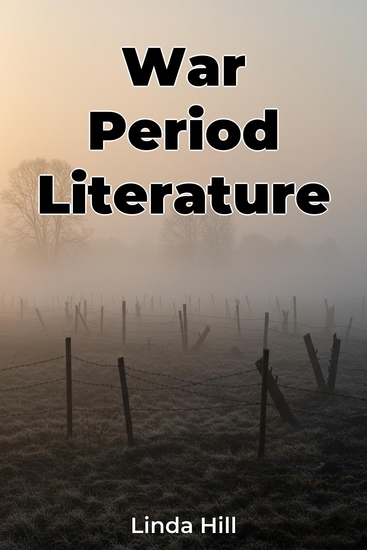
War Period Literature - cover

War Period Literature

Linda Hill

Translator A Ai

Publisher: Publifye

  • 0
  • 0
  • 0

Summary

"War Period Literature" delves into how global conflicts shape human expression, using literature as a lens to understand wartime experiences. It argues that literature serves as a crucial historical record, often providing deeper insights than official accounts. For instance, the book explores how psychological theories of trauma help us understand PTSD themes in war narratives, or how political ideologies influence war representation in literature.

 
The book progresses by first establishing "war literature" as a genre, then examining specific historical periods like World War I, World War II, and the Cold War, showcasing diverse writer responses. Finally, it analyzes recurring themes such as trauma, heroism, and disillusionment. This approach reveals the unique perspectives and literary styles that emerged during each era, demonstrating literature's adaptability in capturing the impact of war on individuals and societies. It’s a valuable resource for understanding military history and the cultural impact of war.
Available since: 05/06/2025.
Print length: 82 pages.
Other books that might interest you

  • Whispers in the Dark - A Collection of Short Scary Stories - cover

    Whispers in the Dark - A...

    Elias Blackwood

    • 0
    • 0
    • 0
    Step into a world where shadows have a voice, and nightmares linger long after the lights go out. Whispers in the Dark is a spine-chilling anthology of short horror stories that will haunt your imagination. Each tale is a gateway to the unknown, where ordinary moments twist into terrifying encounters and the mundane transforms into the macabre. From ancient curses and vengeful spirits to eerie coincidences and the monsters lurking just out of sight, these stories are crafted to unsettle and disturb. Perfect for reading late at night, this collection will make you question every creak and whisper in the darkness. Are you brave enough to turn the page or listen?
    Show book
  • The Great Learning - cover

    The Great Learning

    Confucius

    • 0
    • 0
    • 0
    "The Great Learning," a classic Chinese text attributed to Confucius, is a concise treatise on personal development and societal harmony. It outlines a path to self-improvement through the cultivation of virtue, emphasizing the importance of starting with oneself and extending moral influence to family, community, and the world. This foundational Confucian work underscores the idea that by perfecting one's character and aligning with the principles of benevolence and righteousness, individuals can contribute to a just and harmonious society. "The Great Learning" serves as a timeless guide to ethical living and leadership, offering enduring wisdom for personal growth and social progress. Read in English, unabridged.
    Show book
  • World Citizen Journeys of a Humanitarian - cover

    World Citizen Journeys of a...

    Jane Olson

    • 0
    • 0
    • 0
    These stories are about light and hope in the midst of unimaginable human suffering in war zones and places of extreme poverty around the world. Important lessons from a childhood in rural western Iowa are woven throughout, as are examples of human strength and resiliency. Each chapter can be read as a complete experience. Intimate details recorded by the author in journals and on film take the reader on memorable journeys with international human rights and humanitarian organizations. Despite being plunged into war zones, crowded refugee camps, and some of the poorest and most disease-affected places on the planet, we learn the life-saving impact of humanitarian intervention, the healing power of community, the importance of justice, and the truth that one caring person can indeed make a difference. To be a World Citizen is to embrace and champion the Universal Declaration of Human Rights, knowing that all lives are valuable and equally deserving of protection and support.
    Show book
  • My Blue Book of Grammar for Class 3 - cover

    My Blue Book of Grammar for Class 3

    Meigha Rawat

    • 0
    • 0
    • 0
    A Grammar Series That Uses the Functional Approach
    
    KEY FEATURES 
    - Functional approach to grammar teaching, using exemplars to illustrate the usage before defining the structure and rules
    - Vocabulary taught through language-in-use to build the learners’ vocabulary through use rather than memorisation of rules
    - Contemporary topics to inculcate 21-century skills amongst learners
    - Use of literature to help learners understand how grammar is used in text
    - A comprehension section comprising texts from different genres so that learners may relate grammar to different types of works produced in English
    - Phonics in Grades 1 and 2 to teach the very basis of language
    - Uniquely stylised illustrations
    - Activities such as puzzles, crosswords, word grids and games to aid the facilitator in using the concept of ‘flipped classroom’
    - Periodic tests to help the learners self-assess the acquisition of concepts
    - Digital component to cater to a technology-driven classroom
    
    DESCRIPTION: 
    My Blue Book of Grammar is a course that has been conceptualized and designed keeping in mind the increasingly dynamic role of the English language in today’s world. Especially in our country, where English serves as the lingua franca, a grammar course has to offer not only an exposition of the pedagogy but also the exhibition of the utility of that pedagogy. The aim of a grammar series should be to encourage the development of competency amongst learners, even though their proficiency levels may vary. While the level of exposure to English of all learners may be different, a grammar series should aid in the development of a certain level of confidence amongst the learners, with the end result being that they are able to converse without hesitation in English. 
    
    WHAT WILL YOU LEARN
    - Understand grammar concepts
    - Learn how to use different vocabulary concepts taught through language-in-use 
    - Learn 21-century skills 
    - Develop deeper understanding of and appreciation for literature
    - Have clearer pronunciation through a better understanding of phonics
    
    WHO THIS BOOK IS FOR: 
    School students of Grades 3
    
    TABLE OF CONTENTS
    GRAMMAR
    1. Nouns 
    2. Definite Article – the 
    3. Types of Sentences 
    4. Possessive Helping Verbs and Pronouns 
    5. Simple Future Tense – will and shall 
    6. Contractions 
    7. Present Continuous 
    8. Adjectives – Superlative Form 
    9. Kinds of Adverbs 
    10. Conjunctions – so, because 
    11. Prepositions of Time 
    12. Irregular Verbs 
    Test Paper 1 
    VOCABULARY
    13. Alphabetical Order – Using the Second Letter of the Word 
    14. Gender 
    15. Suffix: –able 
    16. Suffixes: –ness, –ship 
    17. Helping Verbs – can or may 
    18. Synonyms – Revision 
    19. Homonyms 
    Test Paper 2 
    WRITING
    20. Picture Composition 
    21. Diary Entry 
    22. Informal Letter Writing 
    23. A Birthday Invitation 
    24. Describing a Scene 
    25. Paragraph Writing 
    Test Paper 3 
    COMPREHENSION
    26. Black Beauty 
    27. Little House in the Big Woods 
    28. Rajasthan Hues: 
    Blue Pottery in India 
    29. Wednesday, Thursday and Friday 
    Orange Global Olympiad – English Sample Paper
    Show book
  • Bacon Shakespere and the Rosicrucians - cover

    Bacon Shakespere and the...

    Manly Palmer Hall

    • 0
    • 0
    • 0
    The present consideration of the Bacon--Shakspere--Rosicrucian controversy is undertaken not for the vain purpose of digging up dead men's bones but rather in the hope that a critical analysis will aid in the rediscovery of that knowledge lost to the world since the oracles were silenced. It was W. F. C. Wigston who called the Bard of Avon "phantom Captain Shakespeare, the Rosicrucian mask." This constitutes one of the most significant statements relating to the Bacon-Shakspere controversy.
    Show book
  • Empty Cages - Facing the Challenge of Animal Rights - cover

    Empty Cages - Facing the...

    Tom Regan

    • 0
    • 0
    • 0
    Described by Jeffrey Masson as "the single best introduction to animal rights ever written, Tom Regan's EMPTY CAGES stands as an essential guide to the ongoing animal rights debate. In a style at once simple and elegant, Regan dispels the negative image of animal rights advocates as portrayed by the mass media, unmasks the fraudulent rhetoric of "humane treatment" favored by animal exploiters in both familiar and less well-documented contexts, and explains why existing laws function to legitimize institutional cruelty. In so doing, Regan invites readers to join the struggle for animal rights—one person at a time, one step at a time. Written by the leading philosophical spokesperson for animal rights, Tom Regan's shocking exposé of animal abuse makes an essential and lasting contribution to how animal rights is viewed in the United States and around the world. 
    "Tom Regan delivers a searing indictment of the way we treat animals in the world we have made for ourselves, and presents a trenchant case that animals have or should have rights in the same way that human beings have."—J. M. Coetzee, winner of the 2003 Nobel Prize for Literature 
    "Every so often a book is written that is destined to change the way people think. Tom Regan has written just such a book. EMPTY CAGES is compelling because it is logical, rational, and written in an elegantly simple style. Please buy this book, read it, and tell your friends about it. Everyone needs a copy on their bookshelf."—Jane Goodall 
    "Tom Regan's EMPTY CAGES is a powerful call for justice on one of the most urgent issues human society faces. Calmly, lucidly, he asks readers to confront the miserable conditions we have inflicted on animals, leaving us with three choices: find a flaw in the argument, work for change, or throw the book away and try to forget it. The indelible force of Regan's argument makes the third course very difficult."—Martha C. Nussbaum, University of Chicago
    Show book