Join us on a literary world trip!
Add this book to bookshelf
Grey
Write a new comment Default profile 50px
Grey
Subscribe to read the full book or read the first pages for free!
All characters reduced
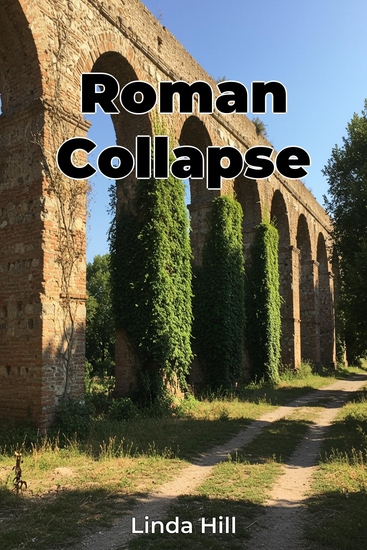
Roman Collapse - cover

Roman Collapse

Linda Hill

Translator A Ai

Publisher: Publifye

  • 0
  • 0
  • 0

Summary

Roman Collapse explores the complex reasons behind the fall of the Roman Empire, moving beyond simple explanations to offer a nuanced view of this pivotal moment in World History. The book emphasizes the interconnectedness of economic struggles, barbarian invasions, and political instability as key factors in the Roman decline. For example, the empire's reliance on slave labor created vulnerabilities in its agricultural system, while constant migration strained resources and military capabilities. This book challenges traditional narratives by presenting a holistic picture of how these elements gradually eroded the empire's foundations, moving beyond the idea of a single cause.

 
The book begins with a background on the Roman Empire at its height before delving into the internal weaknesses and external pressures that led to its demise. Examining economic decline, political turmoil, and barbarian migrations, the book uses archaeological evidence, legal codes, and contemporary accounts to provide a comprehensive analysis.

 
The book concludes by assessing the long-term consequences of the Roman collapse on the development of Europe, highlighting the rise of new kingdoms and the transformation of social structures. By understanding the interplay of these forces, readers gain valuable insights into the dynamics that can cause even the most powerful empires to crumble.
Available since: 03/20/2025.
Print length: 56 pages.

Other books that might interest you

  • Living With My Century - A Memoir - cover

    Living With My Century - A Memoir

    Eda Sagarra

    • 0
    • 0
    • 0
    Professor Eda Sagarra, born in 1933, has been a significant and influential figure in Irish and European academic policy-making, contributing to the early development of the Erasmus scheme. Now, aged nearly 88, this memoir gives striking evidence of her self-discipline and formidable energy. This substantial memoir by one of the foremost female academics in Ireland starts with Sagarra's own perspective on committing her life story to history during the pandemic lockdown of 2020:
    The following memoir recalls for those born in the present century and schooled without the strong sense of Irish history, which defined our people from the Great Famine of the 1840s until recent times, what it was like to grow up as a woman in the twentieth century and seek a career in a man's world. It tries to re-capture as much what it felt like to the person experiencing it as what was happening in society. Younger people today who read of the restrictions to which women were subject in the 1930s, 1940s and 1950s, will find it difficult to comprehend why our generation and the one that followed ours didn't challenge them. But probably the greatest contrast between the Ireland of then and now was the room for manoeuvre – or rather the absence of it. Today our lives are premised on a constantly changing world. Ireland is more connected across the globe than ever it was. Today most people are mobile. The Ireland when I was young was in almost every respect a static, hierarchical and paternalist society, one in which the accident of your birth would generally determine your whole life. No life is representative, but every person's experience is unique and worth recording for those who come after us. 
    A south Dublin convent girl, Sagarra probes childhood and family, schooling, and UCD — with a perceptive commentary on the Ireland of the 1930s and 1940s. Her remarkable memory and shrewd eye for detail present at times a painfully honest account of family and in the upper middle-class world of Catholic south Dublin, revealing the profound influence of Europe during her postgraduate years in post-war Germany, Switzerland and Austria.
    Running through this forensic account of her academic life is a keen awareness of the constant if subtle barriers to female advancement.
    
    For contemporary critics reconstructing the history of gender equality in Ireland and for readers of feminist history, this makes for essential reading. Her description of retirement since 1998 is colourful, poignant and revealing, and her reflections on old age and youth resonate.
    Show book
  • Melanin Base Camp - Real-Life Adventurers Building a More Inclusive Outdoors - cover

    Melanin Base Camp - Real-Life...

    Danielle Williams

    • 0
    • 0
    • 0
    Beautiful, empowering, and exhilarating, Melanin Base Camp is a celebration of underrepresented BIPOC adventurers that will challenge you to rethink your perceptions of what an outdoorsy individual looks like and inspire you to being your own adventure. Danielle Williams, skydiver and founder of the online community Melanin Base Camp, profiles dozens of adventurers pushing the boundaries of inclusion and equity in the outdoors. These compelling narratives include a mother whose love of hiking led her to found a nonprofit to expose BIPOC children to the wonders of the outdoors and a mountain biker who, despite at first dealing with unwelcome glances and hostility on trails, went on to become a blogger who writes about justice and diversity in natural spaces. Also included is a guide to outdoor allyship that explores sometimes challenging topics to help all of us create a more inclusive community, whether you bike, climb, hike, or paddle. Join us as we work together to increase representation and opportunities for people of color in outdoor adventure sports.  
    Show book
  • Stalingrad's Crucible - Unveiling the Turning Point of World War II - cover

    Stalingrad's Crucible -...

    History Retold

    • 0
    • 0
    • 0
    Amidst the tapestry of history, a tale of great valor and unyielding spirit unfolds – "Stalingrad´s crucible." Herein, the annals of time are unrolled, revealing the epochal Battle of Stalingrad in its most intricate and captivating detail. 
    Venture beyond the mortal veil and walk among the soldiers, civilians, and leaders who bore witness to this climactic clash. Peer into personal chronicles, wherein courage, sacrifice, and the unquenchable flame of determination burn bright. 
    Allow the hallowed arena of strategic warfare embrace you, where tactics, maneuver, and the weighty choices of commanders dictated destiny. The dance of command, the intricacies of intelligence, and the ever-shifting lines of battle are laid bare. Traverse the corridors of time to comprehend the intricate tapestry of events leading to this monumental confrontation. Peer beyond the battle's borders and uncover the geopolitical forces, alliances, and ambitions that gave birth to this saga. 
    In this book you´ll:Experience an Epic Prose: The words flow as if spun by the quill of ages past, entwining history into a captivating tapestry of narrative.Enjoy a Holistic Odyssey: Beyond the battle's ardor, delve into the lives and dreams of those who walked its fields, forging a profound connection with history's pulse.Unfade Wisdom: Lessons unveiled transcend epochs, resonating as potently in our modern era as in the echoes of yore. 
    Unleash the Power of "Stalingrad´s Crucible" Today! 
    Embark upon a journey through the corridors of time, reliving the clash that indelibly etched its mark upon the annals of humanity. 
    Don´t wait. Scroll up and buy this book now!
    Show book
  • From Passion To Peace or The Pathway of the Pure - cover

    From Passion To Peace or The...

    James Allen

    • 0
    • 0
    • 0
    A fascinating mix of Christian, Buddhist, and Daoist thought presented by the original self-help guru in 1910. As Lily L Allen put it, "all his works [are] eminently practical. He never wrote theories, or for the sake of writing; but he wrote when he had a message, and it became a message only when he had lived it out in his own life, and knew that it was good. Thus he wrote facts, which he had proven by practice. "Born in Leicester, UK, to an illiterate mother in 1864, Allen's father left when he was 15 to find work in America, and was promptly murdered on arrival. After leaving school and finding work as a clerk,  Allen's writing career lasted for only a decade, from 1902-1912. In that time he wrote nineteen books about how to recognise and live the divine and virtuous life, deeply informed by both Jesus and Buddha. As he puts it in this book,"To have transcendent virtue is to enjoy transcendent felicity. The beatific blessedness which Jesus holds out is promised to those having the beatific virtues—to the merciful, the pure in heart, the peacemakers, and so on. The higher virtue does not merely and only lead to happiness, it is happiness. It is impossible for a man of transcendent virtue to be unhappy. The cause of unhappiness must be sought and found in the self-loving elements, and not in the self-sacrificing qualities. A man may have virtue, and be unhappy, but not so if he have divine virtue. Human virtue is mingled with self, and therefore with sorrow; but from divine virtue every taint of self has been purged away, and with it every vestige of misery. "
    Show book
  • Napoleon’s Escape from Elba: The History of the French Emperor’s Return from Exile and the Road to Waterloo - cover

    Napoleon’s Escape from Elba: The...

    Editors Charles River

    • 0
    • 0
    • 0
    Although Napoleon was exiled, he was allowed to retain the title of Emperor and was given de facto control over Elba. But it should not be surprising the man who once ruled Europe was not content with the island of Elba. Separated from his family and cast away on a small island, Napoleon attempted suicide by taking a poison pill, but he had first carried the pill with him on the retreat from Moscow, rightly concerned about an uncertain fate at the time. The aging process had fatally weakened the pill, which stopped it from fatally weakening Napoleon. 
    Though the emperor busied himself developing the island’s industries and had established a miniature army and navy, he must still have found time to brood upon his situation and could not have helped but think of himself as reduced to laughing stock. The “Emperor of Elba” was a poor title for a man who had once ruled over more than half of mainland Europe. Even some of Napoleon’s old Marshals, like Murat, now controlled more territory than the man who had raised them in the first place. To add insult to injury, the salary he had been promised in the Treaty of Fontainebleau and that was meant to keep him in relative luxury was often late and sometimes failed to arrive at all. Coupled with his deteriorating health and the express refusal of the Austrian court to let him speak or write to his wife and son, Napoleon must have felt himself well and truly slighted. Beaten, but not defeated, he resolved to show the Coalition powers he could still make Europe tremble. 
    Of all the incredible military feats Napoleon accomplished, none were more impressive than his escape from Elba and his return to France, which was literally a bloodless revolution. On February 26, 1815, Napoleon escaped from Elba, and in a desperate gamble, he landed on the French mainland with less than a thousand men and marched on Paris.
    Show book
  • Thanddi Agg - cover

    Thanddi Agg

    Seema Verma

    • 0
    • 0
    • 0
    The book "Thandi Agg" by Seema Verma is a collection of short stories, with around 60 stories included. The stories are full of emotions and engaging plots. The titles of the stories match well with their content, and many of them touch on important social issues as well as relationships and real-life experiences.
    Show book