Join us on a literary world trip!
Add this book to bookshelf
Grey
Write a new comment Default profile 50px
Grey
Subscribe to read the full book or read the first pages for free!
All characters reduced
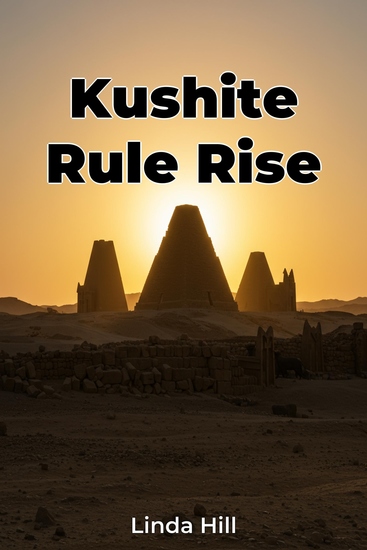
Kushite Rule Rise - cover

Kushite Rule Rise

Linda Hill

Translator A AI

Publisher: Publifye

  • 0
  • 0
  • 0

Summary

Kushite Rule Rise explores the fascinating history of the Kushite kingdom in Ancient Nubia, challenging Eurocentric narratives by highlighting its dynamic role in world history. The book examines how this civilization not only thrived for centuries but even ruled Egypt as the 25th Dynasty. It delves into the political structures, economic systems, and cultural achievements of the Kushites, relying on primary sources like inscriptions from Kushite monuments and archaeological discoveries at sites such as Meroë and Gebel Barkal. The book argues that the Kushite kingdom was an independent civilization that actively participated in regional networks. For instance, their mastery of metallurgy allowed them to develop advanced weaponry and trade goods. The narrative progresses by first introducing the geography and early history of Nubia, then examining the Kushite conquest of Egypt, internal organization, and interactions with other cultures, including trade with the Mediterranean world. By analyzing inscriptions and archaeological finds, Kushite Rule Rise provides a comprehensive understanding of Kushite civilization from its rise around the 8th century BCE to its decline in the 4th century CE. This approach emphasizes the interconnectedness of African and Mediterranean societies, offering valuable insights into the complex interplay between environment, society, and power.
Available since: 05/03/2025.
Print length: 58 pages.

Other books that might interest you

  • Straight White Male - A Faith-Based Guide to Deconstructing Your Privilege and Living with Integrity - cover

    Straight White Male - A...

    Chris Furr, Matthias Roberts,...

    • 0
    • 0
    • 0
    As the cultural conversation around race, gender, and sexuality has evolved, straight, white men are becoming increasingly aware of their privilege. But many may be left thinking, "OK, what am I supposed to do about it?" "We need a way forward beyond feelings of guilt, overwhelmingness, anger, and denial." "We are looking for transformative guidance that helps us be the good guys we want to be." 


    Straight, white, male pastor Chris Furr offers a guide to deconstructing that privilege in Straight White Male. With an emphasis on confession and redemption, Furr invites other privileged men to reconsider the ways they live, work, believe, and interact with others. Alongside Furr's perspective, essays from contributing writers who lack various types of privilege—straight, Black man William J. Barber II, straight, white woman Melissa Florer-Bixler, queer, nonbinary latinx Robyn Henderson-Espinoza, and gay, white man Matthias Roberts—offer insights on how particular types and combinations of privilege (and the lack thereof) shape the way we move through the world. Their combined voices offer much-needed perspective through this deconstruction and provide a vision for how straight, white men can do better for ourselves, our families, and society.
    Show book
  • DBT Skills Workbook for Teens and Parents The: A Comprehensive Guide with 100+ Activities to Cultivate Emotional Resilience Foster Awareness and Build Strong Coping Skills as a Family - cover

    DBT Skills Workbook for Teens...

    Joss Reed

    • 0
    • 0
    • 0
    Two manuscripts in one audiobook:DBT Skills Workbook for Teens: 101 Engaging Exercises and Activities for Handling Difficult Emotions, Increasing Awareness, and Enhancing Coping SkillsThe DBT Skills Workbook for Parents of Teens: The Ultimate Guide to Help Your Teen Manage Difficult Emotions, Increase Awareness, and Strengthen Coping Skills 
    In the first part of this audiobook, you will:Learn about DBT and its benefitsDiscover mindfulness techniquesUnderstand how to balance their emotionsLearn how to express themselves freelyDiscover the secrets to controlling emotional outburstsLearn how to navigate the challenges they may face in lifeLearn how to recognize their feelingsUnderstand how DBT can help them build social skills 
    In the second part of this audiobook, you will:Learn everything about DBT, including what it can offer you and how you can harness it.Learn how to nurture the positive aspects of your relationship with your teenager.Discover how to avoid triggering dangerous conflicts with your teen and stop the angry outbursts before they get out of control.Understand the real reason your teen behaves the way they do.Understand what matters in your teen’s life, what they believe in, and why it’s important to them.Discover different techniques to positively connect with your teen and relate to them in a way they understand.Learn how to help your teenager overcome their fear of failure, gain self-confidence, and discover their strengths. 
    Click the “add to cart” button today to support your teen's mental health, help them grow into a self-actualized, responsible, and empathetic individual by learning skills that fix problems.
    Show book
  • Danger Zone - The Coming Conflict with China - cover

    Danger Zone - The Coming...

    Michael Beckley, Hal Brands

    • 0
    • 0
    • 0
    It has become conventional wisdom that America and China are running a "superpower marathon." Yet Hal Brands and Michael Beckley pose a counterintuitive question: What if the sharpest phase of that competition is more like a decade-long sprint? 


    The Sino-American contest is driven by clashing geopolitical interests and a stark ideological dispute over whether authoritarianism or democracy will dominate the twenty-first century. But both history and China's current trajectory suggest that this rivalry will reach its moment of maximum danger in the 2020s. 


    China is at a perilous moment: strong enough to violently challenge the existing order, yet losing confidence that time is on its side. Witness its aggression toward Taiwan, its record-breaking military buildup, and its efforts to dominate the critical technologies that will shape the world's future. 


    The Chinese challenge will most likely prove more manageable than many pessimists currently believe—but during the 2020s, the pace of Sino-American conflict will accelerate, and the prospect of war will be frighteningly real. America, Brands and Beckley argue, will still need a sustainable approach to winning a protracted global competition.
    Show book
  • Mughal Empire - The Taj Mahal Legacy - cover

    Mughal Empire - The Taj Mahal...

    Rolf Hedger

    • 0
    • 0
    • 0
    The Mughal Empire emerged as one of the most powerful and influential dynasties in Indian history, leaving a lasting impact on culture, architecture, and governance. Its foundation was laid by Babur, a descendant of both Timur and Genghis Khan, who established Mughal rule in the early 16th century. Babur's military prowess and strategic vision enabled him to defeat the Delhi Sultanate in the First Battle of Panipat in 1526. This victory marked the beginning of Mughal dominance in the Indian subcontinent. However, Babur’s reign was short-lived, and it was his grandson, Akbar, who truly solidified the empire’s foundation. 
    Akbar ascended the throne at a young age and quickly proved himself to be an exceptional leader. His reign, which lasted from 1556 to 1605, was marked by territorial expansion, administrative reforms, and a commitment to cultural and religious harmony. Unlike previous rulers, Akbar recognized the diversity of India and sought to integrate different communities into his empire. He abolished the jizya tax on non-Muslims, promoted interfaith dialogue, and appointed talented individuals from various backgrounds to key positions in his administration. His policy of religious tolerance and inclusive governance earned him the loyalty of many, contributing to the stability and prosperity of the empire. 
    One of Akbar’s most remarkable achievements was the establishment of an efficient administrative system. He divided his empire into provinces, each governed by appointed officials who reported directly to the central authority. This system ensured effective governance and facilitated tax collection, trade, and law enforcement. Additionally, Akbar introduced a standardized revenue system that helped regulate the economy and promote agricultural growth. His emphasis on merit-based appointments created a well-organized bureaucracy that endured long after his reign.
    Show book
  • That Behaviour Book - The simple truth about teaching children - cover

    That Behaviour Book - The simple...

    Stephen Baker

    • 0
    • 0
    • 0
    What kind of teacher are you? What values, beliefs and principles do successful teachers have and how do they sustain these in the face of challenging pupil behaviour?
    In this timely book, Stephen Baker contends that rigid punishment systems weaponize young people's defiance against them and that punishment doesn't work. He believes that teachers need to take responsibility for behaviour and to lead it, not just 'manage' it, that we need to love the kids (even if we don't like them), that children are people, thatweare an event intheirlives, and that teaching is a relationship-based activity.
    With each chapter followed by engaging 'takeaway tasks',That Behaviour Bookwill allow teachers to rapidly improve both their practice and their relationships with pupils and classes. The book looks at the values that will sustain you as a teacher, how routines will help you teach better and what 'positive expectations' really mean, making child-centred relational practice easy to apply in the classroom. Teachers will have a more realistic appreciation of their own situation and of the context in which they teach. In short, this book will help teachers learn how to get the very best out of their pupils.
    That Behaviour Bookis an essential guide for both the beginner and the more experienced teacher. Its unique tone makes it an indispensable companion for the busy teacher, providing a sense of connection, challenge and reassurance all at once. Stephen Baker's anecdotes, drawn from his years as a pupil, teacher and trainer pack an emotional punch and are often hilarious.
    Suitable for all teachers.
    Show book
  • Bulgarian Made Easy - Beginner - Volume 2 of 3 - cover

    Bulgarian Made Easy - Beginner -...

    Lingo Wave

    • 0
    • 0
    • 0
    We broke our new series on learning Bulgarian down into different learning stages. Start with the "Lower Beginner" books followed by the "Beginner" and "Upper Beginner" books. Next, progress to the "Intermediate" series, then test and reinforce your knowledge with the "Conversations" series. 
    This audiobook is divided into units.While it provides different learning patterns and accommodates various needs, this audiobook focuses on helping you improve your ability to understand, speak, and memorise Bulgarian. 
    In Unit 1 you will hear Bulgarian decoded with each syllable spoken very slowly and clearly with repetition. Immediately before each sentence is spoken, you will hear the translation, so you will always understand what is being said. 
    Unit 2 focuses solely on increasing your listening ability, which will improve your abilities to engage in dialogue with a native Bulgarian speaker. This chapter requires you to listen very carefully to nuances in the language. 
    By Unit 3 you will already notice progress in your abilities to speak and understand Bulgarian. The spoken translation is followed by two repetitions in Bulgarian at a completely natural speed. While you are learning to process naturally spoken Bulgarian, Units 3 and 4 will help you memorise new vocabulary and full sentences. 
    In Unit 5 you can test yourself on how much you have learned. If you are having difficulties, we suggest you revisit the listening, speaking, or memorisation section of Units 1, 2 3 or 4, according to what you need more help with. 
    Topics covered in this book: 
    1. Asking about family 
    2. Asking about relationship status 
    3. Expressing frequency 
    4. Talking about spare time activities and hobbies 
    5. Using quantifiers/determiners 
    6. Talking about preference 
    7. Talking about abilities 
    8. Talking about location of places 
    9. Describing appearance 
    10. Talking about personality 
    ...
    Show book