Join us on a literary world trip!
Add this book to bookshelf
Grey
Write a new comment Default profile 50px
Grey
Subscribe to read the full book or read the first pages for free!
All characters reduced
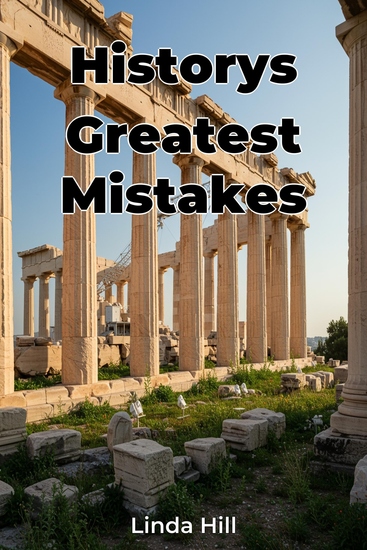
Historys Greatest Mistakes - cover

Historys Greatest Mistakes

Linda Hill

Translator A AI

Publisher: Publifye

  • 0
  • 0
  • 0

Summary

History's Greatest Mistakes explores pivotal moments where critical errors in judgment reshaped civilizations and triggered disasters. The book examines failures in strategic planning, misinterpretations of data, and the consequences of ego, emphasizing that understanding past errors is vital for future decision-making. One intriguing insight is how navigational errors spurred unintended colonization, while political and military blunders led to immense suffering and geopolitical shifts. 

 
The book systematically analyzes historical errors across three core areas. First, it investigates navigational and exploratory errors. Second, it explores political and military blunders that triggered conflicts. Third, it examines technological and scientific oversights that produced catastrophic outcomes, highlighting the importance of risk assessment. This approach provides a richer understanding of the complex factors contributing to historical outcomes, connecting historical analysis with political science, economics, and sociology.

 
The book's unique value lies in its emphasis on the psychological dimensions of decision-making, exploring how cognitive biases and leadership styles impact the likelihood of errors. By presenting a balanced account of events and avoiding simplistic answers, History's Greatest Mistakes encourages readers to grapple with the complexities of historical causality and the ongoing relevance of past mistakes, urging us to learn from the past for a better future.
Available since: 04/03/2025.
Print length: 65 pages.

Other books that might interest you

  • Anarchy State and Utopia: Book Summary & Analysis - cover

    Anarchy State and Utopia: Book...

    Briefly Summaries

    • 0
    • 0
    • 0
    This is a concise summary and analysis of Anarchy, State, and Utopia, by Robert Nozick.
     
    It is not the original book and is not affiliated with or endorsed by Robert Nozick.
    Ideal those seeking a quick and insightful overview.
     
    Anarchy, State, and Utopia presents a profound and provocative exploration of political philosophy, questioning the role and limits of government. Through a compelling defense of libertarianism, this book challenges readers to rethink the nature of individual rights, the legitimacy of the state, and the pursuit of justice in a free society. It offers a rich tapestry of arguments, from the foundational principles of a minimal state to the critique of redistribution and utopian visions. This work is essential reading for anyone interested in philosophy, politics, or economics.
    Show book
  • Unfractured - A Christ-Centered Action Plan for Cultural Change - cover

    Unfractured - A Christ-Centered...

    Skot Welch

    • 0
    • 0
    • 0
    Together we can change the conversation—and change the world. 


    We're often left in dead-end debates on racial tensions, foolishly expecting solutions from a culture obsessed with canceling and dividing. But what if the church could create a more effective dialogue? 


    For over two decades, Skot Welch has been a key advisor on diversity and inclusion around the world, in everything from the arts and entertainment to the church to Fortune 500 companies. With wisdom and a humble graciousness, he challenges us to rethink the way we talk about race and ethnicity, empowering you to celebrate both your identity in Christ and diverse cultural makeup; embrace a new kingdom language that is biblically grounded and culturally relevant; explore a Christ-centered perspective on hard but crucial questions; and build a united, diverse community where compassionate, challenging conversations can take place. 


    The church holds the redemptive solution our world needs, one that puts Christ at the center, modeling conciliation that leads to lasting reconciliation.
    Show book
  • Rome and the Near East - The History of the Different Kingdoms that Fought the Roman Empire in the Region - cover

    Rome and the Near East - The...

    Charles River Editors

    • 0
    • 0
    • 0
    Rome faced many formidable enemies over the course of nearly 1,000 years, but perhaps none were as enigmatic and forgotten as King Mithridates VI of Pontus. Despite numerous ancient sources detailing the life of the foreign monarch and his wars with Rome, and despite being an interesting character who endured years as a fugitive in his youth, enjoyed a fascination with poisons, and held mercy and pragmatic ruthlessness in a delicate balance, very few scholarly books and works have been produced about the king. It may be that his largely unsuccessful military campaigns have contributed to his disappearance from active historical examination, but despite his poor record in engagements against the Romans, the Kingdom of Pontus dominated much of Asia Minor in the 1st century BCE, and the Romans themselves considered the kingdom one of its most dangerous enemies. According to Plutarch, when Mithridates died, the Roman soldiers felt that “in the person of Mithridates ten thousand enemies had died.” By then, it had required three of Rome’s most famous generals - Sulla, Lucullus, and Pompey - to finally subdue his kingdom.   
    	Among all the periods in ancient Egyptian history, the Ptolemaic Kingdom and its most famous ruler, Cleopatra, may be the most well-known today. By the 4th century BCE, it appeared as though ancient Egypt was in its final death throes. It had long ceased to be an influential kingdom in the Near East and Mediterranean regions, and it had been ruled over by a succession of foreign peoples including Libyans, Nubians, Assyrians, and Persians. But just when Egypt seemed doomed to pass forever into obscurity, it was reinvigorated by outsiders, most notably Alexander the Great. While in the process of campaigning to destroy the Achaemenid Persian Empire and conquer the world in 331 BCE, he made a pit stop in Egypt that forever changed the course of Egyptian history.
    Show book
  • PHILOSOPHY TELLS ITS STORY - A journey through the thoughts that have shaped our world - cover

    PHILOSOPHY TELLS ITS STORY - A...

    Miguel Bevaurd, Madeline Wharter

    • 0
    • 0
    • 0
    This book plunges you into the heart of the most brilliant philosophical thinking, from antiquity to the present day, offering a captivating and enriching overview. 
    Through a fluid, accessible narrative, you'll explore the existential questions posed by thinkers such as Plato, Aristotle, Descartes, Kant and Nietzsche. You'll understand how their ideas on truth, morality, freedom and the meaning of life have spanned centuries and continue to resonate in our modern lives. 
    Each chapter invites you to discover the foundations of the systems of thought that have influenced civilizations. By immersing you in the great periods in the history of philosophy, this book highlights the debates, intellectual revolutions and currents that marked their era. It offers not only a journey through time, but also a new way of understanding today's society and its values. 
    Whether you're a philosophy enthusiast or looking to better understand the foundations of the great ideas that have shaped our world, this book offers a rich and instructive journey. It's an invitation to think deeply, to see beyond appearances, and to rediscover the timeless wisdom of the greatest thinkers. 
    This book will guide you through a fascinating intellectual journey, awakening your curiosity while providing concrete answers to the questions that still animate our times. Essential reading for anyone wishing to understand the roots of human thought and its implications for today's world.
    Show book
  • Camilla - From Outcast to Queen Consort - cover

    Camilla - From Outcast to Queen...

    Angela Levin

    • 0
    • 0
    • 0
    For many years, Camilla was portrayed in a poor light, blamed by the public for the break-up of the marriage between Prince Charles and Lady Diana. Initially, Queen Elizabeth refused to see or speak to her, but, since the death of Prince Philip, Camilla had become one of the Queen's closest companions. Her confidence in Camilla and the transformation she had seen in Prince Charles since their wedding resulted in her choosing the first day of her Platinum Jubilee year to tell the world that she wanted Camilla to be Queen Consort, not the demeaning Princess Consort suggested in 2005. 


    Angela Levin uncovers Camilla's rocky journey to be accepted by the royal family and how she coped with her brutal portrayal in Netflix's The Crown. The public have witnessed her tremendous contribution to help those in need, especially during COVID. Levin has talked to many of Camilla's long-term friends, her staff, and executives from the numerous charities of which Camilla is patron. She reveals why Camilla concentrates on previously taboo subjects, such as domestic violence and rape. Most of all, Levin tells the story of how Camilla has changed from a fun-loving young woman to one of the senior royals' hardest workers. She has retained her mischievous sense of humor, becoming a role model for older women and an inspiration for younger ones.
    Show book
  • The Crucible of Desegregation - The Uncertain Search for Educational Equality - cover

    The Crucible of Desegregation -...

    R. Shep Melnick

    • 0
    • 0
    • 0
    Examines the patchwork evolution of school desegregation policy. 
     
    In 1954, the Supreme Court delivered the landmark decision of Brown v. Board of Education—establishing the right to attend a desegregated school as a national constitutional right—but the decision contained fundamental ambiguities. The Supreme Court has never offered a clear definition of what desegregation means or laid out a framework for evaluating competing interpretations. In The Crucible of Desegregation, R. Shep Melnick examines the evolution of federal school desegregation policy from 1954 through the termination of desegregation orders in the first decades of the twenty-first century, combining legal analysis with a focus on institutional relations, particularly the interactions between federal judges and administrators. Melnick argues that years of ambiguous, inconsistent, and meandering Court decisions left lower court judges adrift, forced to apply contradictory Supreme Court precedents in a wide variety of highly charged political and educational contexts. As a result, desegregation policy has been a patchwork, with lower court judges playing a crucial role and with little opportunity to analyze what worked and what didn’t. The Crucible of Desegregation reveals persistent patterns and disagreements that continue to roil education policy.
    Show book