Join us on a literary world trip!
Add this book to bookshelf
Grey
Write a new comment Default profile 50px
Grey
Subscribe to read the full book or read the first pages for free!
All characters reduced
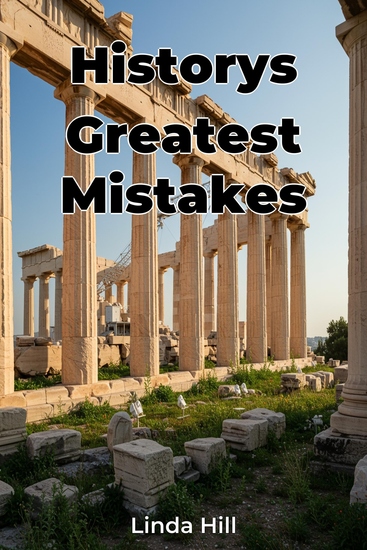
Historys Greatest Mistakes - cover

Historys Greatest Mistakes

Linda Hill

Translator A AI

Publisher: Publifye

  • 0
  • 0
  • 0

Summary

History's Greatest Mistakes explores pivotal moments where critical errors in judgment reshaped civilizations and triggered disasters. The book examines failures in strategic planning, misinterpretations of data, and the consequences of ego, emphasizing that understanding past errors is vital for future decision-making. One intriguing insight is how navigational errors spurred unintended colonization, while political and military blunders led to immense suffering and geopolitical shifts. 

 
The book systematically analyzes historical errors across three core areas. First, it investigates navigational and exploratory errors. Second, it explores political and military blunders that triggered conflicts. Third, it examines technological and scientific oversights that produced catastrophic outcomes, highlighting the importance of risk assessment. This approach provides a richer understanding of the complex factors contributing to historical outcomes, connecting historical analysis with political science, economics, and sociology.

 
The book's unique value lies in its emphasis on the psychological dimensions of decision-making, exploring how cognitive biases and leadership styles impact the likelihood of errors. By presenting a balanced account of events and avoiding simplistic answers, History's Greatest Mistakes encourages readers to grapple with the complexities of historical causality and the ongoing relevance of past mistakes, urging us to learn from the past for a better future.
Available since: 04/03/2025.
Print length: 65 pages.

Other books that might interest you

  • Blood Brothers - To Battleground Smokeshell and Back - cover

    Blood Brothers - To Battleground...

    Deon Lamprecht

    • 0
    • 0
    • 0
    On 10 June 1980, during the Border War, the SADF's 61 Mechanised Battalion Group attacked a complex of Swapo military bases in southern Angola. A long day of bloody fighting ensued.
    Second Lieutenant Paul Louw led Platoon 1, in four Ratel infantry fighting vehicles, to an objective called Smokeshell. After emerging from a dry riverbed, the young national servicemen suddenly found themselves facing a heavily defended enemy position and under deadly fire.
    In the ensuing chaos of that day, 12 troopies of Louw's platoon of 44 were killed and he himself was wounded. The 18-year-old HP Ferreira was shot through the pelvis by a 14,5 mm anti-aircraft round and also hit by AK-47 bullets. He miraculously survived.
    Blood Brothers records the dramatic events of that horrific day, in the words of the survivors of the battle, and follows members of Louw's platoon on their long journey of healing and recovery. It investigates the human cost of war after the last shots have been fired and follows the veterans as they return to the battleground four decades later in search of peace.
    Show book
  • Democracy in America: Book Summary & Analysis - cover

    Democracy in America: Book...

    Briefly Summaries

    • 0
    • 0
    • 0
    This is a concise summary and analysis of Democracy in America, by Alexis de Tocqueville.
     
    It is not the original book and is not affiliated with or endorsed by Alexis de Tocqueville.
    Ideal those seeking a quick and insightful overview.
     
    Democracy in America is a profound and enduring analysis of the American democratic system, offering a unique perspective on the strengths and challenges of democracy in the 19th century. Written by a keen observer of political and social structures, this work examines the balance of equality and liberty, the role of civil society, and the impact of democracy on culture and individualism. With insights that remain relevant today, it serves as a cornerstone for understanding the complexities of democratic governance and the enduring quest for freedom and justice.
    Show book
  • Myths and Mysteries: The Ark of the Covenant - cover

    Myths and Mysteries: The Ark of...

    Raphael Terra

    • 0
    • 0
    • 0
    This audiobook has been recorded using Text to speech (TTS). 
     
    The Ark, a vessel of immense significance in religious and cultural narratives, has captivated the imaginations of artists throughout history. Artists from various cultures and time periods have sought to visually capture the essence of The Ark and its surrounding scenes, exploring its symbolism, religious context, and historical significance. From ancient civilisations to modern interpretations, these artistic representations provide us with a window into the diverse interpretations and cultural perspectives surrounding The Ark. 
     
    This book delves into the rich tapestry of historical artistic depictions of The Ark, analysing their evolution, symbolism, cultural variations, and impact on artistic movements. By examining these artworks, we aim to gain a deeper understanding of the intricate relationship between art, history, and religious narratives, shedding light on the enduring fascination with The Ark in the world of art.
    Show book
  • Hidden Histories - 100 Wild Stories You Never Learned in History Class - cover

    Hidden Histories - 100 Wild...

    Tim Rayborn

    • 0
    • 0
    • 0
    Discover the little known facts about some of the world’s greatest historical icons. 
    We all know what was written in the history books. There are some stories we’ve heard a hundred times—but often our understanding of these events and people is narrow. Have you ever wondered about the lesser known details that influenced major events and figures behind-the-scenes? This hilarious compendium of fascinating facts and dizzying what-ifs will delight and shock history buffs and trivia lovers alike. From Abraham Lincoln’s wrestling champ background to the day Napoleon was attacked by a horde of hungry rabbits, this book will give you a new perspective. Including:Walt Disney gave his housekeeper Disney stock every year on her birthday and Christmas. By the time she retired, she was a multi-millionaire.Charlie Chaplin entered a lookalike contest as a joke…and got 20th place.Henry Ford, the founder of Ford Motor Company, convinced Thomas Edison’s son to collect Edison’s last breath in a test tube. It is on display at The Henry Ford Museum in Detroit.Before Galileo Galilei was buried, three of his fingers and a tooth were removed from his body by his admirers. The body parts are on display at the Museo Galileo in Florence, Italy. 
      
    From ancient civilization to modern times, history is full of mysterious and downright bizarre circumstances. With these crazy and compelling facts, Hidden Histories will change your view of history
    Show book
  • Ancient Greece’s Most Influential Philosophers - cover

    Ancient Greece’s Most...

    Editors Charles River

    • 0
    • 0
    • 0
    In virtually all fields of human endeavor, ancient Greece was so much at the forefront of dynamism and innovation that the products of its most brilliant minds remain not only influential but entirely relevant to this day. The great philosophers of Athens, men like Aristotle, Socrates, and Plato, interrogated themselves with startling complexity about the nature of good and evil, questioned the existence of divinity, advocated intelligent design, and went so far as to argue that all life was composed of infinitesimal particles.  
    	Although the school of philosophy started by Socrates and championed by Plato and Aristotle continues to be the most famous, other schools of thought began to branch, including the Epicureans and Cynics. In the 3rd century B.C., Stoicism arose in response to and under the influence of these older schools, combining many of the best theories from each into a more cohesive whole. With a greater flexibility and more practical application to everyday life, Stoicism quickly became a very popular school of thought, a growth made exponential by its introduction to the Romans.  
    Today, very few have heard of him, but he became a major philosophical and religious figure through the publication of his thoughts, travels, and miracles by Philostratus the Elder (c. 170-247 A.D.), written about a century after Apollonius of Tyana’s death. Philostratus the Elder’s works were based on the works of other writers (Maximus of Aegae, Damis, and Moeragenes), and miracles attributed to Apollonius were often compared to those of Jesus, who lived around the same time. Apollonius’s cult was important throughout the whole of the Pagan era and even carried on into the Middle Ages. Why such an important philosopher has been so forgotten by modern historians is in itself an interesting issue, and it is just as crucial to understand what Apollonius preached and the information he provided about his contemporary world. 
    Show book
  • Capitalist Punishment - How Wall Street Is Using Your Money to Create a Country You Didn't Vote For - cover

    Capitalist Punishment - How Wall...

    Vivek Ramaswamy

    • 0
    • 0
    • 0
    A Wall Street cartel has quietly seized control of the American economy, and they are forcing governments and businesses to bow down to their political agenda—using your money to do it. 
    Three Wall Street firms have quietly amassed more money than Jeff Bezos, Elon Musk, Andrew Carnegie, and John Rockefeller combined. But the money isn’t even theirs. These asset managers have accumulated all their power through “passive funds,” as most investors no longer believe anyone can reliably pick stocks. Yet the Big Three have decided that they can reliably pick the right social policies instead. 
    As entrepreneur Vivek Ramaswamy reveals, the results are all bad—and working their way into every corner of the economy. They force US companies to adopt “racial equity audits” and “emissions caps” while supporting human rights atrocities in China. They coerce Western companies to produce less oil while shifting production to dirtier places like Russia. They allow companies like FTX to take victory laps on good management while collapsing like a house of cards. They charge high fees to mom-and-pop investors for so-called sustainable funds that are effectively identical to lower-fee index funds. 
    Worst of all, they’re celebrated as heroes—at least so far. Capitalist Punishment lifts the veil on the largest fiduciary breaches, antitrust abuses, and First Amendment violations of the twenty-first century, misdeeds that are hiding in plain sight.  
    This isn’t just a threat to capitalism. It’s a threat to democratic self-governance itself. Capitalist Punishment is an easy-to-follow educational tour de force for every participant in financial markets—which, to the surprise of most Americans, includes nearly every single one of them.
    Show book