Join us on a literary world trip!
Add this book to bookshelf
Grey
Write a new comment Default profile 50px
Grey
Subscribe to read the full book or read the first pages for free!
All characters reduced
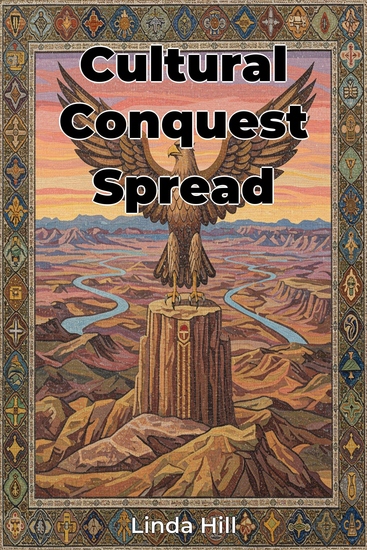
Cultural Conquest Spread - cover

Cultural Conquest Spread

Linda Hill

Translator A AI

Publisher: Publifye

  • 0
  • 0
  • 0

Summary

Cultural Conquest Spread examines how empires throughout world history have significantly shaped cultural landscapes by disseminating their religion, language, and societal norms. It asserts that conquest isn't solely political or military; its cultural dimensions have profoundly molded the modern world. The book explores the mechanics of cultural imposition and its lasting consequences, offering insights into contemporary cultural identities and international relations.

 
For instance, the spread of Islam and Arabic across North Africa and the Middle East following Islamic conquests demonstrates how deeply conquest can influence language and religion. The book challenges readers to consider how military dominance intertwines with cultural dissemination. It uses case studies such as the Roman Empire's influence on European languages and laws, and European colonialism's impact on indigenous cultures in the Americas. These examples illustrate various strategies used to spread culture, from forced assimilation to subtle adoption through trade and social interaction.

 
The book progresses by first establishing a theoretical framework, then delving into specific historical instances, and finally, analyzing the lasting implications on modern societies. By drawing upon historical chronicles, archaeological findings, and linguistic analyses, Cultural Conquest Spread offers a comprehensive overview of cultural conquest. It connects to fields like anthropology and linguistics, providing a holistic perspective on cultural change. This approach helps readers understand how cultural heritage and ongoing debates about colonialism are intertwined with historical power dynamics.
Available since: 05/05/2025.
Print length: 67 pages.


Other books that might interest you

  • Re-Composing YouTube - Vernacular Musical Aesthetics in the Digital Age - cover

    Re-Composing YouTube -...

    Jonas Wolf

    • 0
    • 0
    • 0
    YouTube features a wide array of multimodal musical figurations, including fan-made music videos, musical aestheticisations of pre-circulating content, and musical self-performances. Jonas Wolf explores open-ended forms of musical creative relay on YouTube, delving into formal, imitative, affective, and (non-)institutional aspects of networked media remix and (self-)aestheticisation. Beyond creating value for non-musical fields of discourse, this study is directed at filling a gap in a largely ocularcentric domain of study. It provides a concise theory of vernacular composition within our time's total digital archive that accounts for socio-aesthetic phenomena and their relation to systems of knowledge, control, and discourse.
    Show book
  • The Sensory Child - A Parent’s Guide to Understanding and Supporting Sensory Processing Disorder for a Calmer More Confident Child - cover

    The Sensory Child - A Parent’s...

    Dr. Emily Carter

    • 0
    • 0
    • 0
    Are you exhausted by constant meltdowns, baffling behaviors, and the feeling that you're just not reaching your child? Do everyday situations like getting dressed, eating meals, or going to the playground feel like insurmountable battles? You're not alone, and it's not your fault. 
    You've tried everything – timeouts, reward charts, stern talks – but nothing seems to work. Your child's reactions feel extreme, unpredictable, and leave you feeling helpless and confused. You worry about their future, their friendships, and how they'll navigate a world that seems to overwhelm them. This constant struggle is draining your energy and stealing the peace from your home. 
    This isn't just another parenting book; it's a roadmap to understanding your child's unique sensory world. Dr. Carter, a leading expert in the field, breaks down the complexities of SPD, explaining how the brain processes sensory information and why your child experiences the world differently. You'll learn to identify their specific sensory needs—whether they are hypersensitive, hyposensitive, or both—and discover practical, evidence-based strategies to help them regulate their nervous system. 
    With this book, you will gain the confidence to:Decode your child's baffling behaviors and understand the sensory reasons behind them.Create a sensory-friendly home environment that promotes calm and reduces meltdowns.Navigate social situations, playdates, and extracurricular activities with greater ease.Prioritize your own well-being and find support among other parents who understand your journey. 
    Take the first step towards a more peaceful and connected life with your child. Purchase The Sensory Child today and begin your journey to understanding and empowerment
    Show book
  • San Francisco's Noe Valley - cover

    San Francisco's Noe Valley

    Bill Yenne

    • 0
    • 0
    • 0
    Named for Jose de Jesus Noe, San Francisco's last Mexican mayor, Noe Valley is undoubtedly one of San Francisco's favorite neighborhoods and certainly one of the most picturesque. Yet the area has a rich and varied history reaching far beyond the lovely buildings and lively street scenes familiar to so many citydwellers. Originally part of the Rancho de San Miguel land grant, the area was incorporated into the city and became an early example of a San Francisco enclave situated away from the noise and bustle of the downtown and waterfront areas. Noe Valley gradually became an important residential and business center known for its beautifully restored Victorian homes, as well as for the vibrant commercial corridor on Twenty-fourth Street.
    Show book
  • Saratoga and Yorktown: The History of the American Revolution’s Most Important Campaigns - cover

    Saratoga and Yorktown: The...

    Editors Charles River

    • 0
    • 0
    • 0
    At the end of 1776, the American war effort was on the verge of collapse, and despite Washington’s success at Trenton, the British were confident that they could quell the rebellion in 1777. That winter, the British planned a complicated campaign in which British armies from Canada and New York would strike out across New England and link up, with the goal of cutting off the Northern colonies. Indeed, 1777 did prove to be the pivotal year of the war, but not in the way the British intended. 
    In December 1776, Benjamin Franklin was sent by Congress to France to attempt to secure a critically needed alliance. Franklin was an ideal choice for Enlightened France, which revered Franklin for his scientific accomplishments and his known reputation as a brilliant man. Franklin had also been a diplomat before the Revolution, spending several years in London on behalf of the colonies. However, the French refused to provide more than arms and money throughout 1777, until they learned in December 1777 about Saratoga and Burgoyne’s surrender. With that news, French King Louis XVI entered into a formal military alliance with the United States, and in February 1778, France joined the war. 
    Yorktown was a former tobacco trading post now in decline, not much bigger than a large village. But Yorktown was tucked away on the northern edge of the York peninsula in rural Virginia, and in 1781 it became the site of a brief siege between two small armies, fought with all the decorum and formality of 18th century European warfare. As he made his dispositions at Yorktown in September 1781, he had every reason to expect another British success. The ensuing siege panned out rather differently. On October 19, 1781, for just the second time during the war (the other at Saratoga), an entire British field army surrendered to the rebel patriots.
    Show book
  • On the Motion of Animals - cover

    On the Motion of Animals

    Aristotle

    • 0
    • 0
    • 0
    "On the Motion of Animals" is a scientific work by Aristotle that explores the principles of motion in living beings. In this treatise, Aristotle observes and analyzes the movements of various animals, from insects to humans, in order to understand the mechanics of motion and the physiological and psychological factors that drive it. Aristotle begins by examining the different types of motion, including natural, violent, and voluntary, and how they relate to the movements of animals. He then delves into the anatomy and physiology of different animals, looking at their skeletal structures, muscular systems, and nervous systems, and how they work together to produce motion. Read in English, unabridged.
    Show book
  • The Mysterious Druids of Ancient Britain - Uncovering the Secrets of Their Rituals Knowledge and Lost Influence - cover

    The Mysterious Druids of Ancient...

    Iain Carter

    • 0
    • 0
    • 0
    For centuries, the Druids have fascinated historians and mystics alike. Were they wise scholars, powerful sorcerers, or secretive rebels against Rome? Their influence shaped early Britain, yet much of their knowledge has been lost to time. 
    This audiobook uncovers the rituals, beliefs, and legacy of the Druids, separating myth from reality. Explore their connection to nature, role in ancient Celtic society, and encounters with the Roman Empire. Who were the real Druids, and what secrets did they guard? 
    The Mysterious Druids of Ancient Britain is an immersive journey into history, perfect for those intrigued by ancient religions, lost wisdom, and Celtic culture.
    Show book