Join us on a literary world trip!
Add this book to bookshelf
Grey
Write a new comment Default profile 50px
Grey
Subscribe to read the full book or read the first pages for free!
All characters reduced
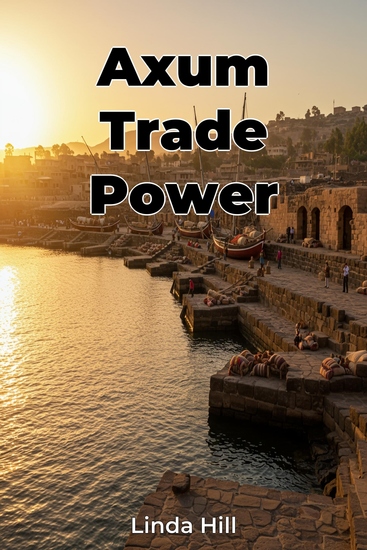
Axum Trade Power - cover

Axum Trade Power

Linda Hill

Translator A AI

Publisher: Publifye

  • 0
  • 0
  • 0

Summary

Axum Trade Power unveils the story of the Axumite Empire, an East African kingdom that became a critical hub in ancient global trade. This book explores how Axum strategically leveraged its geographical location and political acumen to dominate Red Sea commerce, linking empires like Rome, India, and Arabia. Intriguingly, Axum wasn't just a passive intermediary; it actively shaped the economic and cultural landscape of the region. The book systematically examines Axum's ascent, starting with its origins and resource base, including valuable commodities like gold and ivory, that fueled its economy. It then analyzes the intricate trade routes converging in Axum, detailing the goods exchanged and the challenges overcome. The study investigates Axum's maritime capabilities, its relationships with neighboring powers, and the impact of Christianity on its society and trade, before exploring the factors leading to its eventual decline. By presenting a balanced assessment of historical and archaeological evidence, Axum Trade Power highlights Axum's lasting impact on global trade history.
Available since: 05/03/2025.
Print length: 58 pages.
Other books that might interest you

  • Y2K - How the 2000s Became Everything (Essays on the Future That Never Was) - cover

    Y2K - How the 2000s Became...

    Colette Shade

    • 0
    • 0
    • 0
    “Nothing I’ve read has cut to the heart of the ’00s like Y2K.” — Bustle 
    Perfect for fans of Jia Tolentino and Chuck Klosterman, Y2K is a delightfully nostalgic and bitingly told exploration about how the early 2000s forever changed us and the world we live in. 
    THE EARLY 2000s conjures images of inflatable furniture, flip phones, and low-rise jeans. It was a new millennium and the future looked bright, promising prosperity for all. The internet had arrived, and technology was shiny and fun. For many, it felt like the end of history: no more wars, racism, or sexism. But then history kept happening. Twenty-five years after the ball dropped on December 31st, 1999, we are still living in the shadows of the Y2K Era. 
    In Y2K, one of our most brilliant young critics Colette Shade offers a darkly funny meditation on everything from the pop culture to the political economy of the period. By close reading Y2K artifacts like the Hummer H2, Smash Mouth’s “All Star,” body glitter, AOL chatrooms, Total Request Live, and early internet porn, Shade produces an affectionate yet searing critique of a decade that started with a boom and ended with a crash. 
    In one essay Colette unpacks how hearing Ludacris’s hit song “What’s Your Fantasy” shaped a generation’s sexual awakening; in another she interrogates how her eating disorder developed as rail-thin models from the collapsed USSR flooded the pages of Vogue; in another she reveals how the McMansion became an ominous symbol of the housing collapse. 
    Perfect for fans of Jia Tolentino and Chuck Klosterman, Y2K is the first book to fully reckon with the mixed legacy of the Y2K Era—a perfectly timed collection that holds a startling mirror to our past, present, and future.
    Show book
  • Small Medium Large - How Government Made the US into a Manufacturing Powerhouse - cover

    Small Medium Large - How...

    Colleen A. Dunlavy

    • 0
    • 0
    • 0
    We live in a world of seemingly limitless consumer choice. Yet, as every shopper knows without thinking about it, many everyday goods—from beds to batteries to printer paper—are available in a finite number of "standard sizes." What makes these sizes "standard" is an agreement among competing firms to make or sell products with the same limited dimensions. But how did firms—often hotly competing firms—reach such collective agreements? 


    In exploring this question, Colleen Dunlavy puts the history of mass production and distribution in an entirely new light. She reveals that, despite the widely publicized model offered by Henry Ford, mass production techniques did not naturally diffuse throughout the US economy. On the contrary, formidable market forces blocked their diffusion. It was only under the cover of collectively agreed-upon, industry-wide standard sizes—orchestrated by the federal government—that competing firms were able to break free of market forces and transition to mass production and distribution. Without government promotion of standard sizes, the twentieth-century American variety of capitalism would have looked markedly less "Fordist." 


    Small, Medium, Large will make all of us think differently about the everyday consumer choices we take for granted.
    Show book
  • The Khmer Empire - History of Cambodia and the Angkorian Empire - cover

    The Khmer Empire - History of...

    Kelly Mass

    • 0
    • 0
    • 0
    Historians describe Cambodia as the Khmer State or the Angkorian Empire (Khmer:) from the 9th century to the 15th century, when it was a Hindu/Buddhist empire in Southeast Asia. The empire, which developed from the old societies of Funan and Chenla, governed and/or "vassalized" the majority of mainland Southeast Asia and parts of Southern China, covering from the suggestion of the Indochinese Peninsula northward to modern-day Yunnan province in China, and from Vietnam westward to Myanmar. The Khmer Empire was greater at its peak than the Byzantine Empire (Eastern Roman Empire) that existed at the exact same period. 
    The site of Angkor, in modern-day Cambodia, which worked as the Khmer capital throughout the empire's prime time, is maybe its most long-lasting tradition. The stunning Angkor structures, like Angkor Wat and Bayon, attest to the Khmer Empire's incredible strength and wealth, remarkable art and culture, architectural strategy, visual accomplishments, and the series of belief systems that it bought from in time. Angkor was the world's biggest pre-industrial cosmopolitan center between the 11th and 13th centuries, according to satellite photography. 
    Let’s learn more about what we know about the happenings in this vast empire from so long ago.
    Show book
  • Alter Your Life - cover

    Alter Your Life

    Dr. Emmet Fox

    • 0
    • 0
    • 0
    “Alter Your Life” by Emmet Fox is a collection of sermons and writings that delve into practical spiritual teachings for everyday life. The book explores how to apply the principles of metaphysical Christianity to overcome personal challenges, improve mental and spiritual health, and achieve inner peace. Fox discusses topics such as the importance of controlling thoughts, effective prayer, and the healing power of forgiveness. He uses biblical examples to illustrate how readers can transform their lives by renewing their minds and aligning with divine laws. Each chapter provides clear instructions and practical exercises to implement these ideas in daily life.
    Show book
  • Gorgias - Plato - cover

    Gorgias - Plato

    Plato

    • 0
    • 0
    • 0
    Gorgias is a philosophical dialogue written by Plato, set in Athens in the early 5th century BC. The dialogue is named after the renowned Greek sophist Gorgias of Leontini, who is the main interlocutor in the conversation. 
    The dialogue begins with a discussion about the nature of rhetoric and its relationship to truth. Socrates, the main protagonist of the dialogue, argues that rhetoric is merely a skill of persuasion, and that its practitioners do not necessarily possess knowledge of the subject matter they are discussing. Gorgias and his student Polus disagree, and argue that rhetoric can be used to achieve both knowledge and persuasion. 
    The discussion then turns to the question of whether or not it is better to suffer injustice or to commit injustice. Socrates argues that it is better to suffer injustice than to commit it, and that it is always better to do what is right rather than what is expedient. Gorgias and Polus, however, disagree and argue that it is better to be the one who is in power and able to do as they please. 
    The dialogue concludes with a discussion about the nature of happiness and whether or not it can be achieved through the pursuit of power and wealth. Socrates argues that true happiness comes from living a life of virtue and wisdom, rather than from external circumstances such as wealth and power. 
    Overall, Gorgias is a profound exploration of some of the most fundamental questions of philosophy, including the nature of truth, justice, and happiness. It remains one of Plato's most famous and influential works, and is essential reading for anyone interested in the history of philosophy.
    Show book
  • John Adams - The American Statesman Diplomat Writer and Founding Father - cover

    John Adams - The American...

    Kelly Mass

    • 0
    • 0
    • 0
    John Adams was the 2nd president of the United States, serving from 1797 to 1801. He was an American leader, lawyer, diplomat, author, and Founding Father. He was the first vice president of the U.S.A. and a leader of the American Revolution, which caused the nation's independence from Great Britain. Adams kept a journal and communicated with certain crucial individuals in early American history, including his marriage partner and consultant Abigail Adams and Thomas Jefferson. 
    Prior to the revolution, Adams was an attorney and political activist who had faith in the right to counsel and the assumption of innocence. He withstood anti-British belief by effectively protecting British warriors implicated of murder in the Boston Massacre. 
    Adams was an agent from Massachusetts to the Continental Congress who rose to end up being an advanced leader. In the year 1776, he helped make up the Declaration. As a diplomat in Europe, he contributed to negotiating a peace handle the UK and protecting vital federal government loans. Adams was the primary writer of the Massachusetts Constitution, which affected the USA Constitution, as did his post Thoughts on Federal government, which was released in the year 1780. 
    Let’s learn more about this prominent historical figure.
    Show book