Join us on a literary world trip!
Add this book to bookshelf
Grey
Write a new comment Default profile 50px
Grey
Subscribe to read the full book or read the first pages for free!
All characters reduced
Decision Making Science - cover

Decision Making Science

Lila Santoro

Translator A AI

Publisher: Publifye

  • 0
  • 0
  • 0

Summary

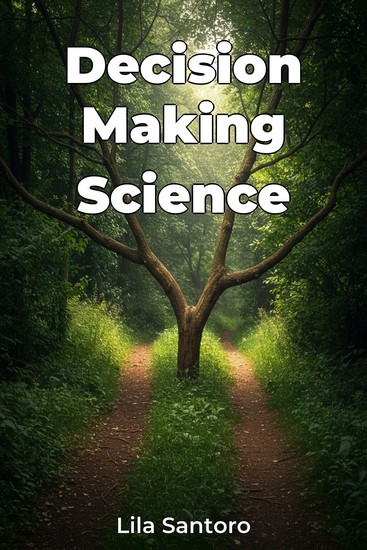
"Decision Making Science" explores the fascinating science behind our everyday choices, delving into the psychological factors and cognitive biases that subtly influence our judgments. This self-help psychology book helps readers understand the neuroscience of decision making and provides techniques to enhance decision-making skills for improved outcomes. For example, the book reveals how our brains are wired to make quick decisions, often relying on mental shortcuts that can lead to predictable errors.

 
The book uniquely combines rigorous scientific research from behavioral economics with practical, actionable advice, moving beyond anecdotal self-help to ground its recommendations in solid empirical evidence. It progresses systematically, starting with fundamental concepts of decision theory and neural pathways, then moves into cognitive biases like confirmation bias and loss aversion, and culminates in effective decision-making frameworks such as decision trees.

 
By understanding these principles, readers can strategically mitigate psychological factors and make better choices in personal finance, strategic business planning, and beyond.
Available since: 03/15/2025.
Print length: 95 pages.
Other books that might interest you

  • History of England from the Accession of James II - (Volume 1 Chapter 05) - cover

    History of England from the...

    Thomas Babington Macaulay

    • 0
    • 0
    • 0
    This chapter of Macaulay’s, History of England is concerned, for a large part, with insurrection against James II and his manoeuverings to suppress these. Argyle has been sheltering in Holland and returns to raise an army against James. Although brave and quick witted, he was no leader of men and the army became a confused rabble and were dispersed. Argyle was captured and died bravely. Monmouth had also been sheltering in Holland and he landed at Lyme and declared himself king on 20th June 1685. He was defeated at the battle of Sedgemoor and eventually caught and executed. Monmouth is a fine romantic and of course ultimately tragic figure. The chapter comes to an end with the Bloody Assizes and the very bloody Judge Jeffries. 
    Summary by Jim Mowatt
    Show book
  • History of the World - cover

    History of the World

    Introbooks Team

    • 0
    • 0
    • 0
    The world history defines the history of mankind as decided by the study of archaeological and inscribed archives. The recorded ancient history starts when writing was invented. Prehistory is marked by the Early Stone Age or the Palaeolithic Era which was followed by New Stone Age or Neolithic Era. The Agricultural Revolution was from 8000 and 5000 BCE; it was during this time that the humans progressed and started farming and animal husbandry and settled down to form villages and then civilizations. Expansion of these villages required one to travel and travelling from one place to the other lead to development of transport. 
    Developments of farming also lead to divisions in labours and also bought lead to division of society in upper class, middle class and lower class. More and more civilizations came up and the population grew fast spreading all over the world. 
    The history of the old world is specially the Mediterranean and Europe is divided in Antiquity or ancient history till the 476 CE, the Middle Ages or Postclassical Ages till 15 century this age also included the Islamic Golden Age and Renaissance Period, the Early Modern Period which lasted from 15th century till the 18th century and also comprised of Age of Enlightenment and Late Modern Period and finally from the Industrial Revolution till present day also counting Contemporary history. 
    Many important inventions like printing bought an end to the Middle Ages and heralded the Scientific Revolution in the middle of the century and growing knowledge and technology quickly bought about the Industrial Revolution by the 18th century. After the 18th century the world has seen quick changes like increase in population, wars, weapons, commerce, trade, technology, environmental degradation, pollution etc. All this has augmented in generating opportunities and jeopardies which now antagonise the planet's mortal communities.
    Show book
  • James Joyce in Context Vol 1: Telemachus - cover

    James Joyce in Context Vol 1:...

    Various

    • 0
    • 0
    • 0
    This is a project invented and created by LibriVox volunteers.  It collects various works which James Joyce quotes and refers to in his epic novel Ulysses, and provides them in audio form.  Perfect for Joyce scholars, fans, and aficionados!  (Summary by Kirsten Ferreri) 
     
    Collection concludes with Joyce's Ulysses chapter 1: Telemachus. 
     
    Coodinated by Kirsten Ferreri, Mary Anderson, and Leni.
    Show book
  • My Blue Book of Grammar for Class 1 - cover

    My Blue Book of Grammar for Class 1

    Meigha Rawat

    • 0
    • 0
    • 0
    A Grammar Series That Uses the Functional Approach
    
    KEY FEATURES 
    - Functional approach to grammar teaching, using exemplars to illustrate the usage before defining the structure and rules
    - Vocabulary taught through language-in-use to build the learners’ vocabulary through use rather than memorisation of rules
    - Contemporary topics to inculcate 21-century skills amongst learners
    - Use of literature to help learners understand how grammar is used in text
    - A comprehension section comprising texts from different genres so that learners may relate grammar to different types of works produced in English
    - Phonics in Grades 1 and 2 to teach the very basis of language
    - Uniquely stylised illustrations
    - Activities such as puzzles, crosswords, word grids and games to aid the facilitator in using the concept of ‘flipped classroom’
    - Periodic tests to help the learners self-assess the acquisition of concepts
    - Digital component to cater to a technology-driven classroom
    
    DESCRIPTION: 
    My Blue Book of Grammar is a course that has been conceptualized and designed keeping in mind the increasingly dynamic role of the English language in today’s world. Especially in our country, where English serves as the lingua franca, a grammar course has to offer not only an exposition of the pedagogy but also the exhibition of the utility of that pedagogy. The aim of a grammar series should be to encourage the development of competency amongst learners, even though their proficiency levels may vary. While the level of exposure to English of all learners may be different, a grammar series should aid in the development of a certain level of confidence amongst the learners, with the end result being that they are able to converse without hesitation in English. 
    
    WHAT WILL YOU LEARN
    - Understand grammar concepts
    - Learn how to use different vocabulary concepts taught through language-in-use 
    - Learn 21-century skills 
    - Develop deeper understanding of and appreciation for literature
    - Have clearer pronunciation through a better understanding of phonics
    
    WHO THIS BOOK IS FOR: 
    School students of Grades 1
    
    TABLE OF CONTENTS
    GRAMMAR
    1. Nouns
    2. Singular and Plural 
    3. Pronouns 
    4. Full Stop and Capitals 
    5. Verbs 
    6. Is and Are 
    7. Conjunction – and 
    8. Conjunction – but 
    9. Prepositions 
    10. Adjectives 
    VOCABULARY
    11. Three Magic Words 
    12. Compound Words 
    13. Missing Letters 
    14. Naming the Place 
    15. Opposites 
    16. Naming the Colours 
    Test Paper 1
    WRITING
    17. My Favourite Animal
    18. All About Me 
    19. My Favourite Toy 
    20. My Favourite Thing 
    21. My Grandparents 
    22. Joining Sentences 
    23. Making Sentences Using Prepositions 
    24. My School Building 
    PHONICS
    25. Consonants C and K 
    26. Plurals 
    27. fr Sound 
    28. S Blends – sk, sl and sn 
    29. S Blends – st, sw and sp 
    30. ph Words 
    31. th Sound 
    32. oo sound 
    33. tr sound 
    34. Digraphs – ch, sh and wh 
    35. Long and short a and e 
    36. Long and short i, o and u 
    Test Paper 2 
    Orange Global Olympiad – English Sample Paper
    Show book
  • Dark Psychology - Powerful Mind Control and Persuasion Techniques - cover

    Dark Psychology - Powerful Mind...

    Amanda Grapes

    • 0
    • 0
    • 0
    Men and women are not the same. We all know that they think differently. But how do they use those thinking patterns to get what they want? How do they persuade the other gender to give them what they desire? This is where some human psychology will be helpful. The differences will be addressed in the first chapter of this book. 
    Moving on, some false concepts about mind control will be discussed, as well as persuasion techniques that you may have never heard about. The reasons why people choose to buy or do something, is something that will be a determining factor to understanding the psychology of persuasion. This is what you will learn.
    Show book
  • Fairy Tales for Adults - cover

    Fairy Tales for Adults

    Mary Benson

    • 0
    • 0
    • 0
    Do you want something that helps you sleep at night?Do you want to recreate your childhood bedtime story time?Do you wish to have something light to read before going to sleep?Then keep reading!Bedtime tales are an excellent and well-proven method of relaxing and practicing mindfulness. These tales aren't only for kids; they can help you conquer insomnia, get better sleep, and wake up feeling refreshed and reenergized.Doctors suggest that if stories help keep the brains of children busy without making them anxious, they can do the same thing for adults. For adults, the tales may work as a respite for our busy minds and redirect our focus to something tranquil; for children, on the other hand, the stories can be a source of joy and wonder. Considering it from a more pragmatic standpoint, when you lie down, all of the things you have neglected to take care of over the last ten years suddenly come back to you all at once? It's possible that telling ourselves tales before bed will prevent our thoughts from going in that direction. Bedtime tales may help break that specific cycle of negative thinking by diverting our attention away from our worries and onto whatever endearing narrative - or lack thereof - we happen to be enjoying.So what are you waiting for? Click on the purchase button to grab this copy and redirect your focus at night and sleep better!
    Show book