Join us on a literary world trip!
Add this book to bookshelf
Grey
Write a new comment Default profile 50px
Grey
Subscribe to read the full book or read the first pages for free!
All characters reduced
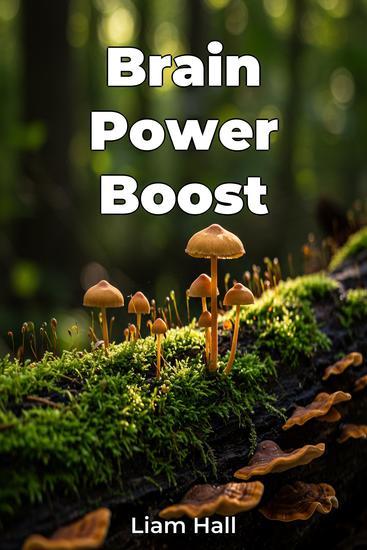
Brain Power Boost - cover

Brain Power Boost

Liam Hall

Translator A AI

Publisher: Publifye

  • 0
  • 0
  • 0

Summary

"Brain Power Boost" offers a comprehensive guide to enhancing cognitive function and safeguarding brain health through nutrition, exercise, and mental stimulation. It emphasizes that improved brain power, memory enhancement, and cognitive resilience are achievable goals with the right strategies. The book delves into the science behind how specific nutrients impact cognitive function and how physical activity promotes neurogenesis and brain plasticity, highlighting actionable methods to combat cognitive decline. Mental stimulation, such as learning new skills, is presented as a crucial factor in maintaining robust neural networks.

 
The book uniquely integrates these three core pillars, each explored in detail across individual sections. It begins with foundational knowledge of brain anatomy and neurotransmitters before progressing to nutrition, exercise, and mental stimulation strategies. It shows how combining these elements yields the most significant and enduring results for brain health.

 
Did you know that exercise can lead to the creation of new neurons in the brain, a process called neurogenesis? Or that specific nutrients have a direct impact on cognitive functions like memory and focus?

 
Adopting a conversational yet authoritative tone, "Brain Power Boost" translates complex scientific concepts into clear, actionable advice, making it accessible to a broad audience interested in optimizing their cognitive abilities. The book culminates with a practical guide to integrating these strategies into daily life, offering personalized plans to improve focus and overall brain health.
Available since: 03/17/2025.
Print length: 112 pages.
Other books that might interest you

  • History of Poland between 966-1919 - The Rise and Fall of the Polish Lithuanian Commonwealth - cover

    History of Poland between...

    HISTORY FOREVER

    • 0
    • 0
    • 0
    ★ Do you want to discover the History of Poland? ★ 
    If your answer is yes, get this book now! 
    ★ BUY THIS BOOK NOW AND DISCOVER MORE ABUOT POLAND  TODAY! ★ 
    In this book you will discover; 
    ·       History of the Polish Kingdom: Lech, Czech, and Rus 
    ·       Vladislav the Short & Kashmir the Great 
    ·       The Grand Duchy of Lithuania – The 15th century 
    ·       Polish History of the 16th and 17th century 
    ·       Polish History of the 18th and 19th century 
    ·       Occupation & Revolution - The French Polish Legion 
    ·       The November Uprising 
    ·       The Galician Province 
    ·       The Polish Lithuanian Commonwealth 
    ·       The Great Northern War 
    ·       Poland after the Partition 
      
    ★ BUY THIS BOOK NOW AND DISCOVER MORE ABUOT POLAND TODAY! ★
    Show book
  • Popular Works Volume 2 - The Characteristics of the Present Age The Doctrine of Religion and Other Works - cover

    Popular Works Volume 2 - The...

    Johann Gottleib Fitche

    • 0
    • 0
    • 0
    Though born to a poor but pious family of ribbon weavers in in Saxony in 1762, Johann Gottlieb’s exceptional intelligence was apparent from an early age. Remarkably, from this humble background, he earned himself a respected place in the pantheon of late 18th and early 19th century German philosophers. That fact that he is placed between Kant and Hegel, yet still retains a significant and individual presence, says much about his work and personality. He became known, especially, for initiating the concept of ‘German idealism’ (linked with Romanticism and the revolutionary politics which emerged after the Enlightenment). In the 20th and 21st century, his importance and contribution to Western philosophy has been increasingly acknowledged.  
     
    There are two substantial lecture series and one essay stemming from his time in Berlin in Popular Works Volume 2: much of Fichte’s important work appeared initially in lectures. 
     
     The Characteristics of the Present Age, (1806) consists of 17 lectures in which Fichte presents his ‘speculative philosophy of history’. The series opens with ‘The Idea of Universal History’ in which he ‘divides earthly life into 5 Principal Epochs.’ Against this overview of history and culture, (including the state, civil and political freedom, science and religion) he develops his thesis with particular reference to his ‘present age’ – the time of Voltaire, Rousseau on the one hand and Lessing, Kant and Goethe on the other.  
     
    In The Way Towards The Blessed Life or The Doctrine Of Religion (1806) (11 lectures) Fichte considers the relationship between established religion and his particular view on ‘transcendental’ philosophy. His opening statement is ‘Life is Love; and hence Life and Blessedness are in themselves one and the same.’  He continues by examine metaphysics, ontology, mysticism, actual and apparent life, Christianity, and his Doctrine of Being.  
     
    The final work in this anthology is Outlines of the Doctrine of Knowledge (1810). It is a concise exposition of Fichte’s Wissenschaftslehre’ but in its strictly scientific form. It had an unusual provenance in that it was printed by Fichte at the conclusion of lectures as a form of a memorandum with 14 short sections. It opens with the question: ‘How this Knowledge can come into being, and what it is in its inward and essential Nature?’
    Show book
  • The Fourth History of Man - cover

    The Fourth History of Man

    MD John Bershof

    • 0
    • 0
    • 0
    In the spirit of medieval writer Chaucer, all human activity lies within the artist’s scope, the History of Man Series uses medicine as a jumping off point to explore precisely that, all history, all science, all human activity since the beginning of time. The jumping off style of writing takes the reader, the listener into worlds unknown, always returning to base, only to jump off again. History of Man are stories and tales of nearly everything. 
    The Fourth History of Man continues with virus infections where The Third History of Man left off hashing-out those specks of genetic schmutz, covering the R-naught of those naughty infectious scoundrels. Some big hitters will be considered, from polio and the famous celebrities that had it, through fifty shades of hepatitis, rabies and the hair of the dog, and the monkey business of HIV and AIDS. Leaving viruses, we’ll delve into a study of parasites, including the parasite of all parasites, Sigourney Weaver’s alien. Opening up a can-of-worms we’ll launch a nerd rumble: who would win between Weaver’s Alien and Schwarzenegger’s Predator. Other topics include the sociology of a social death preceding the actual death, the sociology of sexual cannibalism, and the sociology of colors, not just of yellow fever, but of other emotions under the rainbow, hopefully not making you feel positively blue. On the science side we’ll flip the script on the infamous Krebs cycle fleeced of the boring jargon that usually flows from the lecture hall and our road will scrutinize nuclear bombs, nuclear footballs and weapons of mass destruction, the secret of Ondine’s curse, and lessons in global warming.
    Show book
  • Public Choice Theory - cover

    Public Choice Theory

    Introbooks Team

    • 0
    • 0
    • 0
    Elections are the primary mechanism through which governments are decided. It is indeed, also one of the oldest practices of universal consent and what might be called as ‘multiple voices, one government’. Elections decide the destiny of a country, the government that the people choose; it is in its very essence, a characteristic activity that defines an identity of a nation. That can be thought of as quite obvious since the governments that people choose portray the type of society they live in and define further their dreams and aspirations. Elections in theory, is an activity that can be thought of as whirlwind of several mathematical and theoretical concepts. Several political scientists, mathematicians and philosophers have spoken too rightly about it and some have even gone steps further to devise equations and theorems that define what elections are comprised of. 
    Considering that point, elections are one of the main attraction points when it comes to economic theories and what people aspire in socio-political terms. Although elections have so far been a subject of political thought, recently since the last four decades, several economists have been able to successfully combine methods of game theory, probability and predictive techniques with conceptscoming from economics and political science, to come up with what is widely known as the public choice theory, a concept that tries to delve deep into the ‘mind’ of the voter and decode what really happens during the time of elections, how opinions are formed and how these very same opinions can either become a majority or a minority among the voter population. It also tries to, and has been successful at that, in proving the notion that instead of a ‘collective’ environment, elections are governed more by individual choices and preferences, which when aggregated among the electorate, transforms into a majority or a minority, a concept different from the common understanding that political parties are won primarily by collective choices instead of them being individual. This book tries to explain the concept in detail and bridge the gap for thosewanting to understand the deep mechanics governing elections and how voters, through a continuous set of mathematical and economic concepts, decide on the suitability of the desired candidates. 
    This book will offer a brief understanding of the concept and try to shape the understanding about elections for most people. An introductory chapter on what is public choice is followed by the theory’s historical development starting from late 1700s till modern day, what concepts from several disciplines shape up our understanding about public choice with explanations for each of these concepts for the reader to have more clarity for public choice is a fine relationship between several seemingly unrelated matters. Finally, conclusion remarks on how the theory applies on the general electorate followed by its implications and further evolution have also ben discussed.
    Show book
  • Willpower: Rediscovering the Greatest Human Strength - Group discussion - cover

    Willpower: Rediscovering the...

    Vines Graener

    • 0
    • 0
    • 0
    What if the key to unlocking your potential and achieving your most ambitious goals lies in mastering one single skill? That skill is willpower—a resource that drives discipline, focus, and the ability to resist distractions. 
    What Is Willpower? 
    Willpower is like a muscle—it gets tired when overused, but it can also be trained and strengthened over time. It’s the driving force behind saying “no” to temptations, “yes” to healthy choices, and staying on track even when the path gets tough. The problem? It’s a finite resource. Every decision you make chips away at your willpower reserves, making it essential to learn how to protect and replenish this vital strength. 
    Why Does It Matter? 
    From overcoming procrastination to managing finances, willpower is at the heart of many challenges we face daily. Lack of self-control can lead to missed opportunities, unhealthy habits, and unfulfilled potential. But here’s the good news: research shows that willpower isn’t fixed. It can be nurtured, expanded, and wielded more effectively through simple, actionable strategies.
    Show book
  • How to Be a Dictator - An Irreverent Guide - cover

    How to Be a Dictator - An...

    Mikal Hem

    • 0
    • 0
    • 0
    A tongue-in-cheek guide to becoming a dictator, based on the outrageous, scandalous, and excessive behavior of dictators past and present 
    Who hasn’t dreamed of one day ruling your own country? Along with great power comes unlimited influence, control, admiration, and often wealth. How to Be a Dictator will teach you the tricks of the trade—how to rise to the top and stay in power, and how to enjoy the fruits of your excellence. 
    Featuring examples from the most successful leaders and regimes in the business, including Kim Jong Il, Robert Mugabe, Muammar Gaddafi, Nicolae Ceauşescu, François “Papa Doc” Duvalier, and many others, this handy guide offers ten easy lessons on becoming and acting like a dictator: from how to rig an election and create your own personality cult to the dos and don’ts of dictator fashion and palace architecture; how to become wealthy and spend your fortune the right way; expressing your literary genius; and how to avoid being toppled, exiled, and/or meeting any other dismal end. 
    Combining black humor with political insights, How to Be a Dictator is peppered with horrifying and hilarious stories from some of the most eccentric modern world leaders.
    Show book