Join us on a literary world trip!
Add this book to bookshelf
Grey
Write a new comment Default profile 50px
Grey
Subscribe to read the full book or read the first pages for free!
All characters reduced
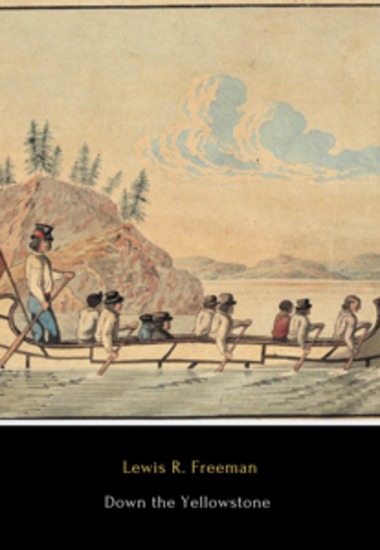
Down the Yellowstone - cover

Down the Yellowstone

Lewis R. Freeman

Publisher: The Old Pioneer Press

  • 0
  • 0
  • 0

Summary

Lewis Ransome Freeman was an American explorer, journalist, and war correspondent who wrote over twenty books chronicling his many travels, as well as numerous articles. Down the Yellowstone chronicles the author's experiences on the Yellowstone River during various seasons. On his journeys, Freeman meets a panoply of fascinating early West characters, including the famous Calamity Jane, to whom he devotes a whole chapter. Down the Yellowstone is a delightful and entertaining story about floating down the Yellowstone, Missouri, and Mississippi rivers from Yellowstone National Park to New Orleans, Louisiana.
Available since: 05/28/2025.

Other books that might interest you

  • LSAT Success Secrets: Engage and Excel with Proven Strategies - "Supercharge your LSAT preparation! Explore interactive audio lessons crafted to enhance performance and boost your success!" - cover

    LSAT Success Secrets: Engage and...

    Orson Blackridge

    • 0
    • 0
    • 0
    Audiobook Title: Unlock Your Potential: Achieve Excellence with Proven Techniques 
    Are you striving to advance your career and enhance your knowledge by successfully conquering the LSAT? 
    In search of a thorough guide that encompasses everything needed to excel in the LSAT? 
    Your quest ends here! 
    This comprehensive guide is your ultimate resource for deepening your understanding, honing your skills, and engaging in practical exercises. With this audiobook, you'll be on the path to success. 
    Updated for the 2024-2025 LSAT Structure. 
    Key features of this enriched guide include: 
    - In-depth insights into the LSAT Certification 
    - Detailed explanations of essential LSAT concepts  
    - Effective strategies for exam preparation and tackling difficult questions  
    Our guide stands out due to its extensive coverage, which is critical for your exam success. Concepts are not merely brushed over; they are explored with accuracy and clarity. 
    Please note that this guide is independent and not affiliated with any official LSAT organization; it is designed to benefit you directly. 
    With a well-organized structure and straightforward language, our LSAT Guide ensures smooth transitions between topics. Say goodbye to confusing jargon and welcome clear, concise, and technically accurate content. 
    So, why wait? Click the BUY NOW button, secure your guide, and embark on your journey toward LSAT success! 
    Unleash your full potential and achieve greatness with proven techniques!
    Show book
  • Empire of Ife - The Cradle of Yoruba Culture and the Kingdom of Sculptors - cover

    Empire of Ife - The Cradle of...

    Rolf Hedger

    • 0
    • 0
    • 0
    The origins of Ife are deeply rooted in mythology, oral traditions, and historical accounts, making it one of the most revered ancient cities in West Africa. Ife is often referred to as the cradle of the Yoruba civilization, a place where culture, religion, and governance took form. The story of its beginning is intertwined with Yoruba cosmology, particularly the legend of Oduduwa, who is considered the progenitor of the Yoruba people. 
    According to Yoruba mythology, Olodumare, the Supreme Being, entrusted Oduduwa with the sacred task of creating the earth. He descended from the heavens with a chain, a handful of earth, and a rooster. Upon reaching the watery expanse that covered the world, he spread the earth on the surface, and the rooster scattered it, forming the first landmass. This sacred land became known as Ile-Ife, meaning “The Land of Expansion.” Over time, Oduduwa and his followers established a kingdom that became the center of Yoruba civilization, laying the foundation for its political, spiritual, and artistic traditions. 
    Beyond mythology, historical and archaeological evidence suggests that Ife was already a flourishing city-state by the 9th century, possibly earlier. It grew as a hub of trade, attracting merchants and artisans from different parts of West Africa. Its strategic location allowed for the exchange of goods, ideas, and cultural practices, contributing to the city’s rapid development. The city’s early rulers, often referred to as the Oonis, played a crucial role in consolidating power and maintaining the harmony between religious and political institutions. The Ooni of Ife, regarded as both a king and a divine figure, acted as the intermediary between the people and the gods, reinforcing Ife’s status as a sacred city.
    Show book
  • Impactful Decisions Today for a Brighter Tomorrow - "Elevate your decision-making skills! Dive into transformative audio lessons for a brighter future today!" - cover

    Impactful Decisions Today for a...

    Jasper Falloway

    • 0
    • 0
    • 0
    Impactful Decisions Today for a Brighter Tomorrow 
    ⭐⭐ A Simplified Guide & Explanations Included ⭐⭐  
    Are you eager to advance in your career and enhance your knowledge to pave the way for a successful future?   
    Looking for a comprehensive resource that offers everything you need to make informed decisions today for a brighter tomorrow?   
    Your search ends here!   
    This guide acts as your ultimate companion for deepening your understanding, applying your skills, and engaging in practical exercises—setting you up for success.   
    Updated for the 2025 landscape of decision-making.   
    Key features of this insightful guide include: 
    - In-depth insights into the principles of intentional decision-making   
    - Detailed explanations of how today’s decisions shape your future   
    - Proven strategies for preparing effectively and tackling challenges   
    Our guide stands out with its thorough coverage, which is vital for your success. Concepts are explored in detail, ensuring a deeper grasp of the material.   
    Please note that this guide operates independently and is not affiliated with any official entity, focusing solely on offering you valuable insights.   
    With a clear structure and straightforward language, our guide ensures seamless transitions between topics. Say goodbye to complex jargon and welcome clear, accurate, and user-friendly content.   
    So, why delay? Click the BUY NOW button, secure your guide, and embark on your journey toward success through intentional decision-making!
    Show book
  • Royal Navy Versus the Slave Traders - Enforcing Abolition at Sea 1808–1898 - cover

    Royal Navy Versus the Slave...

    Bernard Edwards

    • 0
    • 0
    • 0
    On 16 March 1807, the British Parliament passed The Abolition of the Slave Trade Act. In the following year the Royal Navy's African Squadron was formed, its mission to stop and search ships at sea suspected of carrying slaves from Africa to the Americas and the Middle East. With typical thoroughness, the Royal Navy went further, and took the fight to the enemy, sailing boldly up uncharted rivers and creeks to attack the barracoons where the slaves were assembled ready for shipment. 


    For much of its long campaign against the evil of slavery, Britain's Navy fought alone and unrecognized. Its enemies were many and formidable. Ranged against it were the African chiefs, who sold their own people into slavery, the Arabs, who rode shotgun on the slave caravans to the coast, and the slave ships of the rest of the world, heavily armed, and prepared to do battle to protect their right to traffic in the forbidden so-called "black ivory." 


    The war was long and bitter and the cost to the Royal Navy in ships and men heavy, but the result was worthy of the sacrifices made. The abolition of the slave trade led to a scramble for empires and, in place of slaves, Africa began to export cocoa, coffee, timber, palm oil, cotton and ores, all very much in demand in the West.
    Show book
  • From Plato to Christ - How Platonic Thought Shaped the Christian Faith - cover

    From Plato to Christ - How...

    Louis Markos

    • 0
    • 0
    • 0
    What does Plato have to do with the Christian faith? 


    Quite a bit, it turns out. In ways that might surprise us, Christians throughout the history of the church and even today have inherited aspects of the ancient Greek philosophy of Plato, who was both Socrates's student and Aristotle's teacher. 


    To help us understand the influence of Platonic thought on the Christian faith, Louis Markos offers careful readings of some of Plato's best-known texts and then traces the ways that his work shaped the faith of some of Christianity's most beloved theologians, including Gregory of Nyssa, Augustine, Dante, and C. S. Lewis. 


    With Markos's guidance, listeners can ascend to a true understanding of Plato's influence on the faith.
    Show book
  • Unsettling Choice - Race Rights and the Partitioning of Public Education - cover

    Unsettling Choice - Race Rights...

    Ujju Aggarwal

    • 0
    • 0
    • 0
    What do universal rights to public goods like education mean when codified as individual, private choices? Is the "problem" of school choice actually not about better choices for all but about the competition and exclusion that choice engenders? Unsettling Choice addresses such questions through a compelling ethnography that illuminates how one path of neoliberal restructuring in the United States emerged in tandem with, and in response to, the Civil Rights movement. 


    Unsettling Choice traces the contestations that surfaced when, in the wake of the 2007–2009 Great Recession, public schools navigated austerity by expanding choice-based programs. Ujju Aggarwal argues that this strategy mobilized mechanisms rooted in market logics to recruit families with economic capital on their side, solidifying a public sphere that increasingly resembled the private. 


    As Unsettling Choice shows, these struggles over public schools were entrapped within neoliberal regimes that exceeded privatization and ensured exclusion even as they were couched in language of equity, diversity, care, and rights. This book tracks an architecture of expansive rights, care, and belonging built among poor and working-class parents at a Head Start center, whose critique of choice helps us understand how we might struggle for justice, and a public that remains to be won.
    Show book