Join us on a literary world trip!
Add this book to bookshelf
Grey
Write a new comment Default profile 50px
Grey
Subscribe to read the full book or read the first pages for free!
All characters reduced
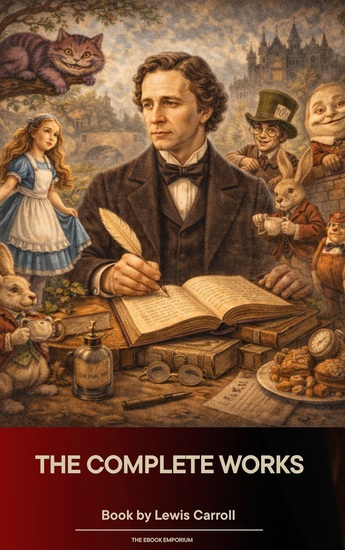
The complete works of Lewis Carroll - cover

The complete works of Lewis Carroll

Lewis Carroll

Publisher: The Ebook Emporium

  • 0
  • 0
  • 0

Summary

What if imagination had no rules—and logic learned how to play?

The Complete Works of Lewis Carroll brings together the full literary legacy of one of the most imaginative writers in world literature. Best known for Alice's Adventures in Wonderland and Through the Looking-Glass, Lewis Carroll created worlds where nonsense reveals truth, language bends reality, and curiosity leads to wonder.

This comprehensive collection includes Carroll's beloved fantasy novels, whimsical poetry, and inventive short works—blending wordplay, satire, mathematics, and childlike imagination into stories that delight readers of all ages.

Beneath the playful surface lies sharp wit and intellectual depth, making Carroll's writing as fascinating to adults as it is enchanting to children. His works continue to influence fantasy, children's literature, and modern storytelling.

Inside this eBook, you'll explore:

The complete Alice books and related writings

Whimsical poems such as "Jabberwocky" and "The Hunting of the Snark"

Inventive short fiction and playful essays

A cornerstone collection of fantasy and nonsense literature

Read aloud in families, studied in classrooms, and cherished worldwide, Lewis Carroll's works remain timeless celebrations of imagination and creativity.

Step into worlds where logic dances and dreams speak. Buy now and experience the complete works of Lewis Carroll.
Available since: 01/26/2026.
Print length: 1396 pages.

Other books that might interest you

  • Street The (Unabridged) - cover

    Street The (Unabridged)

    H. P. Lovecraft

    • 0
    • 0
    • 0
    The story traces the history of the titular street in a New England city, presumably Boston, from its first beginnings as "but a path" in colonial times to a quasi-supernatural occurrence in the years immediately following World War I. As the city grows up around the street, it is planted with many trees and built along with "simple, beautiful houses of brick and wood", each with a rose garden. As the Industrial Revolution runs its course, the area degenerates into a run-down and polluted slum, with all of the street's old houses falling into disrepair.
    After World War I and the October Revolution, the area becomes home to a community of Russian immigrants. Among the new residents is the leadership of a "vast band of terrorists," who are plotting the destruction of the United States on Independence Day. When the day arrives, the terrorists gather to do the deed, but before they can get started, all the houses in the street collapse concurrently on top of each other, killing them all. Observers at the scene testify that immediately after the collapse, they experienced visions of the trees and rose gardens that had once been in the street.
    Show book
  • Sailors' Yarns (Unabridged) - cover

    Sailors' Yarns (Unabridged)

    Pierre Loti

    • 0
    • 0
    • 0
    Pierre Loti born to a Protestant family, Loti's education began in his birthplace, Rochefort, Charente-Maritime. At age 17 he entered the naval school in Brest and studied at Le Borda. He gradually rose in his profession, attaining the rank of captain in 1906. In January 1910 he went on the reserve list. He was in the habit of claiming that he never read books, saying to the Académie française on the day of his introduction (7 April 1892), "Loti ne sait pas lire" ("Loti doesn't know how to read"), but testimony from friends proves otherwise, as does his library, much of which is preserved in his house in Rochefort. In 1876 fellow naval officers persuaded him to turn into a novel passages in his diary dealing with some curious experiences in Istanbul. The result was the anonymously published Aziyadé (1879), part romance, part autobiography, like the work of his admirer, Marcel Proust, after him.
    SAILORS' YARNS: Within the tropics, on a wondrous evening when the Southern trades were blowing with their balmiest softness, the corporeal portion of his being tired with a healthy muscular fatigue, gently lulled by the slumberous rhythmic motion of the ship.
    Show book
  • The Sun Also Rises - cover

    The Sun Also Rises

    Ernest Hemingway

    • 0
    • 0
    • 0
    Immerse yourself in the world of post-war disillusionment with "The Sun Also Rises" by Ernest Hemingway, a classic audiobook that captures the essence of the Lost Generation. Follow the journey of Jake Barnes and his circle of expatriate friends as they navigate love, loss, and the search for meaning in the vibrant cities of Paris and Pamplona. 
    Set against the backdrop of the Roaring Twenties, Hemingway’s debut novel delves into the lives of disenchanted individuals seeking solace in a world forever changed by war. Through sharp dialogue and evocative descriptions, "The Sun Also Rises" paints a vivid picture of a generation struggling to find purpose and identity. 
    Narrated with clarity and depth, this audiobook brings Hemingway’s concise prose and rich characterization to life, making it an engaging experience for both new listeners and longtime fans of the author. Whether you're drawn to the exploration of human emotions or the historical context of the 1920s, this timeless classic offers a compelling listen. 
    Perfect for road trips, quiet afternoons, or any moment when you seek a thought-provoking and immersive story, "The Sun Also Rises" remains a profound exploration of the human condition. 
    Start Listening to "The Sun Also Rises" today and experience Hemingway’s unforgettable tale of love and loss.
    Show book
  • The Pit and The Pendulum - cover

    The Pit and The Pendulum

    Sampi Books, Edgar Allan Poe

    • 0
    • 0
    • 0
    In Edgar Allan Poe's "The Pit and the Pendulum", a prisoner of the Spanish Inquisition faces psychological and physical torture in a dark cell. He struggles to survive deadly traps, including a sharp pendulum and a deep well, using his ingenuity to escape.
    Show book
  • Treasure Island The Lost Manuscript - cover

    Treasure Island The Lost Manuscript

    Robert Lewis Stevenson

    • 0
    • 0
    • 0
    Treasure Island is an adventure novel by Scottish author Robert Louis Stevenson, narrating a tale of "buccaneers and buried gold 
     
    Its influence has been popular on its perceptions of pirates, including such elements as treasure maps marked with an "X", schooners, the Black Spot, tropical islands, and one-legged seamen bearing parrots on their shoulders.
    Show book
  • Candide - cover

    Candide

    Voltaire

    • 0
    • 0
    • 0
    Candide, ou l'Optimisme is a French satire first published in 1759 by Voltaire, a philosopher of the Age of Enlightenment. The novella has been widely translated, with English versions titled Candide: or, All for the Best (1759); Candide: or, The Optimist (1762); and Candide: Optimism (1947). It begins with a young man, Candide, who is living a sheltered life in an Edenic paradise and being indoctrinated with Leibnizian optimism by his mentor, Professor Pangloss. The work describes the abrupt cessation of this lifestyle, followed by Candide's slow and painful disillusionment as he witnesses and experiences great hardships in the world. Voltaire concludes Candide with, if not rejecting Leibnizian optimism outright, advocating a deeply practical precept, "we must cultivate our garden", in lieu of the Leibnizian mantra of Pangloss, "all is for the best" in the "best of all possible worlds".
    Candide is characterized by its tone as well as by its erratic, fantastical, and fast-moving plot. A picaresque novel with a story similar to that of a more serious coming-of-age narrative (Bildungsroman), it parodies many adventure and romance clichés, the struggles of which are caricatured in a tone that is bitter and matter-of-fact. Still, the events discussed are often based on historical happenings, such as the Seven Years' War and the 1755 Lisbon earthquake. As philosophers of Voltaire's day contended with the problem of evil, so does Candide in this short theological novel, albeit more directly and humorously. Voltaire ridicules religion, theologians, governments, armies, philosophies, and philosophers. Through Candide, he assaults Leibniz and his optimism.
    Candide has enjoyed both great success and great scandal. Immediately after its secretive publication, the book was widely banned to the public because it contained religious blasphemy, political sedition, and intellectual hostility hidden under a thin veil of naïveté. However, with its sharp wit and insightful portrayal of the human condition, the novel has since inspired many later authors and artists to mimic and adapt it. Today, Candide is considered as Voltaire's magnum opus and is often listed as part of the Western canon. It is among the most frequently taught works of French literature. The British poet and literary critic Martin Seymour-Smith listed Candide as one of the 100 most influential books ever written.
    Show book