Join us on a literary world trip!
Add this book to bookshelf
Grey
Write a new comment Default profile 50px
Grey
Subscribe to read the full book or read the first pages for free!
All characters reduced
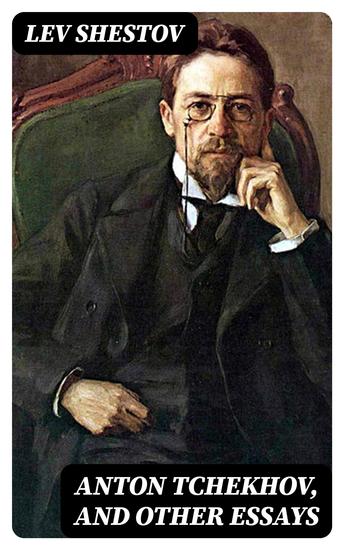
Anton Tchekhov and Other Essays - cover

Anton Tchekhov and Other Essays

Lev Shestov

Translator John Middleton Murry, S.S. Koteliansky

Publisher: DigiCat

  • 0
  • 0
  • 0

Summary

In "Anton Tchekhov, and Other Essays," Lev Shestov presents a profound exploration of Tchekhov's literary genius through a philosophical lens. Shestov's essays blend critical analysis with existential thought, illustrating how Tchekhov's works capture the essence of human fragility and the absurdities of life. With a stylistic clarity and depth, Shestov interweaves biographical context with textual interpretations, revealing Tchekhov's influence amidst the broader currents of Russian literary modernism. This collection invites readers to engage with Tchekhov's themes of suffering, morality, and the search for meaning within the human experience. Lev Shestov, a pivotal figure in 20th-century Russian philosophy, is known for his existentialist and sometimes mystic views, which deeply inform his writings. Torn between his Russian roots and European influences, Shestov's insights into Tchekhov reflect his own struggles with faith, doubt, and the complexities of existence. Shestov's literary career was shaped by his belief in the power of literature to confront life's existential dilemmas, making this collection a natural extension of his philosophical inquiries. Readers who seek a deeper understanding of Tchekhov's work will find Shestov's essays indispensable. By melding literary criticism with philosophical reflection, this collection not only enriches one's appreciation of Tchekhov's texts but also prompts introspection about our own existence. Shestov's unique perspective offers a compelling invitation to explore the intricate dance between tragedy and comedy that defines the human condition.
Available since: 09/04/2022.
Print length: 129 pages.

Other books that might interest you

  • The Two Marias - cover

    The Two Marias

    Jonathan Kis Lev

    • 0
    • 0
    • 0
    In their early teens, two girls were forced to sit next to each other in school. Although they were complete opposites−one a social butterfly and the other a withdrawn bookworm−they soon realized that they shared similar hopes and dreams. Over time, against all expectations, they became best friends. 
    Until the war broke out. 
    Now, each was thrown into opposite sides of the conflict. And mistakes were made−unforgivable mistakes, that would shape both their futures. 
    How could their friendship endure? 
    BASED ON A REMARKABLE TRUE STORY, with an appendix including authentic WWII photographs and documents. 
    “Wonderful... A wry, sharply observed tale of both heroism and coming-of-age-story during one of the darkest times in humanity.” 
    “Compulsively readable... In this 200-page novella Kis-Lev proves to be yet again a distinctively contemporary literary voice.” 
    “Biting, brilliant exploration of a female friendship. And though The Two Marias focuses on young women, readers need be neither young nor female in order to enjoy it...”
    Show book
  • When Left Moves Right - The Decline of the Left and the Rise of the Populist Right in Postcommunist Europe - cover

    When Left Moves Right - The...

    Maria Snegovaya

    • 0
    • 0
    • 0
    Over the past two decades, postcommunist countries have witnessed a sudden shift in the electoral fortunes of their political parties: previously successful center-left parties suffered dramatic electoral defeats and disappeared from the political scene, while right-wing populist parties soared in popularity and came to power. This dynamic echoed similar processes in Western Europe and raises a question: Were these dynamics in any way connected? When Right Moves Left argues that they were. And that the root of the connection between them lies in the pro-market rebranding of the ex-communist left—the key explanatory variable. This book asserts that, though the left's pro-market shift initially led to electoral rewards, it had a less straightforward impact on left-wing parties' electoral fortunes in the long run. 


    The book draws upon different levels of analysis: cross-country observational data, case studies, and individual-level experimental surveys. It argues that scholars should incorporate the economic policy dimension when explaining the demise of the left and the rise of the populist right in the region. It also examines important parallels between the dynamics of Western and postcommunist countries by arguing that the idiosyncrasy of Eastern European politics has been overstated in scholarly literature.
    Show book
  • The Secret History of Food - Strange but True Stories About the Origins of Everything We Eat - cover

    The Secret History of Food -...

    Anonymous

    • 0
    • 0
    • 0
    An irreverent, surprising, and entirely entertaining look at the little-known history surrounding the foods we know and love 
     
    Is Italian olive oil really Italian, or are we dipping our bread in lamp oil? Why are we masochistically drawn to foods that can hurt us, like hot peppers? Far from being a classic American dish, is apple pie actually . . . English? 
    “As a species, we’re hardwired to obsess over food,” Matt Siegel explains as he sets out “to uncover the hidden side of everything we put in our mouths.” Siegel also probes subjects ranging from the myths—and realities—of food as aphrodisiac, to how one of the rarest and most exotic spices in all the world (vanilla) became a synonym for uninspired sexual proclivities, to the role of food in fairy- and morality tales. He even makes a well-argued case for how ice cream helped defeat the Nazis. 
    The Secret History of Food is a rich and satisfying exploration of the historical, cultural, scientific, sexual, and, yes, culinary subcultures of this most essential realm. Siegel is an armchair Anthony Bourdain, armed not with a chef’s knife but with knowledge derived from medieval food-related manuscripts, ancient Chinese scrolls, and obscure culinary journals. Funny and fascinating, The Secret History of Food is essential reading for all foodies. 
    Supplemental enhancement PDF accompanies the audiobook.
    Show book
  • Letters to a Young Poet - cover

    Letters to a Young Poet

    Rainer Maria Rilke

    • 0
    • 0
    • 0
    Explore the timeless wisdom of Rainer Maria Rilke's Letters to a Young Poet, now available as an audiobook. This collection of ten remarkable letters offers guidance on poetry, life, and the human experience, written by the renowned German lyric poet to a young would-be writer. 
    Rilke's words are a source of inspiration and insight, as he shares his thoughts on creativity, sensitivity, and the complexities of the human heart. Written between 1903 and 1908, these letters are a poignant reflection of Rilke's own journey as a young artist, and his advice to the next generation. 
    Through these pages, experience the vibrant and deeply felt life of Rilke, as he navigates the challenges of being a sensitive observer in a harsh world. This audiobook includes a chronicle of Rilke's life, providing context and depth to these beloved letters. 
    Perfect for fans of poetry, literature, and personal growth, Rilke's Letters to a Young Poet is a timeless classic that will resonate with listeners of all ages. 
    Features: 
    Ten timeless letters on poetry, life, and the human experience 
    A chronicle of Rilke's life, providing context and depth 
    Guidance on creativity, sensitivity, and the complexities of the human heart 
    A source of inspiration and insight for writers, artists, and anyone seeking wisdom 
    Narrated with elegance and nuance, this audiobook is a must-listen for anyone seeking to deepen their understanding of the human experience.
    Show book
  • Africonomics - A History of Western Ignorance - cover

    Africonomics - A History of...

    Bronwen Everill

    • 0
    • 0
    • 0
    A bold, concise history of Western economic interventions in Africa, by the former director of the Centre of African Studies at the University of Cambridge 
     
    For centuries, Westerners have tried to "fix" African economies. From the abolition of slavery onward, missionaries, philanthropists, development economists, and NGOs have arrived on the continent, full of good intentions and bad ideas. Their experiments have invariably gone awry. 
     
    Historian Bronwen Everill argues that these interventions fail, and frequently cause harm, because they start from a misguided premise: that African economies just need to be more like the West. Ignoring Africa's own traditions of economic thought, Americans and Europeans assumed a set of universal economic laws that they thought could be applied anywhere. They enforced specifically Western ideas about growth, wealth, debt, unemployment, inflation, women's work, and more, and used Western metrics to find African countries wanting. 
     
    The West does not know better than African nations how an economy should be run. By laying bare the myths and realities of our tangled economic history, Africonomics moves from Western ignorance to African knowledge.
    Show book
  • The North Korean Famine - A Chronicle of Suffering - cover

    The North Korean Famine - A...

    Sarah Willards

    • 0
    • 0
    • 0
    The roots of the North Korean famine can be traced back to a combination of political decisions, economic isolation, and environmental misfortune. In the decades following the Korean War, North Korea embraced a rigid command economy based on Juche, or self-reliance, which emphasized centralized planning and rejected significant foreign trade or aid. While this model initially allowed for rapid industrial growth and agricultural development, it was not sustainable in the long term. The system lacked flexibility and efficiency, and over time, infrastructure and productivity began to deteriorate. 
    A major turning point came with the dissolution of the Soviet Union in the early 1990s. North Korea had relied heavily on Soviet subsidies, favorable trade terms, and access to cheap fuel and machinery. The collapse of this relationship led to a sharp decline in industrial output and a severe energy crisis. The loss of external support laid bare the fragility of North Korea’s economy, which was unable to function independently at the necessary scale to support its population. 
    Compounding these issues were a series of natural disasters that struck the country in the mid-1990s. Heavy flooding in 1995 and 1996 destroyed large areas of farmland, washed away infrastructure, and further reduced the already-limited food supply. The government’s agricultural methods, which were outdated and heavily dependent on chemical fertilizers and machinery, proved ill-suited to withstand environmental shocks. Poor land management and deforestation made the country even more vulnerable to flooding and soil erosion.
    Show book